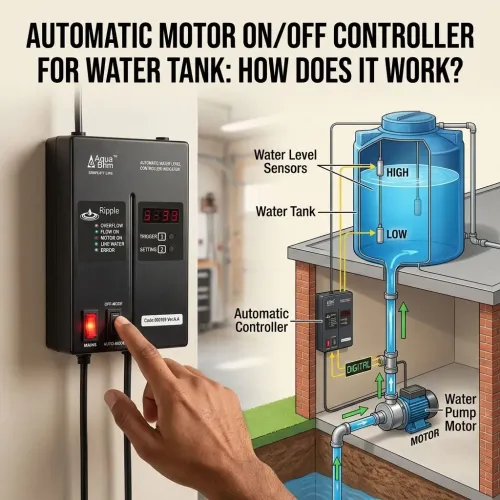

RF Based Water Level Controller: How Wireless Technology Makes Water Management Smarter
Managing water tanks manually can be time-consuming. Someone must check the water level, switch on the motor, and remember to turn it off when the tank is full. If water arrives at an unexpected time or the motor keeps running unattended, it can lead to overflow, wasted water, and potential pump damage.
An RF Based Water Level Controller offers a smarter approach. It uses radio frequency (RF) wireless communication to send water-level information from sensors to a controller. Depending on the system design, the controller can automatically operate the water pump based on tank levels and water availability.
AquaBrim provides wireless water automation solutions for homes, apartments, commercial buildings, and multi-tank installations. Its product range includes systems designed for municipal water supply, borewell and submersible pumps, and centralized multi-tank management.
What Is an RF Based Water Level Controller?
An RF based water level controller is a system that monitors water levels through sensors and communicates readings to a controller using radio frequency signals instead of requiring signal cables between the tank and the controller.
The system typically includes:
Water-level sensors: Detect water levels in overhead or underground tanks.
RF wireless transmitters: Send sensor information to the controller.
Controller unit: Processes the received information and applies the configured control logic.
Pump control connection: Starts or stops the motor when the required conditions are met.
Safety features: Depending on the model, these may include overflow prevention, dry-run protection, and alerts.
The exact features depend on the selected model and installation. A wireless controller should be chosen according to the water source, motor type, tank arrangement, and required safety functions.
How Does an RF Based Water Level Controller Work?
An RF based water level controller generally works through the following steps.
1. Detects the Water Level
A sensor installed in the tank monitors the water level. Depending on the application, the system may also monitor the underground water source or the availability of municipal water.
2. Sends Information Wirelessly
The sensor communicates with the controller using radio frequency signals. This can eliminate the need to run sensor cables between the tank and the control unit.
3. Processes the Information
The controller evaluates the received level information against configured thresholds and operating conditions.
4. Starts or Stops the Motor
When the tank level falls below the configured starting point and the required operating conditions are satisfied, an automatic system can start the pump. When the tank reaches its set full level, the controller can stop the pump.
5. Applies Available Safety Protections
Depending on the model, the controller may stop the motor when the source water is insufficient, water supply is interrupted, or another monitored fault occurs.
For example, AquaBrim's Macro is designed for borewell and submersible-pump applications, while Trigger is designed for municipal water supply automation. See the official product pages for their specific functions
Key Benefits of an RF Based Water Level Controller
1. Wireless Communication Between the Tank and Controller
Traditional wired installations may require signal cables between the tank and motor-control location. RF technology can reduce this wiring requirement, making installation simpler in many buildings.
2. Automatic Pump Operation
The controller can manage motor starting and stopping according to configured water-level conditions. This reduces the need for someone to check the tank and operate the switch manually.
3. Reduced Water Overflow
When the system detects that a tank has reached its configured full level, it can stop the pump automatically. This helps reduce water wastage caused by unattended filling.
4. Support for Pump Protection
Some controllers monitor the source-water level or other operating conditions to help prevent the pump from running without sufficient water. Confirm that dry-run protection is included in the model you select.
5. Better Water-Level Visibility
A controller with a digital display or compatible monitoring platform can help users understand the status of their water system without repeatedly visiting the tank.
6. Useful for Different Building Types
RF based systems can be suitable for independent homes, apartment buildings, commercial properties, and industrial sites. The required number of sensors and controller capacity will depend on the installation.
7. Easier Management of Multiple Tanks
For larger installations, a suitable multi-tank controller can receive information from several tanks and coordinate pump operation according to the configured requirements.
8. Potential for Building Management Integration
Some advanced controllers support communication with a Building Management System (BMS). For example, AquaBrim's Matrix supports MODBUS connectivity and multi-tank management. Check the official product specifications to confirm compatibility with your setup.
RF Based Water Level Controller vs. Traditional Wired Controller
| Feature | Traditional wired system | RF based wireless system |
|---|---|---|
| Communication | Uses signal wiring | Uses radio frequency signals |
| Tank-to-controller cabling | May be required | Can be eliminated for wireless sensor communication |
| Installation | Cable routing may add work | Can simplify installation where wiring is difficult |
| Tank monitoring | Depends on the installed system | Depends on the wireless sensors and controller |
| Automatic pump operation | Available in suitable models | Available in suitable models |
| Multi-tank support | Depends on design | Available in compatible models |
| Dry-run protection | Depends on design | Depends on model and configuration |
Important: RF communication alone does not guarantee pump automation, remote app monitoring, or dry-run protection. These functions must be supported by the selected controller and installed correctly.
Where Can an RF Based Water Level Controller Be Used?
Residential Homes
Homeowners can use wireless water-level monitoring and automatic pump control to reduce manual tank checks and avoid unnecessary overflow.
Apartments and Housing Societies
Buildings with underground reservoirs and rooftop tanks can benefit from automatic filling and coordinated water-level management. The controller must be sized for the number of tanks and motors.
Borewell and Submersible Pump Systems
Borewell installations need special attention to source-water availability. A suitable controller can monitor the source and overhead tank and apply dry-run protection when the feature is supported.
Municipal Water Supply Systems
Where municipal water arrives at irregular times, a compatible controller can detect supply availability and automate tank filling. AquaBrim's Trigger is designed for this type of application.
Commercial and Industrial Buildings
Facilities with multiple tanks may require centralized level visibility, multiple motor controls, adjustable thresholds, or BMS integration. A suitable multi-tank controller should be selected based on the site's operational needs.
How to Choose the Right RF Based Water Level Controller
Before purchasing, evaluate the following factors:
Water source: Identify whether your supply comes from a municipal line, borewell, submersible pump, or underground reservoir.
Number of tanks: Check how many overhead and underground tanks the controller supports.
Motor compatibility: Verify the motor's phase, electrical rating, and required switching arrangement.
Wireless range: Confirm that the RF signal can reliably reach the controller from the sensor locations. Walls, floors, and reinforced concrete can affect signal performance.
Dry-run protection: If the system uses a borewell or underground source, check how the controller detects insufficient water and stops the pump.
Overflow prevention: Confirm that the controller supports automatic stopping at the required tank level.
Monitoring options: Determine whether you need only local indicators or also remote monitoring and alerts.
Installation and support: Choose a system with suitable installation guidance and after-sales support.
Expansion needs: For apartments and commercial sites, check whether additional tanks, sensors, or BMS connectivity are supported.
AquaBrim RF Based Water Level Control Solutions
AquaBrim offers different products for different water-management requirements:
AquaBrim Trigger — Municipal Water Supply Automation
Trigger is designed for applications where water arrives through a municipal or corporation supply line. It detects supply availability and can automate motor operation to fill the overhead tank, with features such as RF communication and overflow and dry-run protection listed on its product page.
AquaBrim Macro — Borewell and Submersible Pump Automation
Macro is designed for borewell and submersible-pump installations that transfer water from an underground source to an overhead tank. Its listed features include RF wireless communication, automatic motor control, tank-level monitoring, and dry-run protection.
AquaBrim Matrix — Multi-Tank Water Management
Matrix is intended for larger buildings and installations requiring multi-tank management. AquaBrim lists support for up to 13 overhead tanks and one underground tank, control of up to two motors, and MODBUS connectivity for BMS integration.
For complete product specifications and suitability, refer to the relevant official product page or contact AquaBrim.
Installation and Maintenance Tips
A correctly selected controller must also be installed properly to deliver reliable operation.
Position sensors according to the manufacturer's instructions.
Mount the controller in a dry, protected location.
Keep the controller's motor connection within the electrical ratings specified for the system.
Test the RF signal between the sensor and controller after installation.
If signal range is unreliable, ask the installer whether a compatible signal booster is required.
Test automatic start and stop functions, along with the safety features supported by the model.
Inspect sensors, wiring at the motor connection, and the installation periodically.
Use a qualified electrician for motor and mains connections.
RF technology reduces the need for tank-to-controller signal cables, but it does not necessarily remove all electrical wiring. Safe installation and correct configuration remain essential.
Frequently Asked Questions (FAQs)
1. What is an RF based water level controller?
An RF based water level controller monitors water levels through sensors and sends the information to a controller using radio frequency signals. Compatible models can use this information to automate water-pump operation.
2. What does RF mean in a water level controller?
RF stands for Radio Frequency. It is a method of transmitting information wirelessly between electronic devices, such as a tank sensor and a water-level controller.
3. Does an RF based water level controller require wires between the tank and controller?
In a wireless RF system, sensor information is transmitted without a signal cable between the tank and controller. Electrical wiring may still be required to connect the controller to the motor and power supply.
4. Can an RF based water level controller stop tank overflow?
Yes, a model with automatic tank-level control can stop the pump when the tank reaches its configured full level. Correct sensor placement and system configuration are important for reliable operation.
5. Does an RF based water level controller protect a motor from dry running?
Some models include dry-run protection. The controller must be designed to detect the relevant source-water or pump condition, so check the product specifications before purchasing.
6. Can RF based controllers be used with borewell pumps?
Yes. A controller designed for borewell or submersible-pump applications can monitor the source and overhead tank and automate filling. AquaBrim Macro is one such solution:
7. Can an RF based controller work with municipal water supply?
Yes, if the controller is designed to detect municipal supply availability. AquaBrim Trigger is intended for municipal or corporation water supply automation:
8. What affects the wireless range of an RF water level controller?
Distance, walls, floor construction, reinforced concrete, metal obstructions, and the installation environment can affect signal quality. Confirm the specified range and test the signal at the actual installation site.
9. Can one RF based controller manage multiple water tanks?
Some systems support multiple tanks, but capacity varies by model. AquaBrim Matrix is designed for multi-tank management and lists support for up to 13 overhead tanks and one underground tank:
10. How do I choose the best RF based water level controller?
Consider your water source, tank count, motor compatibility, wireless range, dry-run protection, overflow prevention, monitoring requirements, and installation conditions. Compare these needs with the manufacturer's specifications before selecting a model.