
Benefits of Smart Water Level Monitoring Systems
Water is one of the most essential resources in every home, apartment, commercial building, and industrial facility. However, managing water storage efficiently can be challenging, particularly when multiple tanks, underground sumps, and overhead reservoirs are involved.
Traditionally, people have relied on manual inspections, float switches, and basic water level indicators to monitor their tanks. While these methods can serve basic requirements, they may not provide the convenience, visibility, and automation needed for modern water management.
A smart water level monitoring system offers a more advanced approach by using electronic sensors, wireless communication, digital displays, and connected monitoring platforms to track water levels.
Depending on the system, users can monitor tank levels, receive alerts, automate pump operation, and access water-related information remotely.
In this article, we will explore the major benefits of smart water level monitoring systems, how they work, and why they are becoming increasingly useful for residential, commercial, and industrial applications.
What Is a Smart Water Level Monitoring System?
A smart water level monitoring system is an electronic solution that measures and monitors the amount of water available inside storage tanks.
It uses sensors or transmitters to detect water levels and communicates the information to a central control unit or digital monitoring platform.
Unlike traditional manual monitoring methods, smart systems can provide continuous information about the water level without requiring someone to physically inspect the tank.
Depending on the product and configuration, a smart water level monitoring system may offer:
- Real-time water level monitoring.
- Digital water level indication.
- Wireless sensor communication.
- Tank-full and low-water alerts.
- Automatic water pump control.
- Water overflow prevention.
- Dry-run protection for compatible pump applications.
- Mobile application or web-based monitoring.
- Multiple-tank monitoring.
- Integration with Building Management Systems (BMS).
These features make smart water monitoring useful for properties where maintaining a consistent water supply is important.
How Does a Smart Water Level Monitoring System Work?
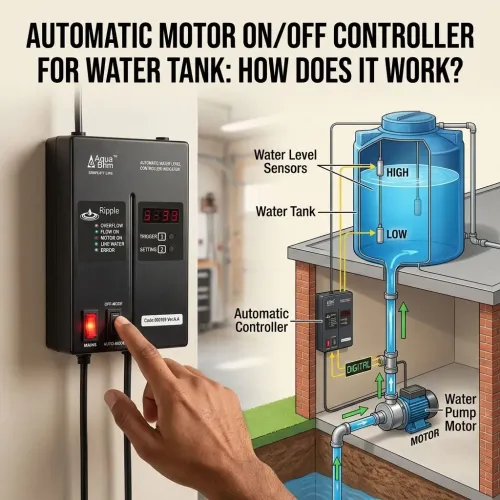
A typical smart water level monitoring system consists of sensors, a control unit, communication technology, and a monitoring interface.
Here is how the process works.
Step 1: Water Level Detection
A sensor or transmitter is installed inside or near the water tank.
It continuously detects the water level and measures how much water is available.
Depending on the technology, sensors may use contact-based, capacitive, ultrasonic, radar, or other sensing methods.
Step 2: Wireless Data Transmission
In wireless systems, the sensor transmits the collected water-level information to the controller using radio-frequency communication.
This eliminates the need for long signal cables between compatible tank sensors and the control unit.
Step 3: Data Processing
The controller receives the sensor information and processes it to determine the current water level.
The information may be displayed as:
- Percentage of tank capacity.
- Low-water indication.
- Full-tank indication.
- Digital water-level readings.
- Overflow alerts.
Step 4: Remote Monitoring
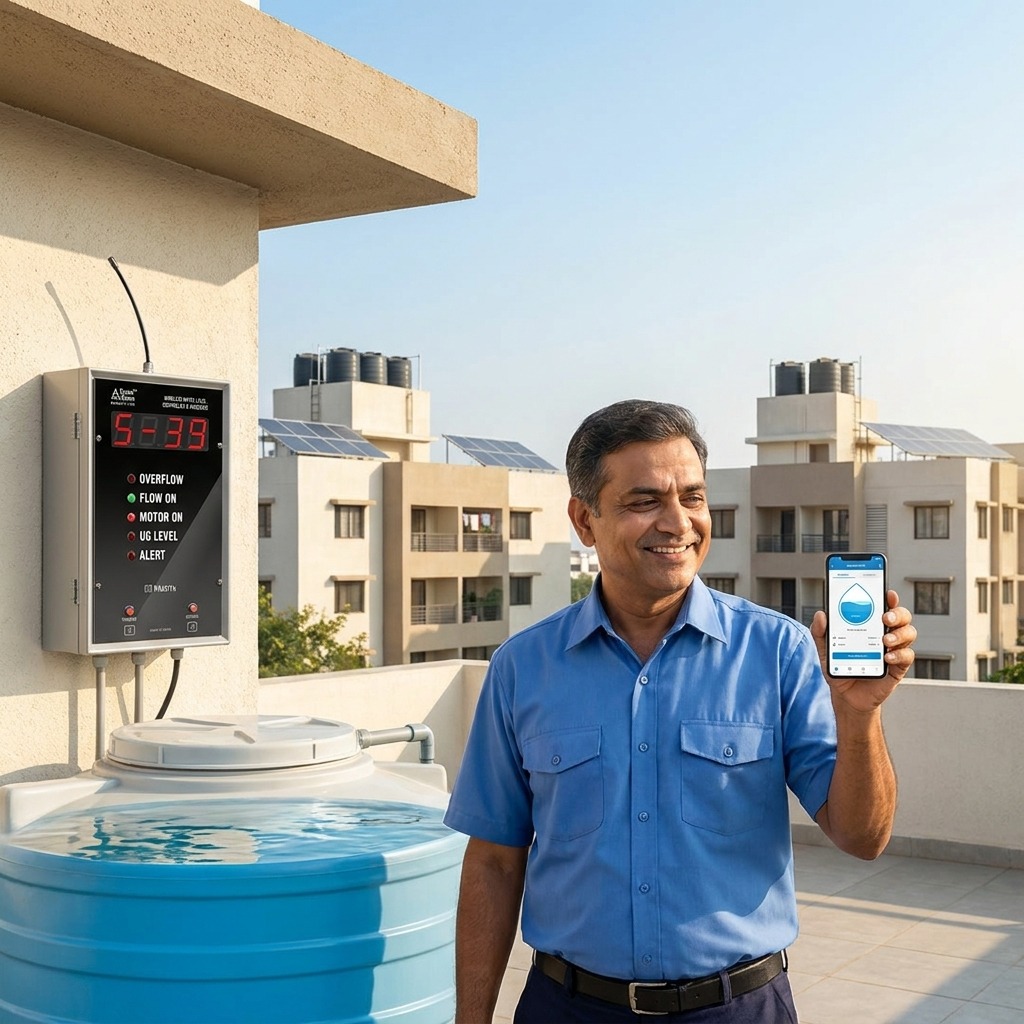
Advanced systems can connect to web-based or mobile monitoring platforms.
This allows authorised users to access water-level information without physically visiting the tank or control room.
Depending on the system, users may also receive alerts regarding tank conditions and pump operation.
Step 5: Automatic Pump Control
If the system supports automatic pump control, it can start the motor when the water level reaches a configured low threshold.
When the tank becomes full, the controller automatically switches off the motor.
This reduces manual intervention and helps prevent water overflow.
In simple terms:
Water-level sensor → Wireless communication → Controller → Digital monitoring → Alerts and automatic pump operation.
10 Major Benefits of Smart Water Level Monitoring Systems
1. Real-Time Water Level Monitoring
One of the biggest advantages of a smart water level monitoring system is the ability to check water availability without physically inspecting the tank.
Instead of climbing to the rooftop or opening tank covers, users can view the water level through a digital display or supported mobile and web platforms.
This is particularly useful for:
- Independent houses.
- Apartment complexes.
- Hotels.
- Hospitals.
- Schools and colleges.
- Commercial buildings.
- Industrial facilities.
Real-time monitoring helps users understand water availability and plan their consumption more effectively.
2. Prevents Water Tank Overflow
Water overflow is a common problem in residential and commercial buildings.
When pumps are operated manually, someone must remember to switch them off after the tank becomes full.
A smart water level monitoring system with automatic pump-control functionality can eliminate much of this manual effort.
The system monitors the water level and switches off the connected motor when the configured full level is reached.
This helps prevent unnecessary water wastage and makes water management more convenient.
Important: A monitoring-only system may provide an alarm without controlling the pump. If automatic overflow prevention is required, choose a model that specifically supports automatic motor control.
3. Protects Water Pumps from Dry Running
Dry running occurs when a water pump operates without an adequate water supply.
This can cause overheating and damage, depending on the pump design and operating conditions.
Smart water automation systems with suitable source-water sensors and protection logic can detect low water availability and stop the motor.
This is particularly useful for properties that depend on:
- Underground water storage tanks.
- Borewells.
- Submersible pumps.
- Irregular municipal water supply.
Dry-run protection helps reduce the risk of pump damage and unnecessary maintenance.
4. Remote Monitoring from Anywhere
Modern smart water monitoring systems can offer web-based or mobile application connectivity.
This allows users to check water levels and system conditions without being physically present at the property.
For example, homeowners can monitor their water storage while travelling, and facility managers can check tank conditions across different locations.
Depending on the product configuration, remote monitoring may provide:
- Current tank water levels.
- Pump operating status.
- Tank-full notifications.
- Low-water alerts.
- System notifications.
- Historical monitoring information.
This feature is especially useful for property owners managing multiple buildings or facilities.
5. Reduces Manual Work
Traditional water management often depends on someone checking the tank and manually operating the pump.
This becomes difficult when family members are busy, staff members are unavailable, or the building has multiple storage tanks.
A smart water level monitoring system reduces this dependence on manual inspections.
With automatic monitoring and compatible pump automation, the system can manage routine water-filling operations without requiring constant human attention.
6. Supports Multiple Water Tanks
Large residential societies, commercial buildings, hotels, and industrial facilities often have multiple overhead tanks and underground storage tanks.
Monitoring every tank separately can become difficult.
A centralised smart water monitoring system can collect information from multiple sensors and display tank levels at a common location.
For example, Aquabrim Matrix is designed to monitor up to 13 overhead tanks and one underground tank through a single controller.
It also supports dual-motor control and MODBUS connectivity for integration with compatible Building Management Systems.
This makes it useful for large installations requiring centralised water management.
7. Saves Water and Electricity
Water overflow and unnecessary pump operation can contribute to avoidable resource consumption.
A smart water level monitoring system helps address these problems through continuous monitoring and automatic control where supported.
For example:
- The motor stops when the tank becomes full.
- The pump does not need to run unnecessarily after filling is complete.
- Low-water conditions can be identified.
- Water availability can be monitored more effectively.
Actual water and electricity savings depend on the existing installation, water usage, pump capacity, and operating conditions.
8. Improves Water Management in Apartments and Commercial Buildings
Managing water storage becomes increasingly complicated as the number of tanks and users increases.
Apartment societies may have multiple overhead tanks, underground sumps, transfer pumps, and different water supply sources.
A smart monitoring system provides a centralised view of water availability.
Facility managers can identify which tanks need attention and monitor the overall water storage arrangement more efficiently.
For larger buildings, integration with a Building Management System (BMS) can provide additional visibility and control.
9. Provides Alerts and Notifications
Another important advantage of smart water monitoring is the ability to receive alerts when specific conditions occur.
Depending on the selected product, these may include:
- Low water level.
- Full tank.
- Overflow condition.
- Water supply interruption.
- Pump operating status.
- Other configured system conditions.
Some systems offer local audio-visual alarms, while connected configurations may support SMS or other remote notifications.
This helps users respond to water-related issues without continuously monitoring the system.
10. Enables Smarter and More Efficient Water Management
Smart water level monitoring is not limited to checking whether a tank is full or empty.
Advanced systems can combine water-level sensing, pump automation, remote access, wireless communication, and building-management integration.
This provides better visibility into water storage and distribution.
For organisations managing multiple buildings, these capabilities can support more systematic water management and operational planning.
Where Are Smart Water Level Monitoring Systems Used?
Smart water monitoring systems are suitable for different types of properties.
1. Residential Buildings
Homeowners can monitor overhead tanks and underground sumps without manually checking water levels.
Automatic pump control can also help prevent tank overflow and reduce manual motor operation.
2. Apartment Societies
Residential societies often have several water storage tanks distributed across different buildings.
A centralised monitoring system can help maintenance teams monitor water levels and manage pumping operations.
3. Hotels and Hospitals
Hotels and hospitals require reliable water availability throughout the day.
Smart monitoring can help facility teams identify low-water conditions and monitor storage tanks more efficiently.
4. Educational Institutions
Schools, colleges, and universities may have multiple buildings and water storage locations.
Centralised water monitoring can make routine facility management easier.
5. Industrial Facilities
Factories and industrial facilities may use water for manufacturing, cooling, cleaning, and other operations.
Monitoring systems can help facility teams maintain visibility into storage levels and integrate water information with other building-management processes.
Aquabrim Smart Water Level Monitoring Solutions
Aquabrim provides wireless water-level monitoring and automation solutions for residential, commercial, and institutional applications.
Its product range addresses different water management requirements, from basic tank-level monitoring to multi-tank automation and remote monitoring.
Here are some relevant products.
1. Aquabrim Macro – Smart Water Automation for Homes
Aquabrim Macro is designed for homes and buildings that use borewell or submersible pumps to transfer water from an underground source to an overhead tank.
It uses wireless sensors to monitor the overhead tank and underground water source.
Depending on the configured operating conditions, it automatically starts the pump when the overhead tank level falls below its 50% starting threshold and stops it when the tank becomes full.
It also includes dry-run protection logic to help protect the pump when the source water becomes insufficient or water flow is interrupted.
Key features:
- Wireless water-level monitoring.
- Automatic pump ON/OFF operation.
- Underground tank monitoring.
- Dry-run protection.
- Digital water-level indication.
- Multi-tank support.
2. Aquabrim Trigger – Smart Monitoring for Municipal Water Supply
Aquabrim Trigger is designed for homes and buildings that depend on municipal or corporation water supply.
Its wireless sensor detects the availability of water in the incoming supply line.
When water becomes available and the required operating conditions are satisfied, the system automatically starts the connected pump to fill the overhead tank.
It monitors the tank level and switches off the pump when the configured full level is reached.
Key features:
- Wireless municipal water detection.
- Automatic motor operation.
- Overhead tank monitoring.
- Dry-run protection.
- Overflow prevention.
- Digital display and status indications.
3. Aquabrim Matrix – Multi-Tank Monitoring System
For larger buildings, managing several tanks from different locations can be challenging.
Aquabrim Matrix is designed for centralised water-level monitoring and automation.
It supports monitoring of up to 13 overhead tanks and one underground tank through a single controller.
It can also control up to two motors and supports MODBUS connectivity for integration with compatible Building Management Systems.
Key features:
- Multi-tank water-level monitoring.
- Wireless RF communication.
- Centralised digital display.
- Dual-motor control.
- Configurable water-level thresholds.
- MODBUS/BMS integration.
4. Aquabrim Flexibell – Wireless Water Level Indicator and Alarm
Not every building requires automatic pump control. Sometimes, users simply want to monitor multiple tanks and receive alerts when water levels become low or tanks become full.
Aquabrim Flexibell is designed for this requirement.
It can monitor up to six water tanks and provide audio-visual alerts for configured low, full, and overflow conditions.
It is important to note that Flexibell is a monitoring and alarm system. It does not automatically start or stop the water pump.
Optional web-based monitoring and SMS alert functionality are available for supported configurations.
Key features:
- Wireless tank-level monitoring.
- Monitoring of up to six tanks.
- Low-water and full-tank alarms.
- Overflow alerts.
- Digital display.
- Optional remote monitoring.
Frequently Asked Questions
1. What is a smart water level monitoring system?
A smart water level monitoring system uses electronic sensors and communication technology to monitor the amount of water available inside storage tanks. Depending on the model, it can provide digital readings, alerts, remote monitoring, and automatic pump control.
2. Can I monitor my water tank from my mobile phone?
Yes. Some smart water monitoring systems offer mobile application or web-based monitoring. This allows users to view tank levels and other supported system information remotely.
3. Does a smart water level monitoring system prevent overflow?
A monitoring system can alert users when a tank becomes full. If you require automatic overflow prevention, select a model that also supports automatic pump control.
4. Can one system monitor multiple water tanks?
Yes. Certain systems are designed for multiple-tank monitoring. For example, Aquabrim Matrix supports up to 13 overhead tanks and one underground tank.
5. What is the difference between a water level indicator and a water level controller?
A water level indicator displays the amount of water available inside a tank. A water level controller can additionally operate a connected pump automatically according to configured water-level conditions.
Some advanced products combine both functions.
6. Are wireless water level monitoring systems reliable?
Wireless systems can provide reliable monitoring when properly designed and installed. Performance depends on communication range, building materials, interference, sensor quality, and installation conditions.
7. Can smart water monitoring systems be connected to a BMS?
Yes. Certain industrial water monitoring systems support communication protocols such as MODBUS, allowing water-level information to be integrated with compatible Building Management Systems.
8. Which Aquabrim product is suitable for apartment societies?
Aquabrim Matrix is designed for larger installations involving multiple overhead tanks and underground storage tanks. It supports centralised monitoring and dual-motor control.
9. Does Aquabrim offer remote water-level monitoring?
Yes. Aquabrim offers web and mobile-based monitoring for supported systems and configurations, allowing users to access relevant water levels, motor performance, tank conditions, and notifications remotely.
10. Can I use a smart water monitoring system for an underground tank?
Yes. Suitable systems can monitor underground sumps and other water storage sources. The appropriate sensor depends on tank depth, installation conditions, and the selected product.
Conclusion
A smart water level monitoring system makes water management more convenient by providing better visibility into water storage and reducing dependence on manual inspections.
From monitoring individual household tanks to managing multiple storage tanks across large buildings, these systems offer practical benefits such as real-time monitoring, overflow alerts, automatic pump operation, dry-run protection, and remote access.
The right solution depends on your requirements, whether you need a simple wireless water level indicator, a residential automatic water controller, or a centralised multi-tank monitoring system.
Explore Aquabrim's range of smart water monitoring and automation solutions to make your water management more efficient, reliable, and convenient.