

Multi-Tank Water Level Monitoring System: How to Monitor Multiple Tanks from One System
Managing water in a building with multiple storage tanks can be challenging. In residential societies, commercial complexes, hotels, hospitals and industrial facilities, water is often stored in several overhead tanks and underground reservoirs.
Monitoring each tank manually takes time and requires regular attention. Someone may need to visit different floors, rooftops or pump rooms just to check whether the tanks have sufficient water. If a tank becomes empty or overflows without being noticed, it can create inconvenience, water wastage and additional operating costs.
A multi-tank water level monitoring system offers a more convenient solution. It collects water-level information from multiple tanks and displays it through a central monitoring unit. Depending on the system, it can also provide alerts and automatically control connected water pumps.
But how does one system monitor several tanks at different locations? How do the sensors communicate with the central controller? And what should building managers consider before installing such a system?
Let's explore how multi-tank water monitoring works and why it is useful for modern buildings.
What Is a Multi-Tank Water Level Monitoring System?
A multi-tank water level monitoring system is designed to monitor the water levels of several storage tanks through a common display or controller.
Instead of checking every tank individually, users can view the water-level status of connected tanks from a centralized location.
The system generally consists of three main components:
- Water-level sensors: Installed in individual tanks to detect their water levels.
- Wireless transmitters: Send the detected water-level information to a central receiver.
- Central monitoring unit: Receives information from the connected sensors and displays the status of each tank.
Advanced systems may also include automatic motor control, audible alarms, remote monitoring, programmable timers and integration with a Building Management System (BMS).
For example, an apartment complex may have eight overhead tanks and one underground reservoir. A multi-tank monitoring system can collect information from all these tanks and display their individual water levels on a single controller.
This makes it easier for facility managers to understand the overall water-storage situation without physically inspecting every tank.
Why Is Monitoring Multiple Water Tanks Difficult?
A building with multiple tanks has different water requirements at different locations.
For example:
- One overhead tank may become full while another is still filling.
- Water consumption may vary between residential blocks.
- Underground storage levels may fall while overhead tanks continue demanding water.
- Some tanks may receive water through different supply lines.
- Pumping schedules may need to be coordinated.
When these tanks are managed manually, several problems can occur.
1. Repeated Manual Inspections
Maintenance staff may have to visit multiple rooftops or tank locations to check water levels.
This consumes time and makes regular monitoring difficult, particularly in large buildings.
2. Water Overflow
If a pump continues running after a tank becomes full, water may overflow.
When several tanks are being filled, it can be difficult to monitor every tank simultaneously.
3. Unexpected Water Shortages
A tank may become empty without the maintenance team noticing it in time.
This can interrupt water availability for residents, employees or other building users.
4. Difficulty Coordinating Multiple Motors
Large buildings may use more than one pump to distribute water between underground and overhead storage tanks.
Operating these motors without a clear understanding of tank levels can make water management complicated.
5. Lack of Centralized Information
Without a common monitoring system, maintenance staff may have to collect water-level information from different locations.
A centralized system helps make this information easier to access and manage.
How Does a Multi-Tank Water Level Monitoring System Work?
A multi-tank monitoring system uses individual sensors to collect water-level information and transmit it to a central controller.
The general working process is:
Individual Tank Sensors → Wireless Transmitters → Central Receiver → Water-Level Display → Alerts or Automatic Control
Let's understand each step.
1. Install a Sensor in Each Tank
A suitable water-level sensor is installed in every tank that needs to be monitored.
Each sensor detects the water level inside its respective tank.
For example, if a building has six overhead tanks and one underground tank, the system requires suitable sensing arrangements for all seven tanks.
2. Sensors Transmit Information Wirelessly
In a wireless monitoring system, each tank's transmitter sends its water-level information to a central receiver using radio-frequency communication.
This eliminates the need for long communication cables between individual tanks and the central monitoring unit.
Wireless communication can be particularly useful in buildings where tanks are located on different floors, rooftops or separate structures.
3. The Central Controller Receives Tank Information
The central monitoring unit receives information from the connected transmitters.
It identifies the respective tank and processes the incoming water-level information.
This allows the system to monitor several tanks independently rather than treating the entire building as one storage unit.
4. Water Levels Are Displayed Centrally
The controller displays the water level of each connected tank.
Depending on the system, the display may show:
- Current water level in percentage.
- Low-water status.
- Full-tank status.
- Overflow indication.
- Individual tank identification.
- Motor or valve status.
This gives maintenance staff a quick overview of the building's water-storage conditions.
5. Alerts Are Generated When Required
A suitable monitoring system can be configured to provide alerts when a tank reaches a specific water level.
For example:
- Low-level alert when water falls below a configured threshold.
- Full-level alert when the tank reaches its full level.
- Overflow alert when the water crosses the configured overflow threshold.
Alerts may be provided through a buzzer, indicator lights or supported remote notification services.
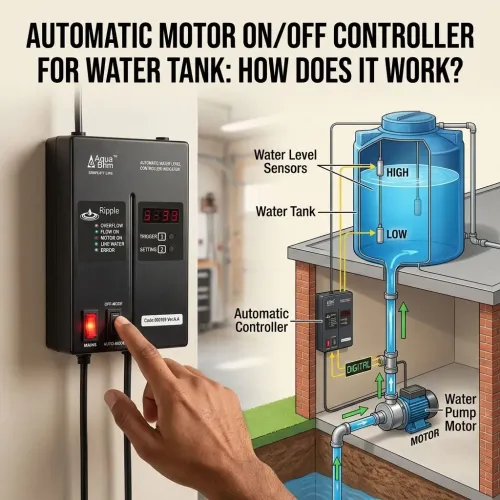
6. Automatic Motor Control Can Be Integrated
Monitoring and motor automation are two different functions.
A basic multi-tank monitoring system displays water levels and provides alerts. An advanced multi-tank controller can also use the sensor information to operate connected pumps.
For example, when a tank requires water, the controller can start the assigned motor if the required operating conditions are satisfied. When the tank reaches its configured full level, the controller can stop the motor.
The actual pumping arrangement depends on the number of motors, tanks, valves and the control logic configured during installation.
What Is the Difference Between Multi-Tank Monitoring and Multi-Tank Automation?
These terms are related, but they do not mean exactly the same thing.
Multi-Tank Monitoring
A monitoring system collects water-level information from different tanks and displays it centrally.
It may also provide alerts when water levels reach configured thresholds.
Its primary purpose is to give users visibility of the water-storage system.
Multi-Tank Automation
An automation system goes a step further. It uses water-level information to control connected pumps and other compatible equipment.
Depending on the configuration, it may:
- Start pumps when water is required.
- Stop pumps when tanks are full.
- Coordinate multiple motors.
- Follow programmable filling schedules.
- Monitor connected motorized valve status.
When selecting a system, building managers should decide whether they only need centralized monitoring or also require automatic pump operation.
Benefits of a Multi-Tank Water Level Monitoring System
1. Centralized Monitoring
The biggest advantage is that multiple tanks can be monitored from one location.
Maintenance staff do not need to visit every tank just to understand the current water levels.
2. Helps Reduce Water Overflow
By identifying when a tank reaches its configured full or overflow level, the system can alert maintenance staff or trigger automatic shutdown when connected to a suitable motor controller.
3. Better Water Availability Management
Centralized visibility helps maintenance teams identify tanks that are running low and respond before water shortages affect building users.
4. Reduced Manual Inspection
Automated sensing reduces the need for repeated physical inspections.
This can be particularly useful in large residential societies and commercial facilities.
5. Better Pump Coordination
Systems with motor automation can coordinate compatible pumps according to configured water-level conditions.
This helps manage water distribution more systematically.
6. Easier Maintenance Planning
When tank levels and system status are available centrally, maintenance teams can identify unusual conditions more quickly.
7. Integration with Building Management Systems
Selected industrial monitoring systems support MODBUS communication, allowing water-level information to be shared with a compatible Building Management System.
This can help facility managers view water-related information alongside other building services.
Aquabrim Matrix: Multi-Tank Water Level Monitoring and Automation
For buildings that need centralized monitoring of several water tanks, Aquabrim offers the Matrix Multi-Tank Water Level Controller.
Matrix is designed for large residential complexes, commercial buildings, hotels, hospitals and institutional facilities where multiple tanks need to be monitored and managed.
According to its published product specifications, Matrix supports:
- Up to 13 overhead tanks.
- One underground tank.
- Wireless RF communication in the 433–434 MHz band.
- Control of up to two motors in configured combinations.
- Digital water-level display.
- Individually configurable low, full and overflow thresholds.
- Up to 10 programmable timers.
- Motorized valve open/close status display.
- MODBUS connectivity for compatible BMS integration.
How Matrix Monitors Multiple Tanks
Each connected tank has a suitable wireless sensor and transmitter.
The transmitters communicate water-level information to the Matrix controller. The controller displays the status of the connected tanks, allowing users to monitor the entire installation from a centralized location.
The system can also operate up to two connected motors according to the configured pumping arrangement.
This makes Matrix suitable for installations where monitoring and automatic water management are both required.
Flexibell: Centralized Monitoring and Alarm for Multiple Tanks
Not every building needs automatic motor control. Some users simply want to know the water level in different tanks and receive alerts when a tank is low or full.
For these requirements, Aquabrim offers Flexibell, a wireless water-level indicator and alarm system.
According to its published specifications, Flexibell supports:
- Water-level indication for up to six tanks.
- Wireless RF communication in the 433–434 MHz band.
- Individual low, full and overflow alarm thresholds.
- Digital water-level display.
- Audible buzzer and visual indicators.
- Optional MODBUS/BMS integration.
- Optional web-based monitoring and SMS alerts.
Important: Flexibell is a monitoring and alarm system. It does not automatically start or stop water pumps.
Level sensors, signal repeaters and optional web-monitoring services are sold separately, so the installation requirements should be confirmed before ordering.
What Should You Check Before Selecting a Multi-Tank Monitoring System?
Before purchasing a system, consider these factors.
1. Number of Tanks: Confirm the maximum number of overhead and underground tanks supported by the controller.
2. Wireless Communication Range: Check whether the transmitters can communicate reliably from every tank location.
3. Monitoring or Automation: Decide whether you need water-level display and alarms only, or automatic motor control as well.
4. Number of Motors: If automatic pumping is required, check how many motors the system can control and how they can be configured.
5. Individual Tank Settings: Check whether low, full and overflow thresholds can be configured separately for each tank.
6. Remote Monitoring: If you want to monitor water levels remotely, check whether web-based or mobile monitoring is supported.
7. BMS Integration: For commercial and industrial buildings, check whether the system supports MODBUS or another compatible communication protocol.
8. Installation and Service: Confirm the sensor installation requirements, power supply, warranty and after-sales support.
Frequently Asked Questions (FAQs)
1. What is a multi-tank water level monitoring system?
It is a system that monitors the water levels of multiple storage tanks through individual sensors connected to a central receiver or controller.
2. How can I monitor multiple water tanks from one location?
Install suitable sensors in each tank and connect them wirelessly or through a compatible wired network to a central monitoring unit. The unit can display the water level of each connected tank.
3. How many tanks can one monitoring system monitor?
This depends on the controller model. For example, Aquabrim Matrix supports up to 13 overhead tanks and one underground tank, while Flexibell supports monitoring for up to six tanks.
4. Does a multi-tank monitoring system require wiring between tanks?
Wireless systems receive information from compatible tank transmitters through radio-frequency communication. Therefore, long communication cables between the tanks and the central controller are not required.
5. Can one system monitor both overhead and underground tanks?
Yes. Suitable systems can monitor both overhead and underground tanks, provided the controller supports the required number and type of sensors.
6. Can a multi-tank monitoring system automatically operate water pumps?
Some systems support automatic motor control. Others only display water levels and provide alerts. Check the features of the selected model before purchasing.
7. What is the difference between Aquabrim Matrix and Flexibell?
Matrix is designed for multi-tank monitoring and automatic motor control. It supports up to 13 overhead tanks, one underground tank and up to two motors.
Flexibell is designed for monitoring and alarm functions for up to six tanks. It does not automatically operate water pumps.
8. Can multiple tank levels be displayed in percentage?
Yes. Suitable monitoring systems can display water levels in percentage, depending on the sensor and controller configuration.
9. Can a multi-tank monitoring system connect to a BMS?
Selected systems support MODBUS connectivity, which can allow water-level information to be shared with a compatible Building Management System.
10. Is a multi-tank water monitoring system suitable for apartment societies?
Yes. It is particularly useful for apartment societies with several overhead tanks, underground storage tanks and multiple pumping requirements.
Conclusion
Managing multiple water tanks manually becomes increasingly difficult as the size of a building grows.
A multi-tank water level monitoring system simplifies this process by collecting information from individual tanks and displaying it through a central unit. Wireless communication can reduce the need for long signal cables, while configurable alerts help maintenance teams identify low-water and full-tank conditions.
For buildings that require more than monitoring, an advanced system can also coordinate compatible pumps and integrate with a Building Management System.
Whether you manage an apartment complex, hotel, hospital, commercial building or industrial facility, choosing the right multi-tank monitoring solution can make water management more organized and convenient.
Explore Aquabrim's wireless multi-tank monitoring and automation solutions to find the right system for your building.