

Wireless Water Level Sensor for Tank: How Does It Monitor Water Levels?
Checking the water level in an overhead or underground tank is a routine task in many Indian homes and buildings. Someone has to climb to the rooftop, open the tank or check the water manually to determine whether it needs refilling.
The challenge becomes greater in apartments, commercial buildings, schools, hospitals and industrial facilities where multiple water tanks may be installed at different locations.
A wireless water level sensor for a tank makes this process easier. It detects the water level and transmits the information wirelessly to a compatible receiver or controller. Users can then monitor the tank's water level through a digital display or, in supported systems, a web or mobile application.
But how does a wireless sensor actually measure water? How does it communicate with a controller without cables? And can it automatically operate a water pump?
Let's understand the technology and its practical applications.
What Is a Wireless Water Level Sensor?
A wireless water level sensor is a device designed to detect or measure the amount of water present inside a storage tank and communicate that information to another device without requiring a physical signal cable between them.
It generally consists of two main parts:
- Sensor: Detects the water level inside or above the tank.
- Wireless transmitter: Sends the measured information to a compatible receiver or controller using radio-frequency (RF) communication or another wireless technology.
The receiving unit processes the information and may display the water level as a percentage, provide low-level or full-tank alerts, or operate a connected motor if the system supports automatic control.
For example, if a tank is 60% full, the sensor can transmit that information to the receiver. The receiver then updates the displayed water level.
Unlike conventional wired systems, wireless sensors can communicate with the controller without running long signal cables from the rooftop or underground tank.
How Does a Wireless Water Level Sensor Monitor a Tank?
A wireless water level monitoring system generally follows a simple process:
Water Level Detection → Signal Processing → Wireless Transmission → Data Reception → Water Level Display
Let's understand each stage.
1. The Sensor Detects the Water Level
The first step is measuring how much water is present inside the tank.
Depending on the sensor technology, this can be achieved using different methods.
For example:
- Capacitive sensors: Detect changes in electrical capacitance associated with the water level.
- Ultrasonic sensors: Measure the distance between the sensor and the water surface using sound waves.
- Radar sensors: Use electromagnetic waves to measure the distance to the water surface.
Some systems use contact-based sensors installed inside the tank, while others measure water levels without touching the water.
The choice depends on the tank design, water conditions, installation requirements and monitoring accuracy needed.
2. The Transmitter Processes the Information
Once the sensor detects the water level, the transmitter processes the measurement.
In a percentage-based monitoring system, the measured level can be converted into a percentage of the tank's configured capacity.
3. Water-Level Information Is Sent Wirelessly
After processing the sensor information, the transmitter sends the data to a compatible receiver using wireless communication.
Many industrial and building water-level monitoring systems use radio-frequency (RF) communication.
In such systems, a transmitter installed near or inside the tank communicates with the receiving controller without requiring a long signal cable.
This is particularly useful when:
- The overhead tank is located several floors above the motor room.
- The underground tank is far from the controller.
- Running signal cables through walls or shafts is inconvenient.
- Multiple tanks need to be monitored from one location.
The communication range depends on the transmitter, receiver, antenna arrangement and building conditions.
4. The Receiver Displays the Water Level
The receiver collects the transmitted information and updates the water-level display.
Depending on the system, the display may show:
- Current water level in percentage.
- Low-water indication.
- Full-tank indication.
- Overflow warning.
- Water-level information from multiple tanks.
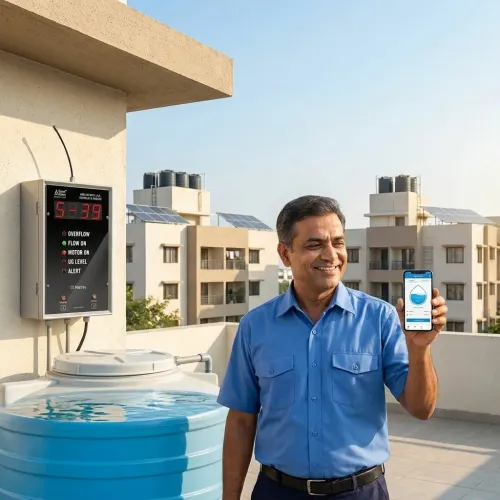
Advanced systems can also make this information available through web-based or mobile monitoring platforms.
5. Alerts or Automatic Motor Control Can Be Activated
The final step depends on the type of system being used.
A wireless water-level indicator may simply display the tank level and activate an alarm when the water reaches a configured threshold.
An automatic water-level controller can perform additional functions.
For example:
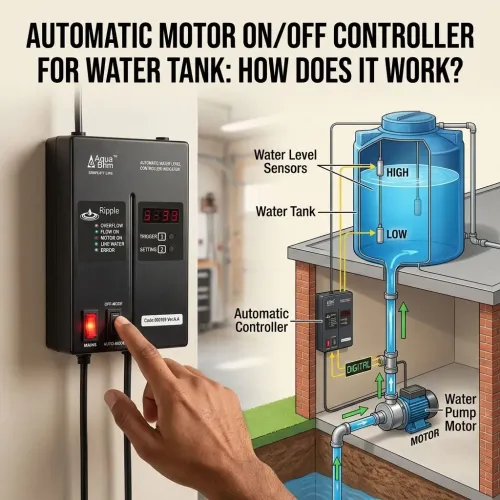
- When the overhead tank becomes low, the controller can start the motor if the required operating conditions are satisfied.
- As the tank fills, the sensor continues sending updated water-level information.
- When the tank reaches its configured full level, the controller switches OFF the motor.
Important: A wireless water-level sensor only detects and communicates water-level information. Automatic motor ON/OFF operation requires a compatible motor controller and suitable electrical connections.
What Are the Different Types of Wireless Water Level Sensors?
Different technologies are used to monitor water levels. Understanding the differences helps in selecting the right sensor for a particular application.
1. Capacitive Water Level Sensors
Capacitive sensors detect changes in capacitance as the water level changes.
In suitable designs, the sensor can measure different water levels and communicate the information to a wireless transmitter.
These sensors are used in water storage and automation applications where continuous level monitoring is required.
Aquabrim offers capacitance-based wireless water-level transmitters designed to communicate with compatible controller and indicator units.
The published product information describes battery-powered operation, automatic full-level calibration and sensors available in different lengths for measuring water depth.
2. Ultrasonic Water Level Sensors
Ultrasonic sensors measure water levels without direct contact with the water.
They are generally installed above the water surface. The sensor sends ultrasonic pulses towards the water and measures the time taken for the reflected sound waves to return.
The distance between the sensor and the water surface is then used to calculate the water level.
These sensors can be useful in applications where direct contact with the stored liquid is undesirable.
3. Radar Water Level Sensors
Radar sensors use electromagnetic waves to measure the distance between the sensor and the water surface.
They are used in certain industrial applications where non-contact measurement is preferred.
Depending on the model, radar sensors can be suitable for challenging environments where contact-based sensors may require additional maintenance.
Benefits of Using a Wireless Water Level Sensor for Tanks
1. No Long Signal Cables Between Tanks and Controller
One of the biggest advantages of wireless technology is that it eliminates the need for long communication cables between compatible tank transmitters and the receiving unit.
This can simplify installations in multi-storey buildings.
2. Convenient Water-Level Monitoring
Users can check the water level from a designated display or supported monitoring platform rather than physically inspecting the tank.
3. Suitable for Multiple Tanks
Wireless systems can be configured to monitor multiple tanks from a centralized receiver.
This is useful for apartments, hotels, hospitals, schools and commercial buildings.
The number of tanks supported depends on the particular controller or indicator.
4. Helps Prevent Water Overflow
When connected to a suitable alarm or automatic motor controller, the sensor can help identify when a tank reaches its configured full level.
The system can then provide an alert or switch OFF the motor, depending on its functionality.
5. Useful for Underground and Overhead Tanks
Wireless sensors can be installed in different water-storage locations, allowing users to monitor water levels from a central location.
6. Supports Smart Water Management
When integrated with compatible monitoring software, wireless water-level information can be accessed remotely.
This can help building managers and facility teams monitor tank conditions without visiting every tank.
How Aquabrim Uses Wireless Sensors for Water-Level Monitoring
Aquabrim develops wireless water-level monitoring and automation systems for residential, commercial and institutional applications.
Its wireless transmitters communicate water-level information to compatible controllers and indicator units using RF technology.
Depending on the product and configuration, these systems can support tank-level display, alerts, automatic pump operation and multi-tank monitoring.
Some relevant Aquabrim solutions include:
1. Wireless Water Level Transmitter
Aquabrim's wireless water-level transmitter range includes capacitance-based sensors designed to measure water levels and transmit information to compatible receivers.
Published product information highlights:
- Battery-powered wireless operation.
- Capacitance-based level sensing.
- Automatic full-level calibration.
- Water-level data transmission.
- Sensor options for different tank depths.
- Outdoor-use-oriented transmitter construction.
Explore: Aquabrim Wireless Water Level Transmitter
2. Flexibell – Wireless Water Level Indicator and Alarm
Flexibell is designed for users who want to monitor multiple water tanks from a centralized display.
It can display water levels for up to six tanks and provide alerts when configured low, full or overflow thresholds are reached.
Its wireless sensors communicate with the display unit using RF technology.
Important: Flexibell is a water-level monitoring and alarm system. It does not automatically start or stop water pumps.
Explore: Aquabrim Flexibell
3. Matrix – Wireless Multi-Tank Water Automation
For larger buildings, Matrix provides centralized wireless monitoring and motor automation.
According to its published specifications, it supports up to 13 overhead tanks and one underground tank, with control of up to two motors.
It also supports configurable water-level thresholds and MODBUS connectivity for Building Management System integration.
Explore: Aquabrim Matrix Multi-Tank Controller
4. Macro – Wireless Borewell and Submersible Pump Controller
Macro is designed for applications where water is pumped from an underground source or borewell to an overhead tank.
It uses wireless sensors to monitor water levels and supports automatic motor operation based on configured conditions.
Explore: Aquabrim Macro Water Level Controller
What Should You Check Before Buying a Wireless Water Level Sensor?
Before selecting a wireless water-level sensor, consider these important factors.
1. Sensor Technology: Determine whether a capacitive, ultrasonic or radar sensor is suitable for your tank and application.
2. Tank Depth: Check the maximum measurement depth supported by the sensor.
3. Wireless Communication Range: Confirm that the transmitter can communicate reliably with the receiver from the actual installation location.
4. Battery Life: For battery-powered transmitters, check the expected battery life and replacement requirements.
5. Number of Tanks: If you need to monitor multiple tanks, verify the receiver's supported tank capacity.
6. Display and Alerts: Decide whether you need a simple water-level display, buzzer alerts, SMS notifications or remote monitoring.
7. Motor Automation: If you want automatic pump operation, ensure the sensor is compatible with a controller that supports motor ON/OFF functionality.
8. Installation and After-Sales Support: Consider installation requirements, warranty and service availability.
Frequently Asked Questions (FAQs)
1. What is a wireless water level sensor for a tank?
It is a device that detects the water level inside a tank and sends the measured information wirelessly to a compatible receiver or controller.
2. How does a wireless water level sensor work?
The sensor measures the water level using a suitable sensing technology. A transmitter then sends the information to a receiver through wireless communication, where it can be displayed or processed.
3. Does a wireless water level sensor require wiring?
Wireless sensors do not require a long signal cable between the tank and the compatible receiving unit. However, certain sensors require batteries or an appropriate power supply, and the receiver may need an electrical connection.
4. How far can a wireless water level sensor transmit data?
The communication range depends on the transmitter, receiver, antenna arrangement, obstacles and building construction. Always check the manufacturer's specified range and verify signal reception at the installation site.
5. Can one wireless sensor monitor multiple tanks?
A single sensor monitors the tank where it is installed. However, a compatible multi-tank receiver can receive information from multiple wireless sensors and display the levels centrally.
6. Can wireless water level sensors prevent tank overflow?
They can help prevent overflow when connected to a suitable alarm or automatic motor controller. The sensor detects the configured full level and communicates the information to the receiving system.
7. Can a wireless water level sensor automatically switch ON and OFF a motor?
Not by itself. The sensor measures and transmits water-level information. A compatible automatic motor controller is required to operate the pump.
8. Which is better: ultrasonic or capacitive water level sensors?
Neither technology is universally better. Capacitive sensors can be suitable for contact-based level measurement, while ultrasonic sensors measure the distance to the water surface without contact. The best option depends on tank conditions, liquid properties, installation and measurement requirements.
9. Can wireless water level sensors be used in underground tanks?
Yes, suitable wireless sensor systems can monitor underground tanks. The transmitter and receiver must be selected and installed according to the tank structure and wireless communication conditions.
10. Can I monitor my water tank from my mobile phone?
Yes, if the wireless sensor is connected to a compatible system that supports web-based or mobile monitoring. A basic wireless sensor and display unit may not include remote monitoring.
Conclusion
A wireless water level sensor makes tank monitoring easier by detecting water levels and transmitting the information to a compatible receiver without requiring long signal cables.
From independent homes to large commercial buildings, wireless technology can simplify water-level monitoring, reduce manual inspections and support better water management.
When combined with suitable controllers, alarms and monitoring platforms, wireless sensors can also help prevent water overflow and improve pump automation.
If you are looking for a wireless water level sensor for your overhead tank, underground tank or multi-tank installation, explore the wireless monitoring and automation solutions offered by Aquabrim.