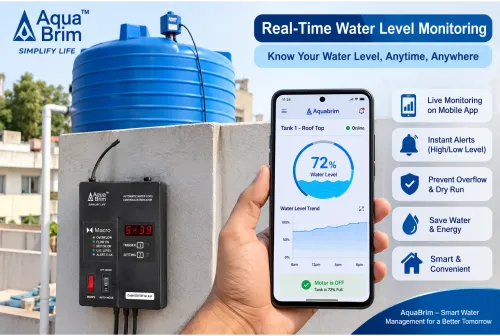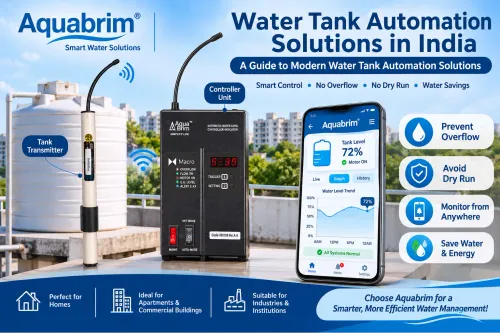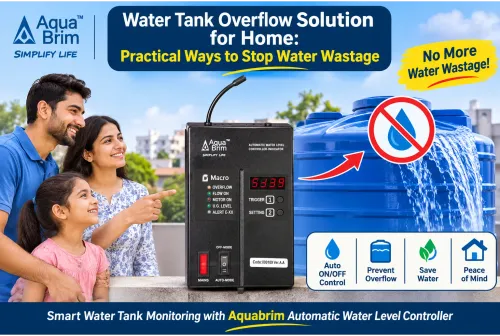

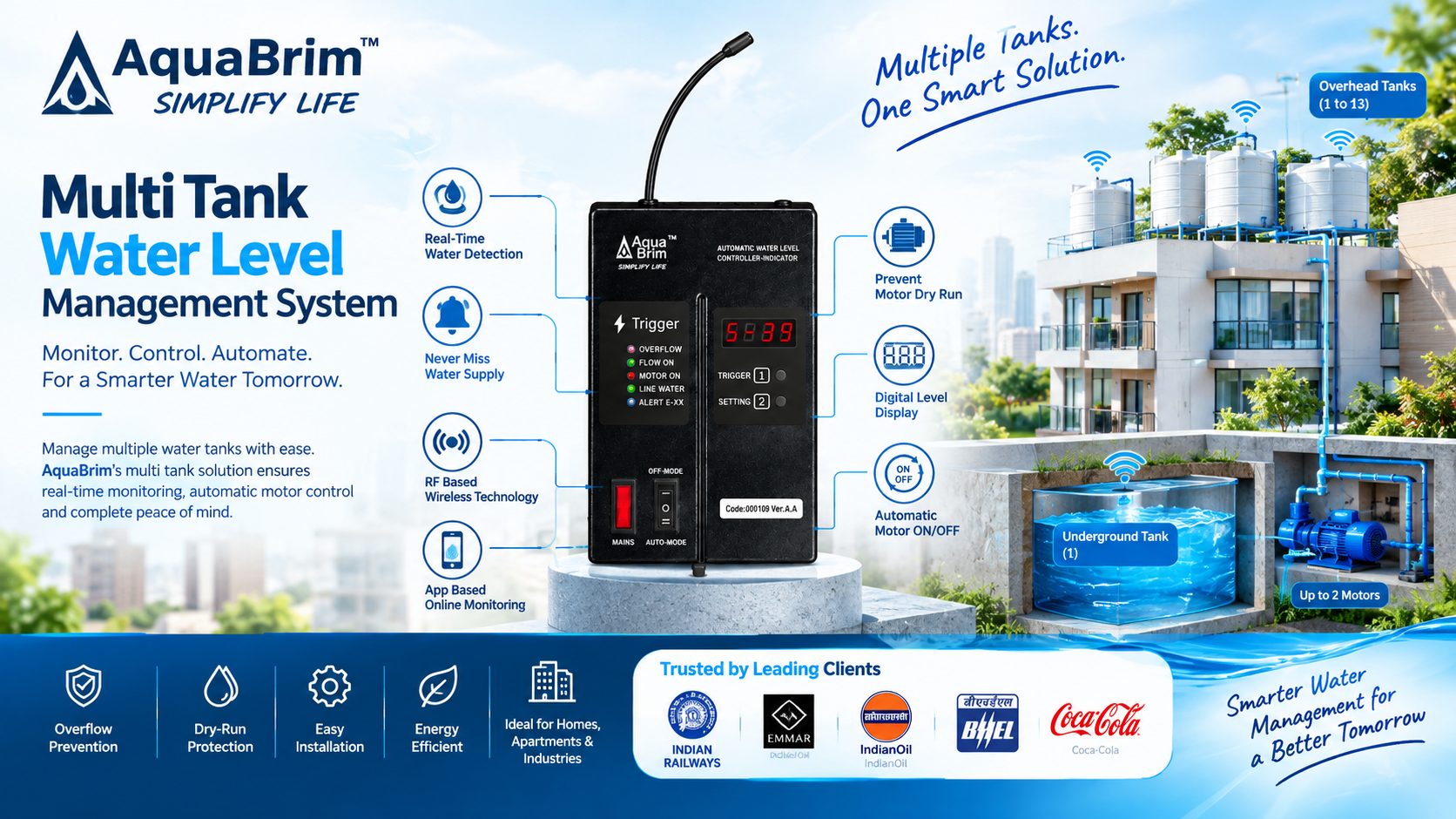
A multi tank water level management system is an automated solution designed to monitor and manage water levels across multiple overhead and underground tanks from a centralized system.
Managing one water tank manually can be relatively simple. However, when a building has several tanks across different floors, towers or areas, manually checking each tank and operating pumps becomes difficult.
AquaBrim's Matrix Multi-Tank Water Level Controller is designed for larger residential complexes, commercial buildings and institutional facilities. It can manage water levels across up to 13 overhead tanks and 1 underground tank from a single controller.
Why Do Buildings Need Multi Tank Water Management?
Multiple tanks create a coordination problem.
For example, an apartment complex may have:
- One underground water tank
- Several rooftop tanks
- Multiple water pumps
- Tanks serving different towers
- Different water-level requirements
- Motorized valves
- Municipal or borewell water sources
With manual operation, staff need to monitor all these components and decide when each pump should operate.
This can result in:
- Tank overflow
- Low water levels
- Uneven water distribution
- Pump dry running
- Unnecessary electricity consumption
- Excessive dependence on maintenance staff
AquaBrim's multi-tank solution is designed to centralize this process and automate water-level management.
How Does a Multi Tank Water Level Management System Work?
A typical automated multi-tank system works through three main stages.
1. Wireless Sensors Monitor Each Tank
Sensors installed in the tanks measure their water levels and transmit the information to the central controller.
AquaBrim Matrix uses wireless RF communication in the 433–434 MHz range, eliminating the need for communication wiring between tanks and the controller.
2. Central Controller Receives the Information
The controller receives information from the connected tanks and displays the relevant water-level information.
Matrix can monitor up to 13 overhead tanks and 1 underground tank.
3. Pumps Operate Automatically
Based on the configured settings, the controller can start or stop the connected motors to maintain the required tank levels.
Matrix can control up to two motors, with the configuration determined according to the installation requirements.
Multi Tank Water Management: Manual vs Automatic
| Manual Management | Automated Multi-Tank Management |
|---|---|
| Staff check tanks individually | Sensors continuously monitor tanks |
| Pumps switched manually | Pumps can start/stop automatically |
| Higher risk of overflow | Configured overflow protection |
| Difficult to coordinate tanks | Centralized management |
| Greater manpower dependency | Less routine manual intervention |
| Tank levels may be unknown | Digital level visibility |
| Difficult to manage remotely | BMS integration available |
| More complicated as tanks increase | Designed specifically for multiple tanks |
The advantage of a multi-tank system is that the building's water infrastructure can be managed as a connected system rather than as separate individual tanks.
Key Benefits of a Multi Tank Water Level Management System
1. Centralized Water Management
Instead of monitoring every tank independently, a central controller can provide visibility across the entire water system.
This is particularly useful for housing societies, commercial buildings and institutions.
2. Automatic Motor Control
The controller can automatically operate connected pumps based on configured tank levels.
AquaBrim Matrix supports control of up to two motors.
3. Multiple Tank Support
The main advantage of a dedicated multi-tank controller is scalability.
AquaBrim Matrix supports:
13 overhead tanks + 1 underground tank
from a single controller.
4. Wireless Communication
Wireless RF communication eliminates the need to run communication cables between every tank and the central controller.
This can simplify installation in multi-storey buildings and large facilities.
5. Overflow Protection
When tank levels are monitored continuously, the controller can use configured thresholds to manage pump operation and help prevent overflow.
Matrix provides configurable overflow, full-level and low-level settings.
6. Dry-Run Protection
Monitoring the source tank is important because an overhead tank may require water while the underground source is running low.
A properly configured automated system can stop pumping when source-water conditions indicate a dry-run risk.
AquaBrim's water automation portfolio includes dedicated dry-run protection, while Matrix is designed for centralized multi-tank water management.
7. Programmable Timers
Matrix includes up to 10 programmable timers, allowing the system to be configured according to site-specific operating requirements.
8. Motorized Valve Monitoring
For installations using motorized valves, Matrix can display the valve's open or closed status on the controller.
9. BMS Integration
Large commercial and institutional facilities may already have a Building Management System.
AquaBrim Matrix supports MODBUS connectivity, allowing water-system information to be integrated with a BMS for monitoring and control.
Multi Tank Water Level Management for Apartments
Apartment buildings often have several overhead tanks and an underground sump.
As the number of tanks increases, manual management becomes more complicated.
A multi-tank system can help facility teams monitor:
- Overhead tank levels
- Underground tank level
- Pump operation
- Overflow conditions
- Low-level conditions
- Valve status
- Configured timers
AquaBrim specifically identifies Matrix as a solution for apartments, housing societies and larger residential complexes with multiple tanks.
Multi Tank Management for Commercial Buildings
Commercial buildings can have multiple water-storage areas serving different floors or zones.
Examples include:
- Office buildings
- Shopping complexes
- Hotels
- Hospitals
- Educational institutions
- Industrial facilities
- Large residential complexes
For these applications, centralized water-level monitoring can provide facility managers with a single point of visibility.
AquaBrim describes Matrix as a solution for large residential, commercial and institutional installations requiring centralized water-supply control.
Wireless Multi Tank Water Level Management
Wireless communication is especially valuable when tanks are located across different floors or building sections.
Instead of running communication cables from every tank to the controller, wireless sensors transmit tank-level information to the central unit.
AquaBrim Matrix uses 433–434 MHz RF communication for its tank sensors.
This makes wireless architecture useful for:
- Multi-storey apartments
- Housing societies
- Commercial complexes
- Large institutions
- Industrial sites
- Buildings with difficult cable-routing requirements
How AquaBrim Matrix Handles Multiple Tanks
AquaBrim Matrix is specifically designed around multi-tank water management rather than simply connecting multiple independent controllers.
Its current specifications include:
| Feature | Matrix |
|---|---|
| Overhead tanks | Up to 13 |
| Underground tanks | 1 |
| Motors | Up to 2 |
| Wireless frequency | 433–434 MHz |
| Programmable timers | Up to 10 |
| BMS integration | MODBUS |
| Digital level display | Yes |
| Motorized valve status | Yes |
| Overflow settings | Configurable |
| Full-level settings | Configurable |
| Low-level settings | Configurable |
These specifications are from AquaBrim's current Matrix product information.
Multi Tank Water Level Management and Water Saving
Water overflow is one of the most visible problems associated with manual tank management.
When a pump continues running after a tank becomes full, treated or pumped water can simply be discharged as overflow.
Automatic monitoring allows the system to use configured level thresholds to manage filling and motor operation.
AquaBrim's broader water automation platform specifically highlights tank overflow prevention, real-time alerts, wireless sensors and dry-run motor protection among its system features.
Multi Tank Water Level Management and Electricity Saving
Water pumps consume electricity while operating.
If a pump runs longer than necessary because a tank was not checked or the motor was not switched off, electricity is consumed without providing additional useful water storage.
Automatic motor control can stop the pump once the configured target condition is reached.
This means the objective is not simply to operate the pump automatically—it is to operate it according to actual water-system conditions.
What Should You Consider Before Choosing a Multi Tank System?
Before selecting a multi tank water management solution, consider the following:
1. Number of Tanks
Determine the number of overhead and underground tanks that need monitoring.
2. Number of Pumps
Check how many motors need to be controlled.
3. Water Source
Determine whether the system receives water from:
- Municipal supply
- Borewell
- Underground sump
- Multiple sources
4. Wireless Range
Ensure the wireless communication system is suitable for the physical layout of the building.
5. Overflow Protection
Check whether full and overflow levels can be configured.
6. Dry-Run Protection
For borewell and underground pumping systems, source-water monitoring and dry-run protection are important considerations.
7. BMS Integration
Commercial and institutional facilities may require MODBUS or another method of integration with their existing building-management infrastructure.
8. Scalability
Choose a system that supports the current number of tanks while leaving room for future expansion.
Who Can Use a Multi Tank Water Level Management System?
A multi-tank solution can be useful for:
- Apartment complexes
- Housing societies
- Residential towers
- Commercial buildings
- Hotels
- Hospitals
- Schools
- Colleges
- Industrial facilities
- Institutional campuses
- Large villas and residential properties
AquaBrim positions Matrix specifically for large residential, commercial and institutional water-management applications.
Multi Tank Controller vs Individual Controllers
A building with several tanks could potentially use separate controllers for individual tanks.
However, this can create another challenge: multiple independent systems can be harder to coordinate.
A centralized multi-tank controller provides one system for monitoring and managing the connected tanks and pumps.
AquaBrim's buying guide specifically describes Matrix as a centralized solution for installations where multiple tanks need to be managed from a single system.
Why Choose AquaBrim for Multi Tank Water Management?
AquaBrim has been developing water-level automation systems for Indian homes and industries since 2008.
Its current portfolio includes solutions for municipal supply, borewell/submersible systems, multi-tank automation, water-level monitoring, flow monitoring, IoT connectivity and centralized command systems.
The AquaBrim platform currently reports:
- 50,000+ customers
- 5,000+ systems installed
- 15+ cities served
- 16+ years of experience
For multi-tank applications specifically, Matrix brings together wireless tank monitoring, centralized motor control, programmable settings and BMS integration.
Frequently Asked Questions
1. What is a multi tank water level management system?
A multi tank water level management system is an automated solution that monitors water levels across multiple tanks and manages connected pumps according to configured water-level conditions.
2. How many tanks can AquaBrim Matrix manage?
AquaBrim Matrix can manage up to 13 overhead tanks and 1 underground tank from a single controller.
3. Can one multi-tank controller control multiple motors?
Yes. AquaBrim Matrix can control up to two motors, with the configuration selected according to the installation requirements.
4. Does a multi-tank water level system require wiring between tanks?
AquaBrim Matrix uses wireless RF communication between the tank sensors and controller, so communication wiring between the tanks and controller is not required.
5. Can a multi-tank system prevent water overflow?
Yes. A suitable automated controller can monitor configured full and overflow thresholds and control pump operation accordingly. Matrix provides configurable overflow and full-level settings.
6. Can a multi-tank controller provide dry-run protection?
Dry-run protection depends on the system configuration and source-water monitoring. AquaBrim provides dry-run protection within its water automation portfolio, while Matrix is designed for centralized multi-tank management.
7. Can Matrix connect to a Building Management System?
Yes. AquaBrim Matrix supports MODBUS connectivity, allowing water-system data to be integrated with a Building Management System.
8. Is a multi-tank water management system suitable for apartments?
Yes. AquaBrim identifies Matrix as a solution for large residential complexes and housing societies where multiple tanks need to be managed from a centralized system.
9. Can the settings of AquaBrim Matrix be configured?
Yes. Matrix provides configurable overflow, full and low-level settings and supports up to 10 programmable timers.
10. Which AquaBrim product is suitable for multiple water tanks?
For installations requiring centralized management of multiple tanks, AquaBrim Matrix is the dedicated multi-tank solution. It supports up to 13 overhead tanks and one underground tank and can control up to two motors.