
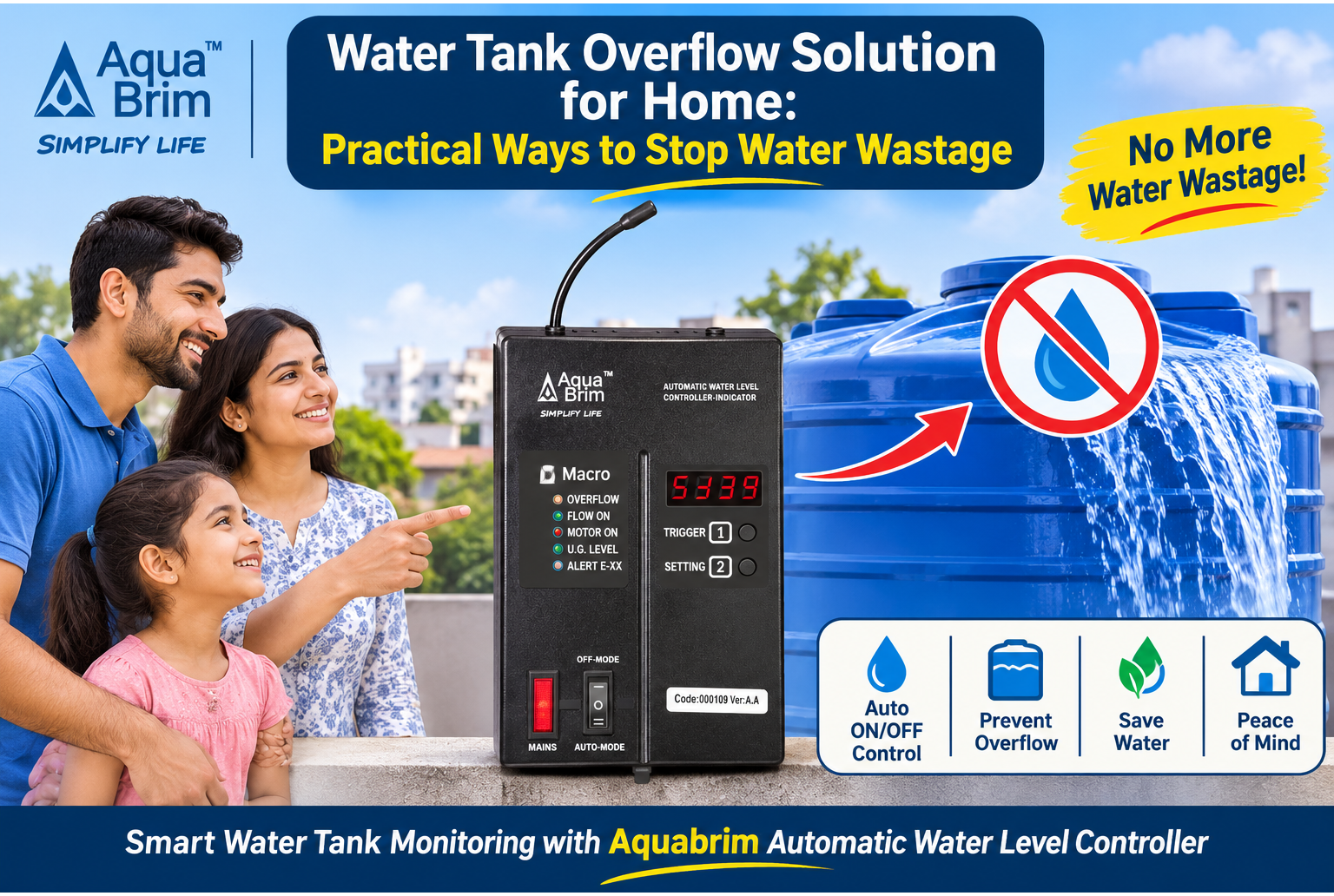
Water Tank Overflow Solution for Home: Practical Ways to Stop Water Wastage
Water tank overflow is one of those household problems that seems small until you notice how much water is being wasted.
You switch on the motor, wait for the tank to fill, and plan to switch it off after a few minutes. Then something comes up. You get busy with work, receive a phone call, leave the house, or simply forget.
By the time you remember, water may already be flowing over the tank.
This happens regularly in many Indian homes, particularly where the overhead tank is on the roof and the pump is operated manually.
The good news is that there are several ways to deal with it. A float valve, water-level alarm, sensor-based indicator, or automatic water level controller can all have a role depending on how your home's water system is designed.
The important thing is choosing a solution that actually addresses the reason your tank is overflowing.
Why Does a Water Tank Overflow?
Before choosing a solution, it helps to understand the problem.
Most household tank overflows happen for one simple reason:
The pump continues supplying water after the tank has already become full.
But why does that happen?
1. Someone Forgets to Switch Off the Motor
This is probably the most common situation.
The motor is switched on manually, but nobody remembers to turn it off when the tank reaches full level.
The problem becomes even more common when the motor switch is located away from the tank.
2. The Tank Is on the Rooftop
In many Indian homes, the overhead tank is several floors above the pump.
Nobody wants to climb to the roof repeatedly just to check whether the tank is full.
As a result, people often estimate the filling time rather than checking the actual water level.
3. Water Supply Timing Is Unpredictable
Municipal water may arrive at different times depending on the locality and supply schedule.
A homeowner may switch on the pump when water becomes available and then become occupied with something else.
This is particularly inconvenient when water arrives early in the morning, late at night, or during working hours.
4. The Existing Float Valve or Sensor Fails
A mechanical float valve can become stuck, worn out, or incorrectly adjusted.
Similarly, an electronic sensor can fail because of installation problems, deposits, wiring issues, or other faults.
A backup method can therefore be useful in important installations.
5. Manual Pump Operation
The fundamental problem with manual operation is that it depends on a person being available at exactly the right time.
If the person forgets, the tank doesn't know that it should stop filling.
That is where automatic water-level sensing becomes useful.
7 Practical Water Tank Overflow Solutions for Home
There isn't one solution that is perfect for every house.
Here are the most practical options, starting from simple solutions and moving toward complete automation.
1. Install an Automatic Water Level Controller
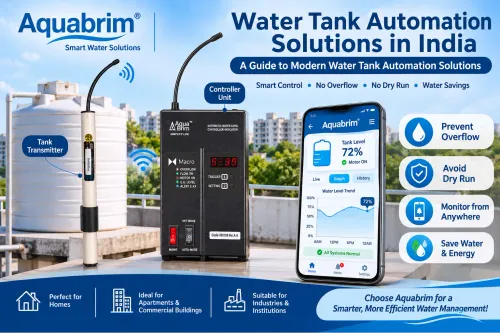
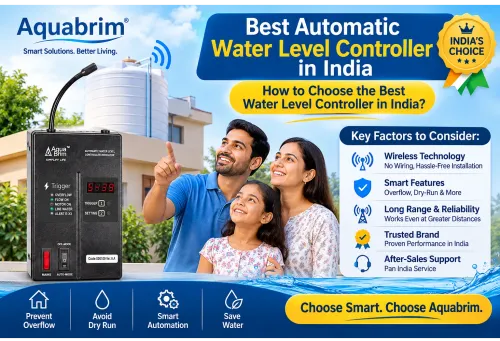
For a home where the main problem is forgetting to switch off the motor, an automatic water level controller is one of the most practical solutions.
Instead of relying on someone to watch the tank, the system monitors the water level itself.
The basic process looks like this:
Water level falls → Sensor detects low level → Controller starts motor → Tank fills → Full level detected → Controller stops motor
The homeowner doesn't have to manually switch the motor off every time.
A suitable controller can therefore reduce the possibility of overflow caused by an unattended running pump. automation.aquabrim.com
Why this is useful
- Less manual work
- Reduced chance of overflow
- Automatic pump operation
- Better water management
- Convenient for rooftop tanks
- Useful when nobody is available to monitor the tank
However, the controller must be correctly matched to the pump, tank and water source.
2. Use a Water Level Alarm
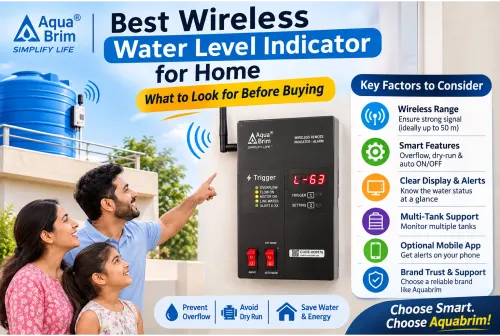
If you don't want automatic motor control, a simpler option is a water level alarm.
The sensor detects when the tank reaches a particular level and gives an audible or visual warning.
For example:
Tank approaching full → Alarm sounds → User switches OFF motor
This can be useful if you still want to operate the motor manually but don't want to continuously check the tank.
The important limitation is that an alarm alerts you; it doesn't necessarily switch off the pump.
So if you are looking for complete overflow prevention rather than a warning, an automatic pump-control system is generally more appropriate.
Aquabrim Flexibell, for example, is designed as a water-level indicator and alarm rather than an automatic motor controller. automation.aquabrim.com
3. Install a Float Valve
A float valve is a simple mechanical method of controlling water entering a tank.
The principle is straightforward.
As the water level rises, the float rises with it. When the water reaches the configured level, the valve closes and restricts the incoming water.
This can work well in suitable gravity-fed water arrangements.
Advantages
- Simple mechanism
- No electronics required
- Relatively straightforward
- Can act as an additional safety measure
Limitations
A float valve isn't necessarily the best solution for every pumped-water arrangement.
Its performance can depend on:
- Water pressure
- Valve quality
- Installation
- Maintenance
- Mechanical wear
- Type of water supply
So don't assume a float valve alone is sufficient for every home.
4. Install a Wireless Water Level Sensor
A wireless sensor is useful when the tank and motor/controller are physically far apart.
For example:
Rooftop tank
↓
Several floors
↓
Motor/control unit
Running a long sensor cable through the building may be inconvenient.
A wireless sensor can transmit the tank-level information to a compatible receiver or controller.
This can make installation cleaner and more flexible.
However, wireless range should be checked against the actual building rather than relying only on the manufacturer's maximum advertised range.
Walls, concrete structures, floors and other environmental conditions can affect wireless communication. automation.aquabrim.com
5. Monitor the Underground Tank Too
Sometimes the problem isn't only the overhead tank.
Consider a typical home:
Underground tank → Pump → Overhead tank
The overhead tank can overflow if the pump continues running after it becomes full.
But there is another problem.
What happens if the underground tank becomes empty?
The pump may continue operating without enough water at the source.
This is called a dry-run condition.
A suitable water automation system can monitor both the source and destination tanks and stop the pump when the required protection condition is detected.
This is particularly important for homes using borewells or underground sumps.
6. Use a Smart Water Monitoring System
If you want more visibility than simply hearing an alarm, consider a smart water monitoring system.
Depending on the system, you may be able to monitor:
- Tank water level
- Motor status
- Low-water condition
- Full-tank condition
- Overflow alerts
- Source-water availability
- System notifications
Some connected systems also provide mobile or web-based monitoring.
This can be particularly useful if you travel frequently or manage a property remotely.
Aquabrim's connected platform provides supported users with access to water-level information, motor performance, tank conditions and system notifications. aquabrim.com
7. Use a Combination of Solutions
For some homes, the best approach isn't to depend on a single device.
For example:
Automatic water level controller + float valve
or
Automatic controller + water-level alarm
can provide additional protection.
The exact combination depends on the water source and plumbing arrangement.
For a normal home, however, it's better to keep the system reasonably simple. Adding several devices without understanding how they interact can create unnecessary complexity.
How an Automatic Water Tank Overflow Prevention System Works
The principle is quite simple.
Step 1: Sensor Monitors the Tank
A sensor continuously monitors the water level.
Step 2: Tank Level Falls
When the water level reaches the configured low-level threshold, the system identifies that the tank needs water.
Step 3: Controller Checks Operating Conditions
Depending on the system, the controller may also check whether water is available at the source.
Step 4: Motor Starts
If the required conditions are satisfied, the controller starts the connected pump.
Step 5: Tank Fills
The sensor continues monitoring the water level while the pump is running.
Step 6: Full Level Is Detected
When the tank reaches the configured full level, the controller receives the signal.
Step 7: Motor Stops
The controller switches off the motor.
So instead of:
Person → Checks Tank → Switches Motor → Checks Tank Again → Switches Motor OFF
the process becomes:
Sensor → Controller → Motor
This is the basic idea behind automatic water tank overflow prevention. automation.aquabrim.com
What If Your Home Uses Municipal Water?
Municipal-water homes have a slightly different requirement.
The problem may not simply be:
"The tank is overflowing."
It may be:
"When municipal water finally arrives, someone has to notice it and start the motor."
If water arrives at irregular hours, this can be inconvenient.
A suitable municipal-water automation system can detect water availability and operate the motor according to the configured tank-level conditions.
Aquabrim Trigger, for example, is designed for municipal/corporation water supply and combines water-supply detection, wireless tank-level monitoring and automatic motor control. automation.aquabrim.com
This can turn the process into:
Municipal water available → System detects supply → Motor starts → Tank fills → Full level detected → Motor stops
What If Your Home Uses a Borewell?
Borewell homes have a different challenge.
The system needs to consider both:
How much water is in the overhead tank?
and
Is sufficient water available at the source?
If the overhead tank is low but the borewell/underground source doesn't have sufficient water, simply starting the pump can create a dry-run condition.
For these homes, look for a system that provides appropriate source-water monitoring and dry-run protection.
Aquabrim Macro is designed for borewell and submersible-pump applications, with underground/source and overhead tank monitoring and automatic motor control. aquabrim.com
What About Homes With Multiple Tanks?
A larger house may have:
- One underground sump
- Two or more overhead tanks
- Separate tanks for different floors
- Multiple pumps
In such cases, a basic single-tank controller may not be enough.
A multi-tank system can provide centralised monitoring and control.
For example, Aquabrim offers Matrix for larger multi-tank applications, while Flexibell can be used for centralised wireless level indication and alarms for multiple tanks. automation.aquabrim.com
The important thing is to calculate the actual number of tanks and pumps before selecting the system.
How to Choose the Right Water Tank Overflow Solution for Your Home
Before buying anything, answer these questions.
1. How many tanks do you have?
One overhead tank?
Or underground + overhead?
2. Where is your motor located?
Near the tank?
Or several floors away?
3. What is your water source?
Municipal supply?
Borewell?
Underground sump?
Multiple sources?
4. Do you want only an alert?
If yes, a water-level alarm may be enough.
5. Do you want automatic motor control?
If yes, look for an automatic water level controller.
6. Do you need wireless communication?
If running cables is difficult, wireless may be a better installation approach.
7. Do you need mobile monitoring?
If you travel frequently or manage the property remotely, connected monitoring can be useful.
8. What is your motor's rating?
Check:
- HP
- Voltage
- Phase
- Current
- Starter/control arrangement
The controller must be compatible with the motor and electrical installation.
9. Do you need dry-run protection?
If you use a borewell or variable underground water supply, this can be an important requirement.
10. Who will install and service it?
Don't look at the device price alone.
Installation and after-sales support matter because the system is connected to your home's water and electrical infrastructure.
Which Water Tank Overflow Solution Is Best for Different Homes?
| Home Situation | Practical Solution |
|---|---|
| Manual pump + one overhead tank | Automatic water level controller |
| Want only a warning | Water level alarm |
| Gravity-fed water supply | Float valve |
| Tank far from motor | Wireless water-level system |
| Borewell + overhead tank | Controller with source monitoring/dry-run protection |
| Municipal water supply | Municipal water automation |
| Multiple tanks | Multi-tank monitoring/controller |
| Frequent travel | Smart/mobile water monitoring |
| Large house/society | Centralised multi-tank automation |
This is why there isn't one universal "best" overflow solution.
The correct choice depends on the way water enters, moves through and gets stored in your property.
Aquabrim Solutions for Water Tank Overflow Prevention
Aquabrim provides different water automation products depending on the application.
Trigger
Designed for homes and properties using municipal water supply.
It combines:
- Municipal water-supply detection
- Wireless tank-level monitoring
- Automatic motor ON/OFF
- Overflow prevention
- Dry-run protection
- Wireless communication
It is intended for applications where water availability from the municipal line is an important part of the automation process. automation.aquabrim.com
Macro
Designed for borewell and submersible-pump applications.
It monitors the source/underground water condition and overhead tank level while providing automatic motor control and suitable dry-run protection. aquabrim.com
Flexibell
Designed for homeowners who primarily want water-level indication and alarms.
It can provide low, full and overflow-level indications and is useful when the requirement is monitoring rather than automatic motor control. automation.aquabrim.com
Matrix
Designed for larger multi-tank applications such as societies, commercial buildings and institutions.
It is intended for more complex water-management arrangements where multiple tanks and pumps need centralised monitoring and automation. automation.aquabrim.com
Common Mistakes That Cause Water Tank Overflow
Relying on a Fixed Timer
A timer assumes that the tank always takes the same amount of time to fill.
In reality, water pressure and supply conditions can change.
Assuming the Tank Will Always Fill at the Same Rate
The filling speed can change depending on:
- Water pressure
- Pump performance
- Source-water availability
- Pipe condition
- Other water usage
Using an Alarm and Assuming It Stops the Pump
An alarm may only tell you that the tank is full.
It doesn't necessarily control the pump.
Ignoring the Underground Tank
The overhead tank may need water, but the source tank may be empty.
This can create a dry-run problem.
Buying a Controller Without Checking the Motor
Always check motor specifications and the controller's electrical compatibility.
Choosing a Product Only Because It Is Cheap
A water automation system is protecting a valuable utility and potentially an expensive pump.
The cheapest product isn't necessarily the most economical solution over time.
Can a Water Tank Overflow Damage Your Home?
Yes, repeated overflow can create more than just water wastage.
Depending on the building and installation, persistent water around the tank or terrace can contribute to:
- Dampness
- Algae growth
- Slippery surfaces
- Water seepage
- Damage to nearby structures
- Unnecessary cleaning
- Increased water consumption
The severity depends on the building's construction and how the overflow water is drained.
So preventing overflow isn't simply about saving a few litres of water. It can also help keep the surrounding area cleaner and reduce avoidable water-related problems.
Does an Automatic Water Level Controller Save Water?
It can.
The primary mechanism is simple:
Motor continues running after tank is full → Water is wasted
versus:
Tank reaches full level → Controller stops motor
By stopping the pump at the configured full level, the system can reduce water that would otherwise be lost through overflow. automation.aquabrim.com
The actual savings depend on how often the tank previously overflowed, household water usage and the operating conditions of the system.
Frequently Asked Questions
How can I stop my home water tank from overflowing?
The most reliable approach for a pumped system is to use a properly installed automatic water level controller that detects the full tank condition and switches off the connected pump.
What is the simplest water tank overflow solution?
If you only need a warning, a water-level alarm can alert you when the tank reaches a certain level. If you want the pump to stop automatically, an automatic water level controller is a more complete solution.
Can a float valve prevent water tank overflow?
A properly installed float valve can control water entering a tank in suitable gravity-fed applications. However, it may not replace an automatic pump-control system in every home.
Can a wireless water level controller prevent overflow?
Yes. A compatible wireless controller can receive tank-level information from a wireless sensor and stop the pump when the configured full level is reached. automation.aquabrim.com
Can a water-level alarm stop the motor?
Not necessarily. A water-level alarm may only provide an audible or visual warning. Check whether the particular system has automatic motor-control capability.
What if my underground tank becomes empty?
A suitable controller with source-level monitoring and dry-run protection can stop the pump when the configured low-water condition is detected. This is particularly relevant to borewell and underground-sump installations.
Can I prevent overflow without running wires from the tank?
Yes. Wireless water-level sensors can communicate with a compatible controller or receiver, reducing the need for long sensor cables between the tank and control unit.
Can I monitor my tank from my mobile phone?
Yes, where the selected water automation system supports connected monitoring. Aquabrim's compatible smart systems provide web/mobile access to supported tank levels, motor performance and system notifications. aquabrim.com
Which Aquabrim product should I choose?
It depends on your setup. Trigger is designed for municipal water supply, Macro for borewell/submersible-pump applications, Flexibell for wireless water-level indication and alarms, and Matrix for larger multi-tank installations. automation.aquabrim.com
Conclusion
A water tank overflowing onto the terrace may look like a minor household inconvenience, but it is usually a sign that the water system is relying too heavily on manual operation.
You can address the problem in several ways.
A float valve can work as a simple mechanical solution in suitable installations.
A water-level alarm can warn you when the tank is getting full.
A wireless water-level system can make monitoring easier when the tank is far from the motor or display.
But if your real problem is:
"I don't want to remember to switch the motor ON and OFF every day."
then an automatic water level controller is the more complete solution.
The controller monitors the tank, starts the motor when water is required, and stops it when the configured full level is reached. With the right system, source-water monitoring and dry-run protection can also be included.
For an Indian home, the best solution is ultimately the one that matches your water source, tank arrangement, motor and everyday usage pattern.
Don't just stop the overflow.
Automate the reason it happens