
How to Prevent Water Tank Overflow at Home
Water overflowing from overhead tanks is a common problem in Indian homes. Whether you live in an independent house, apartment, or multi-storey building, you may have experienced a situation where the water tank becomes full but the motor continues running because nobody remembers to switch it off.
This seemingly small problem can lead to significant water wastage, unnecessary electricity consumption, and inconvenience. In some situations, continuous pump operation can also contribute to avoidable maintenance expenses.
The good news is that preventing water tank overflow is easier with the right equipment and a suitable water management system.
A water tank overflow prevention system helps monitor the water level and automatically controls the connected water pump to prevent water from overflowing.
In this article, we will explore the common causes of water tank overflow, practical prevention methods, and how an automatic water level controller can make water management easier.
Why Does Water Tank Overflow Happen?
Before understanding how to prevent water tank overflow, it is important to identify why it happens.
Some of the most common reasons include:
1. Forgetting to Switch Off the Motor
This is one of the most common reasons for overhead tank overflow. Someone switches on the pump but forgets to turn it off after the tank becomes full.
2. Irregular Water Supply Timings
In many Indian cities, municipal water supply is available only during specific hours. People often switch on the motor when water arrives and become occupied with other activities, forgetting to monitor the tank.
3. Lack of Water Level Monitoring
Many traditional water pumping arrangements do not have a reliable system to indicate the actual water level inside the tank.
Without proper monitoring, it becomes difficult to know when the tank is approaching its full capacity.
4. Faulty Float Valves or Sensors
Mechanical float valves and other level-detection devices can become stuck, damaged, or improperly adjusted. This can prevent them from stopping the water flow at the correct level.
5. Manual Pump Operation
When water pumps are operated entirely manually, the system depends on someone being available to monitor the tank.
This becomes inconvenient in busy households, especially when the overhead tank is located on the rooftop.
7 Effective Ways to Prevent Water Tank Overflow at Home
There are several ways to prevent water from overflowing. The right solution depends on your tank arrangement, water source, and pumping requirements.
1. Install an Automatic Water Level Controller
One of the most effective ways to prevent water tank overflow is to install an automatic water level controller.
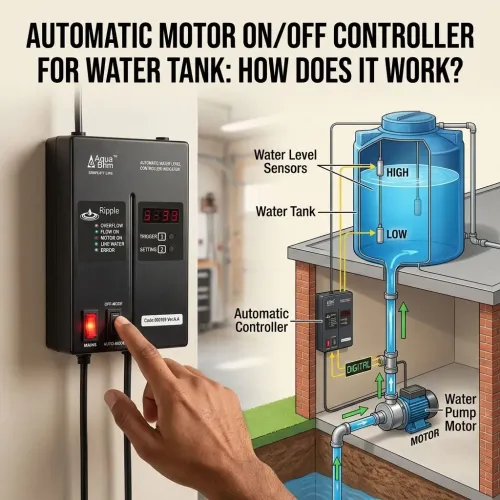
An automatic water level controller monitors the water level inside the overhead tank and controls the connected pump accordingly.
Here is how it works:
A sensor continuously monitors the water level inside the tank.
When the water level drops below the configured starting point, the controller identifies that the tank needs refilling.
The controller switches on the connected pump when the required operating conditions are satisfied.
As the tank fills, the sensor continues monitoring the water level.
Once the tank reaches its configured full level, the controller automatically switches off the pump.
This eliminates the need to manually monitor the tank and switch off the motor every time.
For homeowners looking for a permanent solution, an automatic water tank overflow prevention system is worth considering.
2. Use Water Level Sensors
Water level sensors help identify how much water is available inside a storage tank.
Depending on the technology, sensors can detect different water levels, such as:
Low water level
Medium water level
High water level
Full tank
Overflow condition
Some systems use wired sensors, while advanced systems use wireless communication to transmit water-level information to a central controller.
Wireless water level sensors can be particularly useful when the overhead tank is located far from the pump or control unit.
3. Install a Float Valve as an Additional Safety Measure
A mechanical float valve is another commonly used method to control water flow into a tank.
It works similarly to the float mechanism inside a toilet cistern.
As the water level rises, the float moves upward and gradually closes the inlet valve when the desired level is reached.
Float valves can be useful in gravity-fed water supply arrangements.
However, they are not a complete replacement for an automatic pump-control system in every installation. Their suitability depends on water pressure, valve quality, installation, and maintenance.
4. Monitor Your Underground Water Tank
Preventing overhead tank overflow is important, but monitoring the underground water source is equally necessary.
If your underground sump becomes empty while the pump is running, the motor may continue operating without sufficient water.
This condition is known as dry running.
A suitable water automation system can monitor the underground water level and stop the pump when the configured low-water condition is detected.
This helps protect the pump while managing the water transfer process.
5. Use Wireless Water Level Monitoring
In many buildings, the overhead tank is located on the rooftop, while the pump and its control panel are installed on the ground floor.
Running long sensor cables between these locations can make installation inconvenient.
A wireless water level monitoring system uses radio-frequency communication or another supported wireless technology to transmit water-level information between the sensors and controller.
Depending on the product, wireless monitoring can provide:
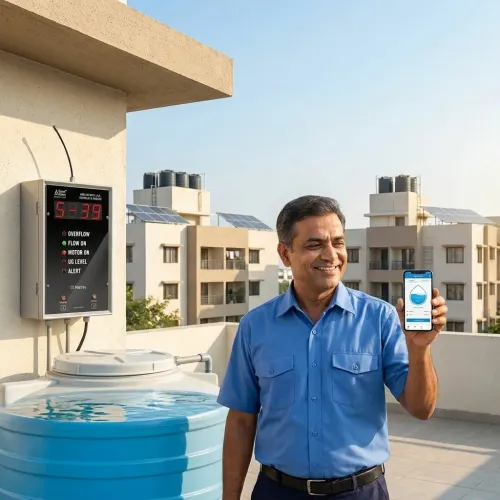
Real-time water-level information.
Automatic pump operation.
Tank-full indications.
Low-water alerts.
Monitoring of multiple tanks.
This approach can simplify installation and provide better visibility into the household water supply.
6. Check Your Pump and Electrical Connections
Even a good automatic water level controller needs a properly installed pump-control arrangement.
Check the following:
The pump is compatible with the controller.
Electrical connections are properly secured.
The switching arrangement is rated for the pump.
Sensors are installed at the correct positions.
The controller is configured according to the tank arrangement.
For electrical safety, have the pump and controller connections inspected or installed by a qualified electrician.
7. Schedule Regular Inspection and Maintenance
Water level sensors, float valves, pumps, and electrical connections should be inspected periodically.
Dust, deposits, physical damage, loose connections, and other installation issues can affect system performance.
Regular inspection helps identify potential problems before they result in water overflow or pump failure.
Follow the manufacturer's maintenance recommendations for the particular system.
How Does an Automatic Water Tank Overflow Prevention System Work?
An automatic water tank overflow prevention system works by combining water-level sensing, a control unit, and a pump-switching arrangement.
The process is simple:
Step 1: Water-Level Detection
A sensor installed inside the overhead tank monitors the available water level.
Step 2: Automatic Motor Activation
When the water level reaches the configured low-level threshold, the controller identifies the need to refill the tank.
Step 3: Water Availability Check
Depending on the system, the controller checks whether water is available from the source before operating the pump.
Step 4: Automatic Tank Filling
Once the required conditions are satisfied, the pump starts and transfers water into the overhead tank.
Step 5: Full-Tank Detection
The sensor continuously monitors the rising water level.
Step 6: Automatic Pump Shut-Off
When the water reaches the configured full level, the controller switches off the pump.
This process repeats automatically whenever the tank requires refilling.
The result is more convenient water management with reduced dependence on manual motor operation.
How Aquabrim Helps Prevent Water Tank Overflow
Aquabrim provides automatic water-level monitoring and pump automation solutions designed for residential, commercial, and institutional applications.
Its systems use wireless RF sensor technology to monitor tank levels and communicate with the controller without requiring long signal cables between supported sensors and the control unit.
Depending on the product and configuration, the system can:
Monitor overhead tank water levels.
Detect when the tank requires refilling.
Automatically start the connected motor.
Stop the motor when the tank reaches its configured full level.
Monitor underground water availability.
Provide dry-run protection.
Support multiple-tank monitoring.
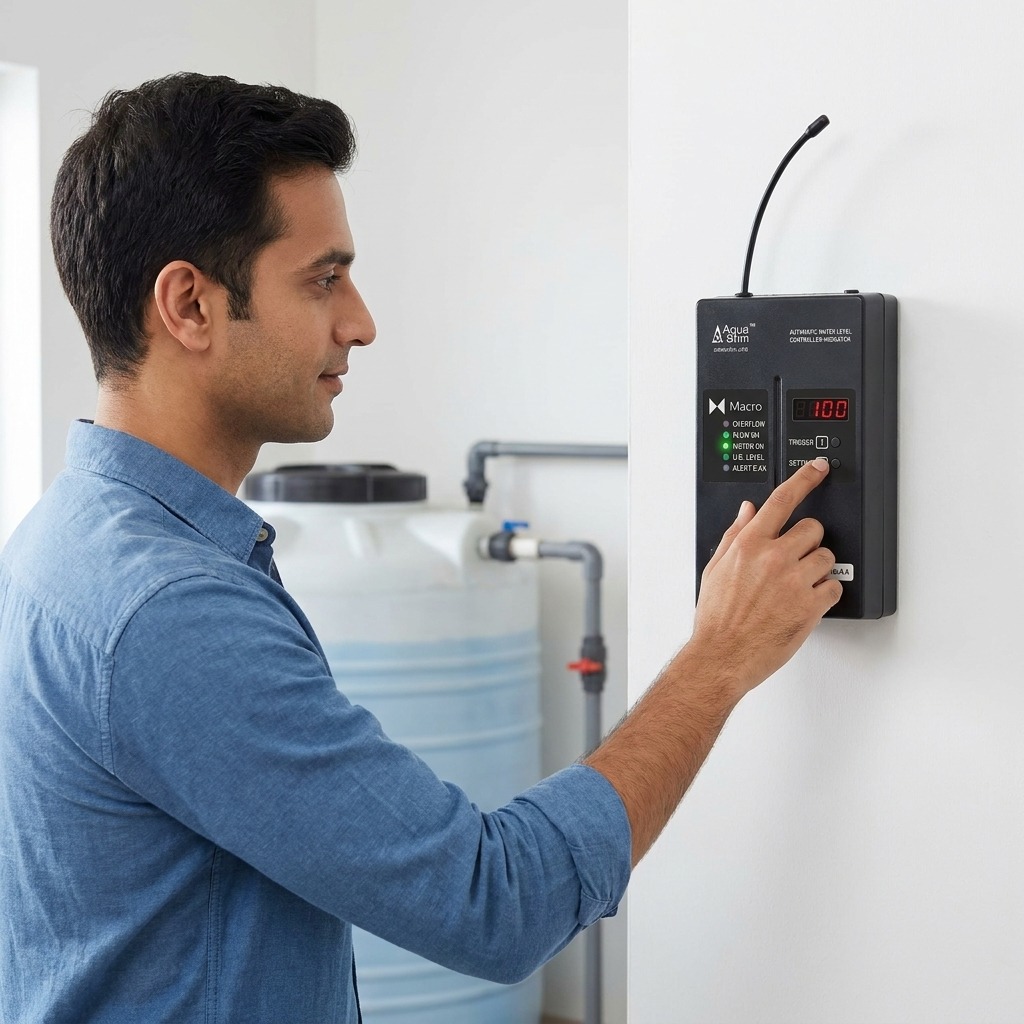
Aquabrim Macro – For Borewell and Submersible Pumps
Aquabrim Macro is designed for homes and buildings that use borewell or submersible pumps to transfer water from an underground source to an overhead tank.
It monitors both the overhead tank and the underground water source through wireless sensors.
When the overhead tank level falls below its configured 50% threshold, Macro automatically starts the pump.
It switches off the motor when the overhead tank becomes full or when its supported dry-run protection conditions are triggered.
This helps prevent water overflow while also protecting the pump from operating without an adequate water supply.
Aquabrim Trigger – For Municipal Water Supply
Homes that depend on municipal water supply often face a different challenge.
Water may arrive at irregular hours, and homeowners need to monitor the supply and operate the motor accordingly.
Aquabrim Trigger is designed for such applications.
It uses a wireless water-supply detection sensor to identify the availability of municipal water and automatically starts the connected motor when the required conditions are met.
It then monitors the overhead tank and stops the motor when the tank reaches its configured full level.
This helps prevent overflow and reduces the need for manual monitoring.
Aquabrim Matrix – For Multiple Water Tanks
Apartments, residential societies, hotels, and commercial buildings often have several water storage tanks.
Aquabrim Matrix is designed for multi-tank water management and can monitor multiple tanks through a centralised system.
It is suitable for installations where water levels need to be monitored and managed across different storage locations.
The appropriate model depends on the number of tanks, water sources, pump arrangements, and required automation features.
Benefits of Installing an Automatic Water Tank Overflow Prevention System
Installing a suitable automatic water level controller offers several practical advantages.
1. Prevents Water Wastage
Automatic pump shut-off helps prevent water from continuously overflowing after the tank becomes full.
2. Reduces Unnecessary Electricity Consumption
The pump does not need to continue operating after the required water level has been reached.
3. Protects the Water Pump
Systems with suitable dry-run protection help prevent pump operation when water is unavailable.
4. Reduces Manual Work
There is no need to repeatedly climb to the rooftop or check the tank manually.
5. Improves Water Management
Water-level monitoring helps homeowners understand the availability of water in their storage tanks.
6. Offers Greater Convenience
Automatic operation reduces dependence on someone being available to switch the motor on and off.
7. Supports Multiple Tanks
Compatible systems can monitor more than one tank, making them useful for larger homes and commercial buildings.
Frequently Asked Questions
1. How can I stop my overhead water tank from overflowing?
You can install an automatic water level controller that monitors the tank and switches off the connected pump when the water reaches its configured full level. A properly maintained float valve can also help in suitable water inlet arrangements.
2. What is a water tank overflow prevention system?
It is a system designed to prevent water from overflowing by monitoring the tank's water level and controlling the water supply or connected pump. Automatic systems generally use sensors and a control unit to switch the motor off when the tank becomes full.
3. Does an automatic water level controller save water?
Yes. By switching off the pump when the tank reaches its configured full level, it helps prevent unnecessary water overflow and wastage.
4. Can a wireless water level controller prevent tank overflow?
Yes. A wireless water level controller can monitor water levels through wireless sensors and automatically stop the pump when the tank reaches the configured full level, provided the model supports automatic pump control.
5. Can one controller manage multiple overhead tanks?
Some controllers support multiple overhead tanks through additional compatible sensors. The maximum number of supported tanks depends on the particular model.
6. What happens if the underground tank becomes empty?
A controller with suitable dry-run protection can detect the configured low-water condition and stop the pump to help prevent damage caused by running without sufficient water.
7. Is a water level alarm enough to prevent tank overflow?
A water level alarm alerts you when the tank reaches a particular level, but it may not automatically stop the pump. If you want automatic overflow prevention, choose a system that supports automatic pump control.
8. Which Aquabrim product is suitable for preventing overhead tank overflow?
Aquabrim Macro is suitable for borewell and submersible pump applications, while Trigger is designed for municipal water supply applications. Matrix is intended for multi-tank installations. Select the model according to your water source and storage arrangement.
Conclusion
Water tank overflow is not just an inconvenience. It can result in unnecessary water wastage, additional electricity consumption, and avoidable maintenance expenses.
The simplest way to reduce this problem is to move from manual pump operation to an automatic water management system.
A suitable water tank overflow prevention system monitors the water level, automatically controls the pump, and stops water filling when the tank reaches its configured capacity.
Whether your home depends on municipal water supply, an underground sump, or a borewell, choosing the right automatic water level controller can make everyday water management easier.
Explore Aquabrim's water automation solutions and take a step towards smarter, more efficient water management.