
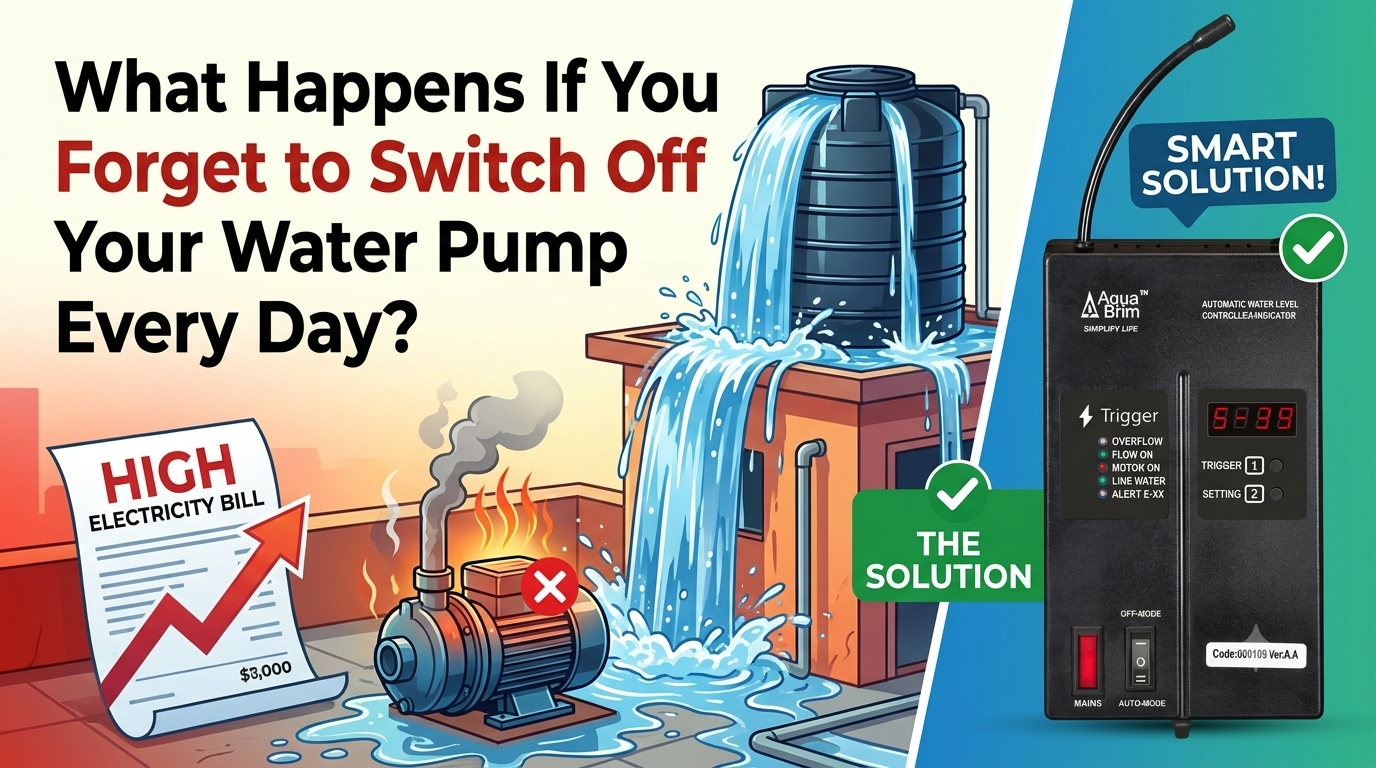
What Happens If You Forget to Switch Off Your Water Pump Every Day?
You switch on the water pump before leaving for work.
The tank isn't full yet, so you tell yourself, “I'll switch it off after a while.”
Then the phone rings. Work gets busy. Someone comes to the door. You leave home. And by the time you remember the pump, it has already been running much longer than necessary.
Sound familiar?
For many homes, switching the water pump on and off is still a completely manual job. Someone has to remember when the tank needs water, start the motor, check the tank again and switch it off at the right time.
The problem is that people are not machines.
We forget things.
And when the forgotten task involves a water pump, the consequences can range from tank overflow and water wastage to unnecessary electricity consumption and avoidable pump stress.
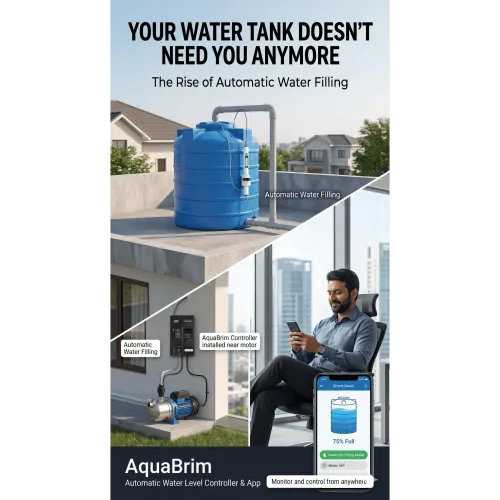
This is one of the reasons automatic water level controllers and water tank automation systems have become increasingly useful.
Let's look at what can actually happen when you forget to switch off your water pump—and why automatic control can make the whole process much easier.
First, What Happens When a Water Pump Keeps Running?
The answer depends on the type of pump, water source, plumbing arrangement and protection available in the installation.
But in a typical home with an overhead water tank, several things can happen.
The most obvious one is simple:
The tank becomes full.
If the pump continues running after the tank has reached its capacity, water starts overflowing.
But overflow isn't necessarily the only problem.
Depending on the system, prolonged or unnecessary pump operation can also mean:
Water is wasted
Electricity is consumed unnecessarily
The pump operates for longer than required
The motor may experience additional operating stress
A borewell pump may face dry-run conditions if the source runs out
Someone eventually has to deal with the consequences
And the frustrating part is that most of this can happen because of something as simple as forgetting to press one switch.
1. Your Water Tank Can Overflow
Let's start with the most common problem.
You switch the pump on when the overhead tank is half full.
The pump fills it.
The tank reaches 80%.
Then 90%.
Then 100%.
If nobody switches the pump off, the water has nowhere to go except out of the overflow pipe.
You may not even notice it immediately.
On a terrace, the overflow water may simply run away through the drainage system.
That means perfectly usable water is being pumped, transported and then discarded.
This is especially frustrating in areas where water availability is already limited.
A water level controller can address this by monitoring the tank level and stopping the pump when the configured level is reached, provided the system is designed for automatic pump control.
2. You May Waste More Water Than You Realise
An overflowing tank doesn't always look dramatic.
Sometimes it is just a continuous stream of water flowing through the overflow pipe.
Because it happens on the terrace or another less frequently visited area, people may not notice it immediately.
Imagine this happening for 20 minutes every day.
Then multiply it by 30 days.
The exact amount of water wasted will depend on the pump's flow rate and how long the overflow continues, but the basic problem remains the same:
You are pumping water only to let it escape.
Automatic water-level control helps reduce this kind of avoidable wastage by stopping the pump when the tank reaches the required level.
3. Your Electricity Is Being Used for Nothing
A water pump consumes electricity while it operates.
If the tank is already full but the pump continues running, the electricity being consumed is not providing any useful additional water storage.
This is why automatic pump control can be useful.
Instead of relying on someone to estimate when the tank will become full, the system can use actual water-level information.
For example:
Tank level low → Pump starts
Tank reaches required level → Pump stops
The actual electricity savings depend on your pump, usage pattern and how often the motor previously ran unnecessarily. But eliminating unnecessary running is still a sensible goal.
4. You Are Putting More Operating Hours on the Pump
A pump is designed to operate, so running it isn't automatically harmful.
The issue is unnecessary operation.
Every additional hour of operation contributes to the pump's overall running time.
Over a long period, unnecessary operating hours can mean more wear on components and potentially more maintenance.
This doesn't mean that a pump will immediately fail because you forgot to switch it off once.
It won't.
The concern is the repeated habit of running the pump longer than necessary.
If the same mistake happens every day, those extra operating hours add up.
5. Borewell Pumps Have a Different Problem: Dry Running
This is where the situation becomes more serious.
With an overhead tank, forgetting to switch off the pump may cause overflow.
With a borewell or underground water source, there can be another problem.
What if the water source doesn't have enough water?
If a pump continues operating when sufficient water is not available at the source, it can enter a dry-run condition.
Dry running can cause serious problems because the pump may not have the water required for proper operation and cooling, depending on the pump type and installation.
This is why borewell pumping systems should not be treated exactly like ordinary overhead tank filling.
A suitable automatic controller can incorporate source-water monitoring and dry-run protection, depending on the model and system configuration.
6. Someone Eventually Has to Check the Tank
Manual pumping creates another problem that isn't technical at all.
It creates a job.
Someone has to remember:
“The motor is running. I need to check it later.”
That sounds easy.
But now imagine doing it every day.
Morning.
Evening.
Weekend.
Holiday.
When you're busy.
When you're travelling.
When you're sick.
When nobody is at home.
The more dependent your water system is on someone's memory, the more likely it is that something will eventually be missed.
Automation removes much of this repetitive responsibility.
7. It Becomes More Difficult With Multiple Tanks
One tank is manageable.
Three tanks are another story.
Consider a building with:
One underground tank
Two overhead tanks
Multiple pumps
Separate water supply lines
Now the person responsible for the water system has to know which pump supplies which tank and when each one needs to be switched off.
This is where multi-tank water automation becomes particularly useful.
A suitable system can monitor multiple tanks and, depending on the configuration, control the associated pumps and valves.
For apartments, commercial buildings, institutions and larger homes, this can be considerably more practical than manually operating every pump.
The Real Problem Isn't the Pump. It's the Manual Process.
This is something worth understanding.
A water pump itself isn't the problem.
The problem is the process around it.
The traditional process looks something like this:
Check tank → Switch pump ON → Wait → Remember → Check tank again → Switch pump OFF
Every arrow represents something a person has to do.
An automated system changes the process:
Water level detected → Pump operates automatically → Required level reached → Pump stops
The difference is not just convenience.
It is that the system is making decisions based on the actual water level rather than someone's estimate of how long the pump should run.
How Does an Automatic Water Level Controller Solve This?
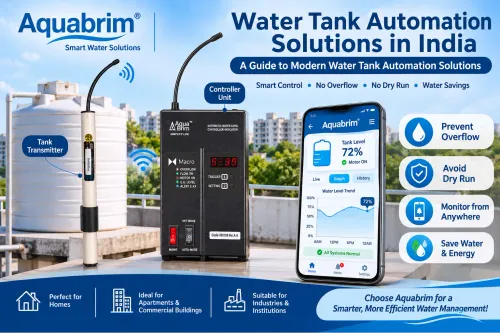
An automatic water level controller uses water-level information to control the pump.
The exact technology varies between systems, but the basic concept is simple.
When the Tank Needs Water
The sensor detects that the water level has fallen below the configured operating point.
The controller can then start the pump.
While the Tank Is Filling
The sensor continues monitoring the water level.
The controller knows that the filling process is still underway.
When the Tank Is Full
Once the tank reaches the configured stop level, the controller switches the pump OFF.
No one has to stand beside the switch.
No one has to guess how long the motor should run.
And nobody has to remember to return to the terrace.
What About Water Supply From the Municipality?
The situation becomes slightly different when the water source is municipal supply.
You cannot pump water if there is no incoming water available.
So an intelligent water automation system may need to know not only the level of the overhead tank but also whether water is actually available at the source.
This is particularly useful in areas where municipal water arrives only during certain periods.
For such applications, a suitable controller can monitor the incoming supply and manage the filling process according to the system's design.
This is one reason why choosing a controller according to the water source is important.
What About Borewell Water?
Borewell applications have a different set of requirements.
The system may need to consider:
Underground water availability
Pump operation
Overhead tank level
Dry-run protection
Motor protection
Filling requirements
A controller designed specifically for borewell or submersible pump applications can combine these requirements into a more suitable automation setup.
The goal is not simply to switch the motor on and off.
The goal is to operate the pumping system according to actual water conditions.
Automatic Water Pump Control Doesn't Mean “Set It and Forget It Forever”
There is one important misconception to clear up.
Automation doesn't mean that the entire water system can be installed and ignored indefinitely.
The pump, electrical connections, sensors, plumbing and control equipment still need normal maintenance.
You should periodically check:
Pump condition
Electrical connections
Sensor/transmitter condition
Water pipes and valves
Tank condition
Controller operation
Any alerts or fault indications
Automation reduces repetitive operation.
It does not replace maintenance.
What Should You Look for in an Automatic Water Pump Controller?
If you are considering replacing manual pump operation, don't simply buy the first controller you find.
Start with the actual problem.
1. What Is Your Water Source?
Is it:
Municipal supply?
Borewell?
Underground tank?
Another storage tank?
Multiple sources?
This can determine the type of controller you need.
2. How Many Tanks Do You Have?
One overhead tank requires a different level of control from a building with several tanks.
3. How Many Motors Are Involved?
Check whether the system supports the number and type of pumps in your installation.
4. Do You Need Wireless Sensors?
Wireless sensing can be useful when the tank and pump/control location are separated by floors or long distances.
However, actual wireless performance depends on the building and installation environment.
5. Do You Need Dry-Run Protection?
For borewell and certain other pumping applications, this can be an important feature.
6. Do You Need Remote Monitoring?
If you want to check the system while away from home or manage multiple properties, a connected monitoring option may be useful.
7. What Kind of Motor Protection Is Required?
Depending on the controller and installation, useful protection features may include overload or voltage-related protection.
Always check the actual specifications of the particular model.
A Simple Example From Everyday Life
Imagine you leave home at 8:30 AM.
The overhead tank is only half full.
You switch the pump ON before leaving.
At 8:45 AM, the tank is full.
Normally, you would switch the pump OFF.
But you're already in the car.
You remember at 10:30 AM.
That's two hours of unnecessary operation.
Now imagine the same thing happening five days a week.
This is exactly the kind of repetitive situation automation is meant to handle.
With a suitable automatic controller:
8:30 AM: Tank requires water → Pump starts.
8:45 AM: Tank reaches required level → Pump stops.
10:30 AM: You don't need to remember anything.
That's the difference.
What If You Have a Smart Water Monitoring System?
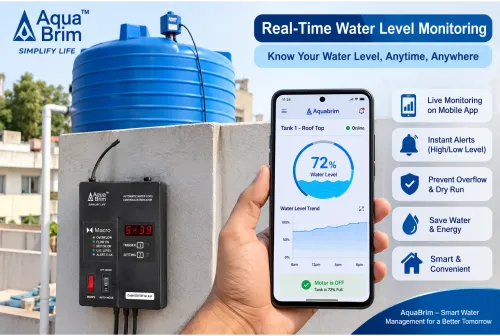
Water-level monitoring adds another layer of visibility.
Instead of simply controlling the pump, a connected system can allow you to see information about the tank remotely, depending on the system.
For example, you may be able to know:
Current tank status
Water-level condition
Pump status
Filling activity
Other configured alerts
This can be particularly useful for people managing properties remotely.
The combination of monitoring + automation is much more powerful than either one alone.
Monitoring tells you what is happening.
Automation can take action.
Aquabrim: From Manual Pump Switching to Water Automation
Aquabrim develops water-level monitoring and automation solutions for residential, commercial and institutional applications.
Different water situations require different approaches.
For example:
Aquabrim Trigger
Designed for municipal water supply applications, Trigger can help automate tank filling based on water availability and tank-level conditions.
Aquabrim Macro
Designed for borewell and submersible pump applications, Macro focuses on automatic water management where source-water conditions and pump operation need to be considered.
Aquabrim Matrix
For larger installations involving multiple tanks and motors, Matrix provides a more extensive multi-tank control approach.
Aquabrim Flexibell
If the primary requirement is water-level indication and alerts rather than automatic pump operation, Flexibell serves a different purpose.
Learn about Aquabrim Flexibell
You can also explore the complete range of Aquabrim water automation products.
Explore Aquabrim Water Automation Products
5 Signs That You Should Consider Pump Automation
You probably don't need someone to tell you that your current system needs improvement if:
1. You regularly forget to switch the pump off.
This is probably the clearest sign.
2. Your tank overflows frequently.
If water is regularly escaping from the overflow pipe, something needs to change.
3. You have to climb to the terrace several times a day.
Your water system is consuming more of your time than it should.
4. Nobody is available to manage the pump.
Automation becomes particularly useful when the house or property is empty for long periods.
5. You have multiple tanks or pumps.
The more complicated the plumbing system becomes, the harder manual control becomes.
Common Mistakes People Make With Water Pumps
Running the Pump Based on Time Alone
A pump does not know that you planned to run it for 30 minutes.
The tank level is what actually matters.
Water flow can change due to supply pressure, pipe conditions, source availability and other factors.
Assuming Every Pump Needs the Same Controller
Different pumps and water sources have different requirements.
Ignoring the Source Tank
Monitoring only the overhead tank may not be enough for a borewell system.
Buying a Water Level Indicator When You Need Pump Automation
An indicator can tell you the level.
It may not be capable of operating the pump.
Installing a System Without Considering the Actual Site
Sensor placement, wireless communication, pump type and plumbing arrangement all matter.
Frequently Asked Questions
Is it bad to leave a water pump running?
Leaving a pump running unnecessarily is not recommended. It can cause tank overflow, water wastage and unnecessary electricity consumption. In some installations, prolonged operation can also create additional pump stress.
What happens if I forget to switch off my overhead tank pump?
If the tank reaches full capacity while the pump continues operating, water may overflow. The pump will also continue consuming electricity while it runs.
Can an automatic water level controller switch the pump off?
Yes, a suitable automatic water level controller can stop the connected pump when the configured water level is reached.
Can an automatic controller also start the pump?
Yes. Depending on the system, the controller can start the pump when the water level falls below the configured start level.
Does automatic pump control prevent dry running?
Some controllers provide dry-run protection, but this is not a universal feature. It should be checked in the specifications of the particular model and installation.
Can automatic water pump control work with borewell pumps?
Yes, controllers specifically designed for borewell or submersible applications can automate pump operation and may include source-water and dry-run protection.
Can I automate a municipal water supply?
Yes, suitable water automation systems can monitor incoming municipal supply and manage tank filling according to the system's design.
Can one controller manage multiple tanks?
Some systems are specifically designed for multi-tank applications. The number of tanks and motors supported depends on the particular controller.
Does automation completely eliminate maintenance?
No. Automation reduces manual operation, but pumps, sensors, electrical connections, plumbing and control equipment still require periodic inspection and maintenance.