
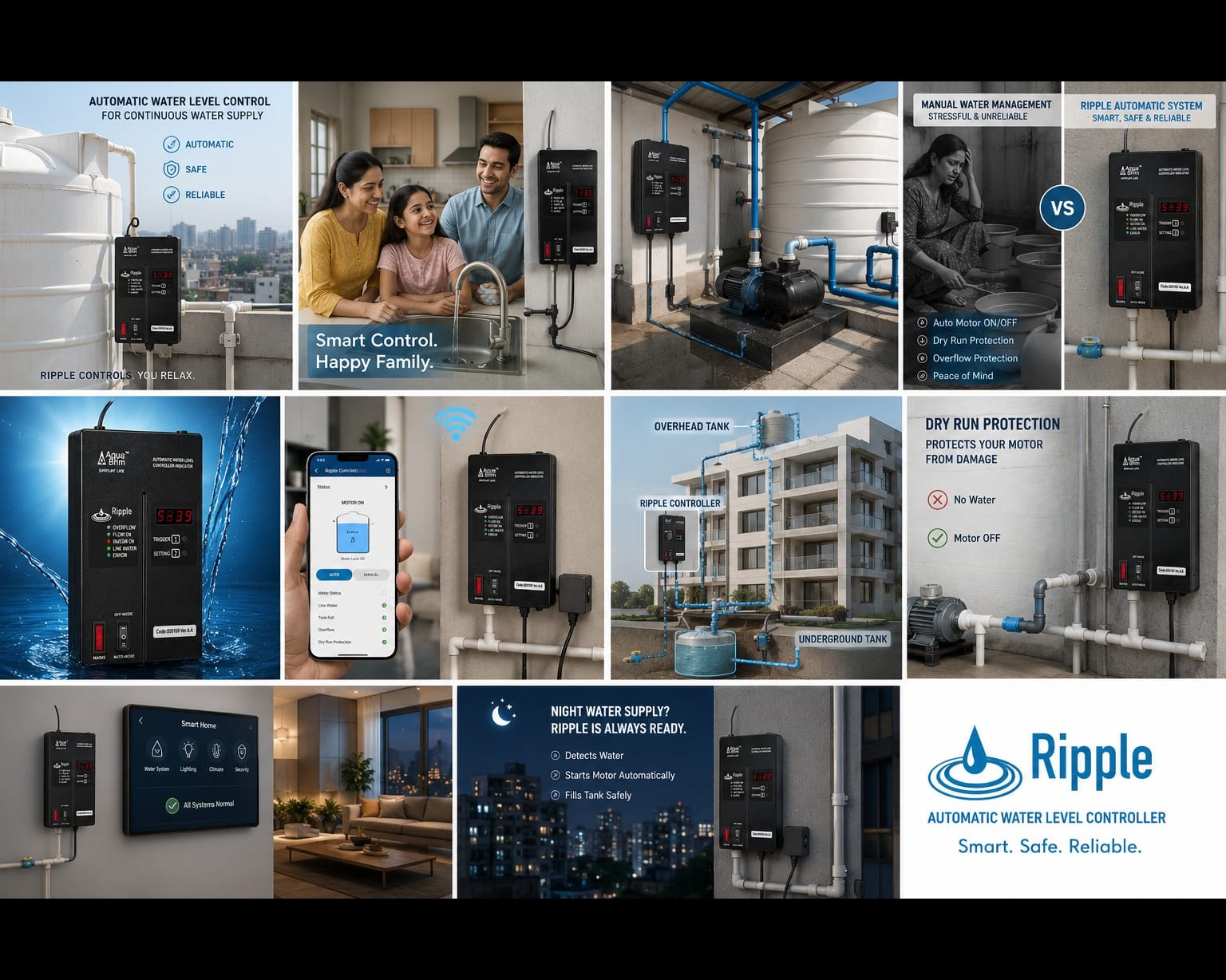
Managing a water tank manually may seem simple—until you forget to switch off the motor, miss the municipal water supply, or discover that your pump has been running without water. These everyday problems can lead to water wastage, inconvenience, and potential motor damage.
A Smart Water Level Controller automates this entire process. Instead of manually checking your tank and operating the motor, a smart system continuously monitors water levels and manages the motor automatically.
Aquabrim's water automation solutions are designed for different types of water systems, including municipal water supply, borewell and submersible pumps, underground tanks, overhead tanks, and multi-tank installations.
What Is a Smart Water Level Controller?
A Smart Water Level Controller is an automated system that monitors the water level inside a tank and controls the water pump or motor based on predefined water levels.
When the water level drops, the system can automatically start the motor. When the tank reaches the required level, it switches the motor off. Depending on the system and water source, it can also detect water availability and prevent the motor from running when there is insufficient water.
Modern smart controllers can use wireless sensor technology, eliminating the need for wiring between the water tank and the controller in many installations. Aquabrim's systems, for example, use wireless technology to monitor tank levels and automate motor operation.
How Does a Smart Water Level Controller Work?
The basic operation involves three important functions:
1. Monitoring the Water Level
Sensors installed in the water tank monitor the available water level and send this information to the controller.
2. Controlling the Motor
When the water level reaches a low point and water is available, the controller can automatically start the motor to refill the tank.
3. Stopping the Motor at the Right Time
Once the tank reaches the required capacity, the controller switches the motor off to help prevent overflow and unnecessary water wastage.
For systems connected to municipal supply, Aquabrim's Trigger can also detect when water arrives in the supply line and automate the pumping process. For borewell and submersible pump systems, Aquabrim's Macro monitors the water system and helps protect the motor from dry-run conditions.
Why Upgrade to a Smart Water Level Controller?
A smart controller can solve several common water management problems.
Prevent Water Tank Overflow
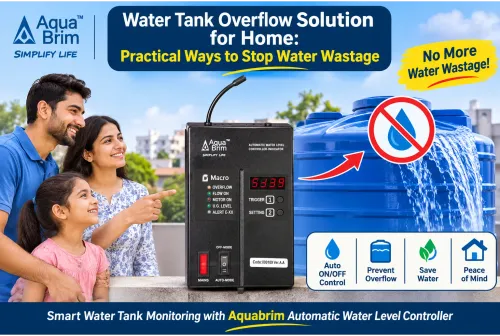
One of the biggest advantages of automation is that the motor can stop automatically when the tank reaches the configured full level.
This reduces the need for someone to constantly check the tank or remember to switch off the motor.
Protect the Motor From Dry Running
A motor running without sufficient water can be at risk of damage. Smart water automation systems can detect relevant low-water or supply conditions and stop motor operation accordingly.
Aquabrim lists dry-run motor protection as a key feature across its smart water automation solutions.
No More Manual Tank Checking
With automated monitoring, homeowners no longer need to repeatedly climb to the rooftop or manually inspect the tank.
The system monitors water levels continuously and manages the motor according to the configured operating logic.
Better Management of Irregular Water Supply
In many locations, municipal water may arrive at unpredictable times. Missing the supply can mean waiting until the next cycle.
Aquabrim's Trigger is designed specifically for municipal or corporation water supply and can detect incoming water and automatically manage the motor and tank filling process.
Wireless Installation
Traditional water level controllers may require wiring between the tank, sensors, and motor controller.
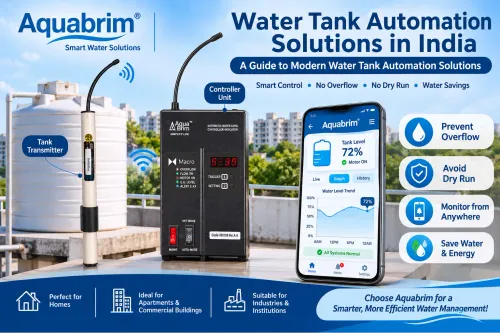
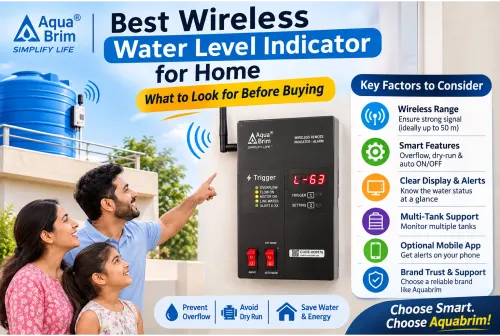
Wireless technology can simplify installation by allowing sensors and controllers to communicate without running tank-to-controller wiring. Aquabrim's Trigger and Macro use RF-based wireless sensor technology for this purpose.
Types of Smart Water Level Controllers
Not every property has the same water setup. The right Smart Water Level Controller depends on where the water comes from and how many tanks or motors need to be managed.
Smart Controller for Municipal Water Supply
Homes dependent on municipal or corporation water need a system that can detect when water becomes available.
Aquabrim's Trigger is designed for this setup. It detects water in the municipal supply line, starts the motor when appropriate, monitors the tank, and stops the motor when the required level is reached. It also includes features such as dry-run protection and wireless sensor communication.
Smart Controller for Borewell and Submersible Pumps
Homes and buildings using borewells or submersible pumps have different requirements.
Aquabrim's Macro is designed for borewell and submersible pump automation. It monitors relevant water levels and can automatically control the motor while helping prevent dry-run damage and tank overflow.
Multi-Tank Water Level Controller
Large buildings, commercial properties, and institutional facilities may have several overhead and underground tanks.
Aquabrim's MATRIX is designed for multi-tank automation and can monitor and control multiple tanks, with support for features such as dual motor control, programmable timers, wireless RF technology, and BMS integration via MODBUS.
Smart Water Level Controller Features to Look For
Before choosing a water automation system, consider the following features:
Automatic motor ON/OFF
Real-time water level monitoring
Tank overflow prevention
Dry-run motor protection
Wireless sensor technology
Municipal water supply detection
Underground and overhead tank compatibility
Multi-tank support
Manual override options
Digital level display
Alerts and notifications
Remote monitoring and control
Timer or scheduling features
Aquabrim's broader product ecosystem includes app-based remote control, smart scheduling, real-time alerts, wireless sensor technology, and monitoring through web and mobile platforms, depending on the solution and configuration.
Can You Control Your Water System Remotely?
Smart water management is moving beyond simple automatic switching.
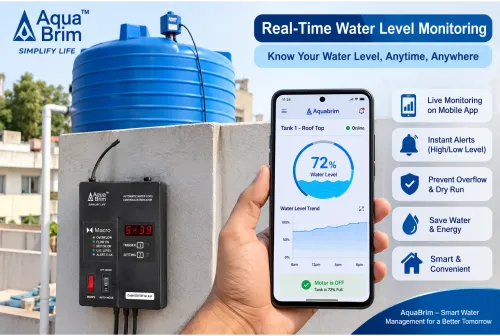
Aquabrim provides a smart web and mobile platform that allows users to monitor water levels, motor performance, tank conditions, and system notifications remotely. This can make water management easier for homeowners and facility managers who want greater visibility into their systems.
Choosing the Right Smart Water Level Controller
The best controller depends primarily on your water source and system design.
Choose a Municipal Water Controller If:
Your home receives corporation or municipal water.
Water supply arrives at irregular times.
You often miss the water supply.
You want automatic detection of incoming water.
Choose a Borewell or Submersible Pump Controller If:
Your water comes from a borewell.
You use a submersible pump.
Water is pumped from an underground tank to an overhead tank.
Motor dry-run protection is an important requirement.
Choose a Multi-Tank Controller If:
Your building has multiple overhead tanks.
You manage a commercial or institutional water system.
Multiple motors or automated valves need to be controlled.
You require centralized monitoring.
Aquabrim offers different solutions for these setups, including Trigger for municipal water supply, Macro for borewell and submersible pump automation, and MATRIX for multi-tank water management.
Why Smart Water Management Matters
Water management should not depend entirely on memory.
Forgetting to switch off a motor can cause overflow. Missing an irregular water supply can leave a tank empty. Running a motor without sufficient water can create avoidable equipment problems.
A Smart Water Level Controller helps automate these repetitive tasks by continuously monitoring the system and responding automatically.
For homes, this means less manual effort. For apartments, commercial buildings, and institutions, automation can provide more consistent monitoring and better operational control.
Aquabrim states that its water automation systems are used across residential, commercial, and institutional installations and offers solutions for different water management requirements.
Frequently Asked Questions About Smart Water Level Controllers
1. What is a Smart Water Level Controller?
A Smart Water Level Controller is an automated device that monitors water levels and controls a motor or pump based on the water level and system conditions.
2. How does a Smart Water Level Controller prevent overflow?
The system monitors the water level while the tank is filling and automatically stops the motor when the tank reaches the configured full level.
3. Can a Smart Water Level Controller protect a motor from dry running?
Yes, compatible smart water automation systems can detect relevant low-water or supply conditions and stop the motor to help prevent dry-run damage. Aquabrim includes dry-run protection in solutions designed for municipal and borewell applications.
4. Does a Smart Water Level Controller work with an overhead tank?
Yes. Smart water level controllers can monitor and automate filling of overhead tanks. Aquabrim's solutions are designed for overhead tanks as well as other water storage configurations.
5. Can it work with municipal water supply?
Yes. Controllers designed specifically for municipal supply can detect when water arrives and automate the pumping process. Aquabrim's Trigger is designed for municipal and corporation water supply systems.
6. Can it be used with a borewell or submersible pump?
Yes. A suitable controller can automate borewell and submersible pump operations. Aquabrim's Macro is specifically designed for these applications.
7. Does a Smart Water Level Controller require wiring between the tank and controller?
Not always. Wireless systems can allow sensors and controllers to communicate using RF technology, reducing or eliminating the need for tank-to-controller wiring.
8. Can I monitor my water tank remotely?
Depending on the system, yes. Aquabrim offers web and mobile monitoring capabilities for viewing water levels, motor status, tank conditions, and system notifications remotely.
9. Can one controller manage multiple water tanks?
Yes. Multi-tank controllers are designed for larger installations where several tanks need to be monitored and managed from a centralized system. Aquabrim's MATRIX supports multi-tank automation.
10. Is a Smart Water Level Controller better than a manual motor switch?
For users who want to reduce manual intervention, a smart controller offers automated monitoring and motor operation. It can also provide additional functions such as overflow prevention, dry-run protection, wireless monitoring, and alerts, depending on the system.
11. What is the difference between a float switch and a Smart Water Level Controller?
A basic float switch is primarily used to detect a water level. A Smart Water Level Controller can provide broader automation by combining water level monitoring with motor control and, depending on the system, features such as wireless communication, dry-run protection, alerts, scheduling, and remote monitoring.
12. Which Smart Water Level Controller is right for my home?
The right solution depends on your water source and system setup. Municipal water users may need a supply-detection solution such as Trigger, while borewell or submersible pump users may need a solution such as Macro. Properties with multiple tanks may require a multi-tank controller such as MATRIX.