
What Is an Automatic Underground to Overhead Water Pump System?
An Automatic Underground to Overhead Water Pump System is a water automation setup that automatically transfers water from an underground tank or water source to an overhead tank using a pump.
Instead of manually checking both tanks and switching the motor ON and OFF, an automatic controller monitors the water levels and operates the pump according to predefined conditions.
A typical system looks like:
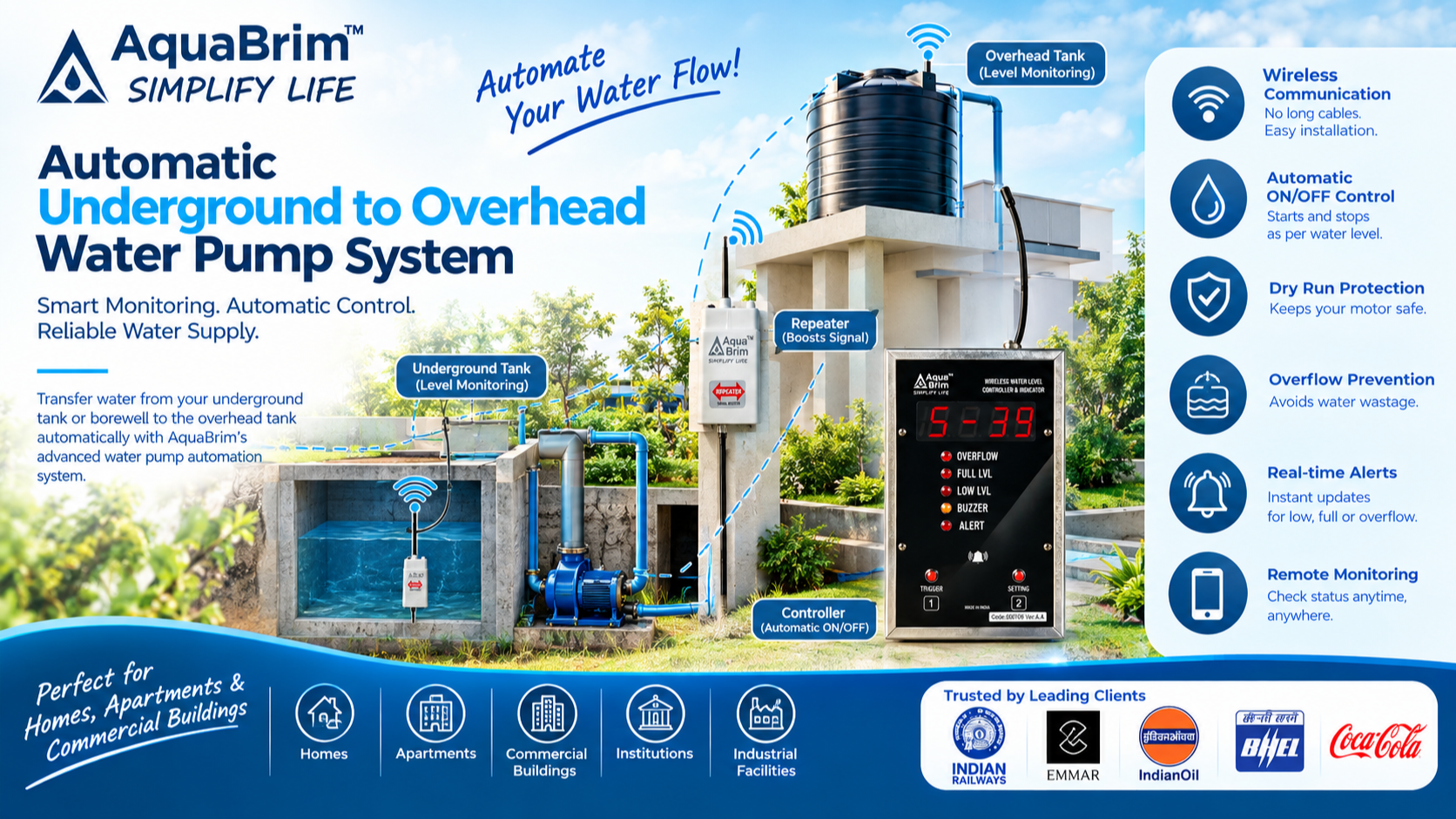
Borewell / Water Source → Underground Tank → Pump → Overhead Tank
AquaBrim's Macro is specifically designed for borewell and submersible pump automation and for transferring water from an underground source to an overhead tank. It uses RF-based wireless sensors to monitor both water-source and overhead-tank levels.
Why Is Underground to Overhead Water Pump Automation Important?
In many homes, apartments and commercial buildings, water is stored in an underground tank before being pumped to an overhead tank.
With a conventional system, someone may need to:
- Check the underground tank.
- Check the overhead tank.
- Switch the pump ON.
- Monitor the filling process.
- Switch the motor OFF when the tank is full.
- Check whether sufficient water remains at the source.
This becomes inconvenient when the pump is located far from the tank or when nobody is available to operate the motor.
An automatic system can continuously monitor the relevant water levels and operate the pump according to the configured conditions. AquaBrim Macro is designed for this type of underground-to-overhead automation.
How Does an Automatic Underground to Overhead Water Pump System Work?
The basic operating cycle is:
Underground Water Source → Water-Level Monitoring → Pump ON → Overhead Tank Filling → Pump OFF
Step 1: Monitor the Underground Water Source
A wireless transmitter monitors the water available in the underground tank or borewell.
Step 2: Monitor the Overhead Tank
Another wireless transmitter monitors the water level in the overhead tank.
Step 3: Detect a Low Overhead-Tank Level
When the overhead tank reaches the configured low level, the controller determines that additional water is required.
With AquaBrim Macro, the published specification states that the motor automatically starts when the overhead tank falls below 50%.
Step 4: Start the Pump
The controller switches ON the connected borewell or submersible pump.
Step 5: Continue Monitoring
While water is being transferred, the system continues monitoring the underground source and overhead tank.
Step 6: Stop the Pump
When the overhead tank reaches the required full level, the motor switches OFF.
The controller can also stop the motor when a configured dry-run condition occurs.
Automatic Underground to Overhead Water Pump System Without Long Sensor Wires
One of the major advantages of a wireless automation system is that communication between the tank sensors and controller can take place through RF technology.
AquaBrim Macro uses RF-based wireless sensor technology, eliminating the need for wiring between the underground/overhead tanks and controller.
This can be particularly useful when:
- The overhead tank is on the roof.
- The underground tank is at ground or basement level.
- The motor is located away from the tanks.
- The building is already constructed.
- Installing long sensor cables would be inconvenient.
- Multiple tanks need to be monitored.
AquaBrim's installation guide also describes wireless transmitter installation for underground and overhead tanks without signal wiring.
Key Features of an Automatic Underground to Overhead Water Pump System
1. Automatic Motor ON/OFF
The system can automatically start and stop the pump based on configured water levels.
2. Underground Water Monitoring
Monitoring the water source helps determine whether sufficient water is available for pumping.
3. Overhead Tank Monitoring
The controller can monitor the overhead tank and start the pump when the water level becomes low.
4. Dry-Run Protection
If the underground source becomes too low, the controller can stop the motor rather than allowing it to continue operating without sufficient water.
5. Overflow Prevention
Stopping the pump when the overhead tank reaches its required level helps reduce unnecessary overflow.
6. Wireless RF Communication
Wireless communication removes the need for long sensor cables between tanks and the controller.
7. Digital Level Display
AquaBrim Macro provides a 4-digit digital display along with LED indicators for system conditions.
8. Multi-Tank Support
Additional wireless sensors can be used where more than one overhead tank needs to be monitored, subject to the system configuration.
9. Manual Trigger
Although the system is designed for automatic operation, Macro also provides a manual trigger function.
10. Flow Monitoring Option
AquaBrim lists an optional flow sensor for Macro installations.
Dry-Run Protection in Underground to Overhead Pump Automation
Dry running occurs when a pump operates without sufficient water at its source.
This is particularly relevant to:
- Borewell pumps
- Submersible pumps
- Underground tanks
- Water sources with fluctuating levels
AquaBrim Macro monitors the underground/source water along with the overhead tank.
According to AquaBrim's current product specifications, Macro can stop the motor when the underground level falls below 20% or when water flow is interrupted for more than 2 minutes. It can restart when the underground level recovers to 30% or above, according to its operating logic.
This creates an automated protection cycle:
Low OH Tank → Motor ON → Source Monitoring → Water Available → Continue Pumping
or
Low OH Tank → Motor ON → Source Too Low → Motor OFF
Automatic Underground to Overhead Water Pump System for Borewell
Borewell installations can benefit significantly from source-level monitoring because the availability of water at the borewell can change.
AquaBrim Macro is designed for borewell and submersible pump automation. It can work with an underground tank or directly with a borewell, depending on the installation. AquaBrim states that when Macro is used purely for borewell automation, an underground-tank transmitter may not be required.
A typical borewell automation setup is:
Borewell → Submersible Pump → Overhead Tank
The controller monitors the overhead tank and source conditions before and during pumping.
Automatic Underground Tank to Overhead Tank Filling
For buildings using an underground storage tank, the setup may look like:
Municipal/Borewell Water → Underground Tank → Pump → Overhead Tank
The automation system can coordinate the two storage levels.
For example:
- Overhead tank level falls.
- Controller detects the low level.
- Pump starts automatically.
- Water moves from the underground tank to the overhead tank.
- Source water continues to be monitored.
- Pump stops when the overhead tank is full.
- Pump can stop earlier if a dry-run condition is detected.
AquaBrim describes Macro as specifically intended for underground-to-overhead water transfer.
Manual vs Automatic Underground to Overhead Pumping
| Manual Pump Operation | Automatic Pump System |
|---|---|
| User checks tank levels | Sensors monitor water levels |
| Motor switched ON manually | Motor can start automatically |
| User must monitor filling | Controller monitors tank level |
| Motor may be left running | Automatic full-level shutdown |
| Source water may be overlooked | Source-level monitoring available |
| Dry-run detection depends on user | Dedicated dry-run protection on compatible systems |
| More manual intervention | Reduced manual intervention |
| Long sensor wiring may be required in wired systems | RF communication can eliminate tank-to-controller signal wiring |
Automation does not remove the need for correct electrical installation and appropriate pump/controller configuration, but it can significantly reduce routine manual operation.
Benefits of an Automatic Underground to Overhead Water Pump System
Reduced Manual Intervention
The controller handles routine motor operation based on water-level conditions.
Prevents Unnecessary Overflow
The motor can automatically stop when the overhead tank reaches its configured level.
Helps Protect the Pump
Source-level monitoring and dry-run protection can stop the motor when insufficient water is detected.
Wireless Installation
RF-based communication can eliminate long signal cables between tanks and the controller.
Better Water-Level Visibility
Digital displays and indicators can provide information about tank and motor conditions.
Suitable for Different Properties
Underground-to-overhead automation can be used in:
- Independent homes
- Apartments
- Residential societies
- Commercial buildings
- Hotels
- Institutions
- Other properties using underground and overhead water storage
AquaBrim states that Macro is suitable for homes, apartments and commercial buildings.
When Should You Consider Underground to Overhead Pump Automation?
An automatic system can be particularly useful when:
- The overhead tank frequently runs low.
- The motor is operated manually every day.
- The rooftop tank is difficult to access.
- The underground tank and overhead tank are far apart.
- The building uses a borewell or submersible pump.
- Pump dry-running is a concern.
- Water overflow is a recurring problem.
- You want to reduce routine motor switching.
- You need wireless tank-level monitoring.
AquaBrim Macro for Underground to Overhead Water Automation
AquaBrim Macro is designed specifically around underground-source-to-overhead-tank water automation.
Its published features include:
- Borewell and submersible pump compatibility
- Automatic motor ON/OFF
- Underground water monitoring
- Overhead tank monitoring
- RF wireless technology
- Dry-run protection
- Overflow prevention
- Multi-tank support
- Digital level display
- LED indicators
- Manual trigger
- Optional flow sensor
- Fuse protection
The system therefore combines water-level monitoring, pump automation and source protection rather than simply functioning as a motor switch.
Frequently Asked Questions — Automatic Underground to Overhead Water Pump System
1. What is an Automatic Underground to Overhead Water Pump System?
It is an automated water-transfer system that monitors an underground water source and overhead tank and operates a pump to transfer water between them according to configured water levels.
2. How does an underground to overhead automatic pump system work?
The system monitors the underground/source water and overhead tank. When the overhead tank reaches its low-level condition, the controller starts the pump. When the required level is reached, the controller stops the motor.
3. Can this system be used with a borewell pump?
Yes. AquaBrim Macro is specifically designed for borewell and submersible pump automation and can transfer water from a borewell or underground source to an overhead tank.
4. Does the system require wiring between the underground and overhead tanks?
No. AquaBrim Macro uses RF wireless sensor technology, so communication between the tank sensors and controller does not require signal wiring between the tanks and controller.
5. Can it automatically start the motor when the overhead tank is low?
Yes. AquaBrim's Macro specification states that the motor automatically starts when the overhead tank falls below 50%.
6. Can it stop the motor when the overhead tank is full?
Yes. The controller automatically stops the motor when the overhead tank reaches the required full level, helping prevent unnecessary pumping and overflow.
7. Does an underground to overhead pump system provide dry-run protection?
A suitable automated system can provide dry-run protection. AquaBrim Macro monitors the underground/source water and can stop the motor if the underground level falls below 20% or if water flow is interrupted for more than two minutes.
8. Can Macro work directly with a borewell instead of an underground tank?
Yes. AquaBrim states that Macro can be connected directly to a borewell or submersible pump. When used purely for borewell automation, the underground tank transmitter is not required.
9. Can one system monitor multiple overhead tanks?
Yes, depending on the installation. AquaBrim Macro supports additional wireless sensors for multi-tank applications, allowing connected tank levels to be monitored by the controller.
10. Which AquaBrim product is suitable for underground to overhead water pump automation?
AquaBrim Macro is the product specifically designed for borewell, submersible and underground-source-to-overhead-tank automation. The appropriate configuration depends on the water source, pump type, number of tanks and installation requirements.