
Wireless vs. Wired Water Level Controllers: Which Is Better?
Managing your home's water supply shouldn't require constant monitoring of overhead tanks, underground sumps, and water pumps. A water level controller helps automate this process, reducing manual effort and helping prevent water overflow.
When choosing a water automation system, one important decision is whether to install a wired or a wireless water level controller.
Both technologies can help monitor water levels and automate pump operation. However, they differ in installation requirements, communication methods, flexibility, and suitability for different buildings.
In this guide, we'll compare wireless and wired water level controllers to help you decide which option is right for your home, apartment, or commercial property.
What Is a Wireless Water Level Controller?
A wireless water level controller monitors water levels using sensors that communicate with a controller through a wireless signal, such as radio frequency (RF).
Instead of running signal cables between the water tank and the controller, wireless systems transmit water-level information through the air.
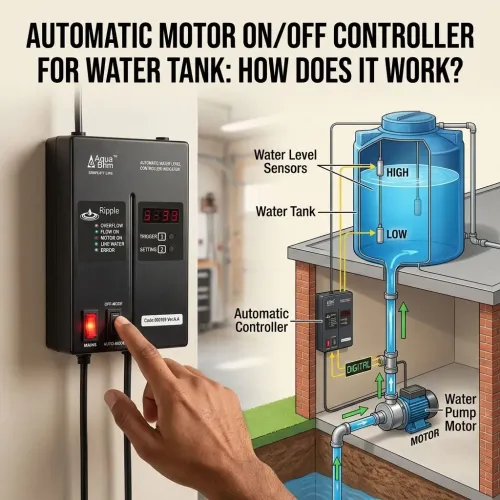
Depending on the model, the controller can automatically switch a connected pump on when water is required and off when the tank reaches its configured level.
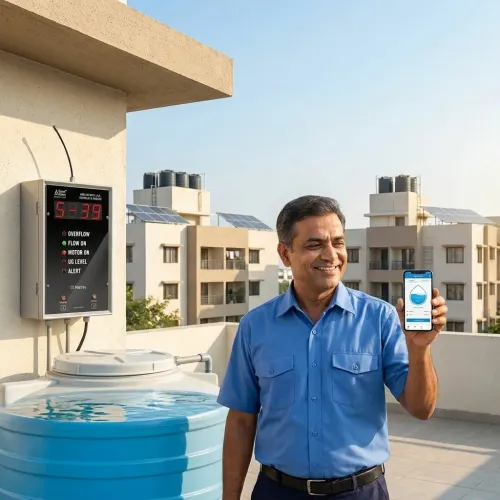
Some advanced systems also offer features such as underground tank monitoring, dry-run protection, overflow prevention, and remote monitoring.
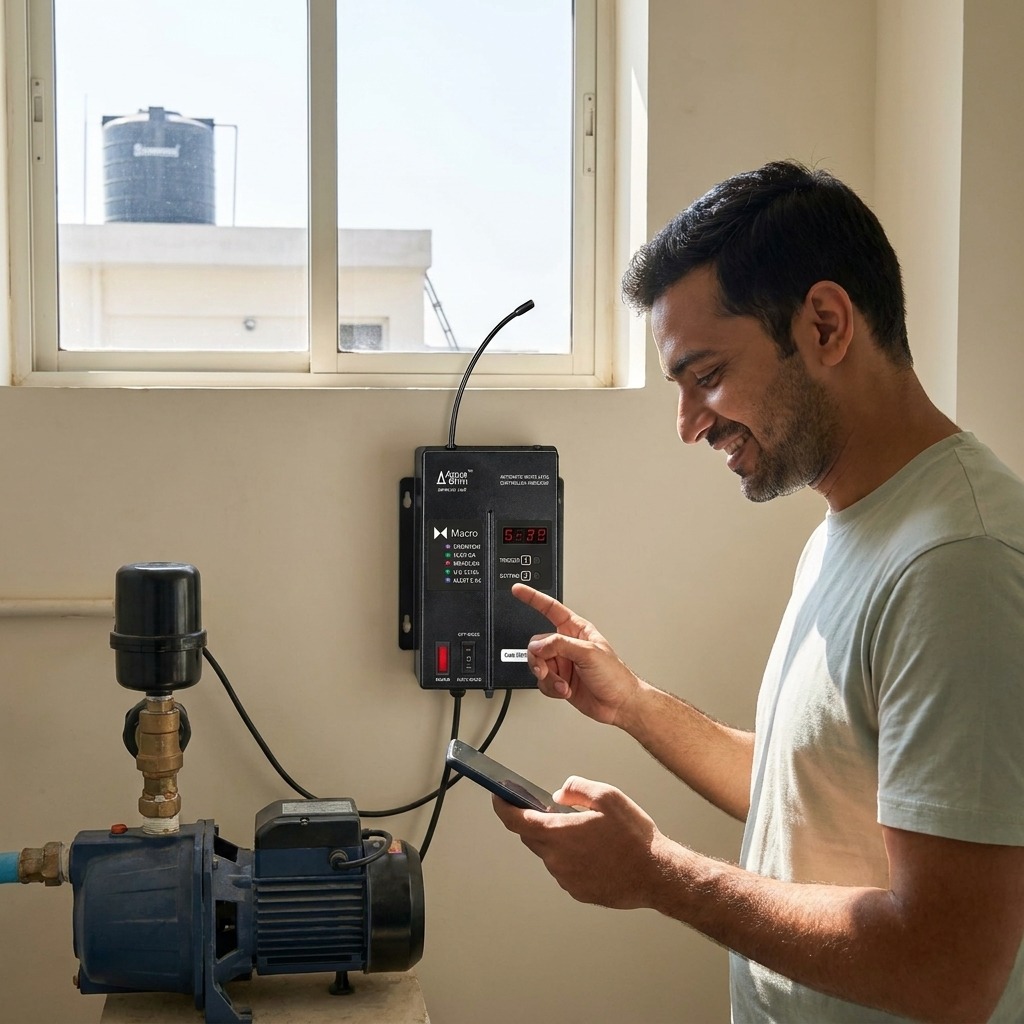
For example, Aquabrim's Macro wireless water level controller is designed to automate water transfer from an underground tank or borewell to an overhead tank. It uses wireless sensors to monitor water levels and manage pump operation automatically.
What Is a Wired Water Level Controller?
A wired water level controller uses electrical cables to connect its sensors to the control unit.
When the water reaches a particular level, the sensor communicates this condition through the wired connection. The controller then operates the connected pump according to its settings.
Wired systems can be suitable for buildings where the tank, sensors, and controller can be connected conveniently.
However, installations involving rooftop tanks, underground sumps, multiple storage tanks, or long distances may require additional cable routing.
The overall installation effort depends on the building layout, sensor arrangement, and controller design.
Key Difference:
1. Installation: Which System Is Easier to Install?
Installation is one of the main differences between wireless and wired water level controllers.
Wireless Controllers
A wireless system can eliminate the need to run signal cables between the tank sensors and the controller.
This can be particularly useful when the overhead tank is on the rooftop while the pump and controller are installed on a lower floor.
It may also simplify installations in existing buildings where running new cables would require additional work.
However, the controller still needs the appropriate electrical connections to operate the pump. Wireless communication does not mean the entire installation is wire-free.
Wired Controllers
A wired system requires suitable cables between the sensors and the controller.
If the tanks and controller are close together, this arrangement may be straightforward. In larger buildings, routing and securing the cables can require additional effort.
Verdict: Wireless systems can offer an installation advantage when running sensor cables is difficult or inconvenient.
2. Reliability: Which Technology Is Better?
Reliability is essential because the controller manages an important part of your home's water supply.
Wireless Systems
Wireless controllers depend on communication between the sensors and the controller.
Their performance can be affected by the distance between devices, building materials, interference, and installation conditions.
Choose a product with a suitable communication range and follow the manufacturer's installation recommendations.
Wired Systems
Wired systems communicate through physical cables, so they do not depend on a wireless signal for sensor communication.
However, damaged cables, loose connections, moisture, or installation problems can affect their performance.
Verdict: Both systems can perform reliably when properly designed and installed. Choose a wireless controller with suitable range and signal performance for your building.
3. Flexibility for Multiple Tanks
Some homes and commercial buildings use several water storage tanks.
For example, a property may have an underground sump that supplies water to multiple overhead tanks.
In such cases, the controller must be capable of monitoring the required tanks and supporting the intended pump-control arrangement.
Wireless controllers can reduce the need for extensive sensor communication wiring, making them attractive for installations where tanks are separated.
Wired systems can also support multiple tanks when the controller is designed for that purpose and the required cabling is feasible.
Before purchasing either type, verify the maximum supported number of tanks and the controller's operating logic.
Verdict: Wireless technology can simplify sensor connectivity, but the controller's actual multi-tank capabilities are more important than the communication method alone.
4. Water Overflow and Pump Protection
Whether you choose a wired or wireless water level controller, check the available automation and protection features.
Important features include:
- Automatic pump ON/OFF: Operates the pump according to configured water-level conditions.
- Overflow prevention: Stops the pump when the tank reaches the specified upper level.
- Dry-run protection: Helps prevent the pump from operating without an adequate water supply when the system supports the necessary detection method.
- Low-water monitoring: Helps identify when a tank or water source needs attention.
- Status indicators: Show relevant operating conditions and alerts.
Not every controller includes all these features. Check the specifications of the particular model before making your decision.
Aquabrim's Macro is one option for users who need wireless monitoring of an underground water source and overhead tank, along with automatic pump operation and dry-run protection features.
5. Maintenance and Long-Term Costs
The initial purchase price is only one part of the overall cost of a water level controller.
With wired systems, the condition of sensor cables and electrical connections is an important maintenance consideration.
With wireless systems, maintenance requirements depend on the product design. Battery-powered transmitters, for example, may require battery replacement, while other components may have different servicing needs.
You should also consider installation charges, warranty coverage, replacement parts, and the availability of after-sales support.
Instead of assuming that one technology is always cheaper, compare the total cost of ownership for the specific products you are considering.
Verdict: Choose the system that offers the best balance of reliability, installation convenience, features, and long-term support for your property.
6. Which Water Level Controller Is Better for Your Home?
The right choice depends on your water storage arrangement and installation requirements.
A wireless water level controller may be a good option if:
- Your overhead tank is far from the pump or controller.
- You want to avoid running long sensor cables.
- Your property has multiple tanks in different locations.
- You want a simpler sensor communication arrangement.
- You need water-level automation in an existing building.
A wired water level controller may be suitable if:
- The tank and controller are relatively close together.
- Cable routing is straightforward.
- You prefer a wired sensor communication system.
- The selected product meets your automation requirements.
For either option, ensure the controller is compatible with your pump, tank configuration, and electrical installation.
Why Consider Aquabrim's Wireless Water Level Controllers?
Aquabrim provides wireless water automation solutions for residential and other applications.
Its product range includes solutions designed for different water supply arrangements.
For example:
Aquabrim Macro: Designed for borewell and submersible pump applications, Macro monitors the underground water source and overhead tank using wireless sensors. It automates pump operation and incorporates protection logic for supported installations.
Aquabrim Trigger: Designed for water supplies such as municipal connections, Trigger uses wireless sensing to detect water availability and automate the connected pump according to its operating conditions.
The appropriate model depends on how your property receives and stores water.
Explore the available products on the official Aquabrim website to find a solution that suits your requirements.
Frequently Asked Questions
1. Is a wireless water level controller better than a wired controller?
A wireless controller can simplify installation by eliminating signal cables between supported sensors and the controller. A wired controller may be suitable when cable routing is convenient. The better choice depends on the installation and product specifications.
2. Does a wireless water level controller require electricity?
Yes. The controller generally requires an appropriate power supply to operate. The sensors may use batteries or another power arrangement, depending on the model.
3. Can a wireless water level controller work across different floors?
It can, provided the wireless signal reaches the controller reliably. Actual performance depends on the communication range, building materials, interference, and installation conditions.
4. Can a wireless water level controller prevent tank overflow?
A controller equipped with suitable water-level detection and pump-control functionality can stop the pump when the tank reaches its configured upper level.
5. Can one water level controller monitor multiple tanks?
Some models support multiple tanks using additional compatible sensors. Check the product specifications to confirm the supported number of tanks and the required configuration.
6. Does a wireless controller protect the water pump from dry running?
Some wireless water level controllers offer dry-run protection. The effectiveness of this feature depends on the controller's sensing method, supported configuration, and operating conditions.
7. Which Aquabrim controller should I choose?
The choice depends on your water source and storage arrangement. Aquabrim Macro is designed for borewell and submersible pump applications, while Trigger is designed for applications involving municipal water supply detection. Review the relevant product specifications before choosing.
Conclusion
Both wired and wireless water level controllers can make water management easier by reducing manual pump operation and helping prevent tank overflow.
Wired systems can be practical when cable installation is straightforward. Wireless systems offer an advantage when sensor cables would be difficult or inconvenient to install.
If you want a flexible solution for monitoring water tanks and automating pump operation, a wireless water level controller is worth considering.
Evaluate the product's sensing technology, communication range, pump compatibility, protection features, warranty, and service support before making your decision.
Explore Aquabrim's wireless water automation solutions to find the right option for your home or building.