
Automatic Motor ON/OFF Controller for Water Tank: How Does It Work?
Managing a water tank manually can be a daily inconvenience. Someone has to check the water level, switch on the motor when the tank is empty and remember to switch it off before the water overflows.
This becomes even more difficult when the overhead tank is on the roof, the water supply arrives at irregular hours or the property has multiple tanks.
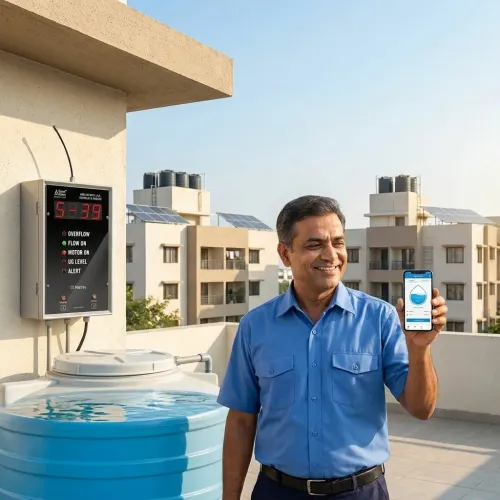
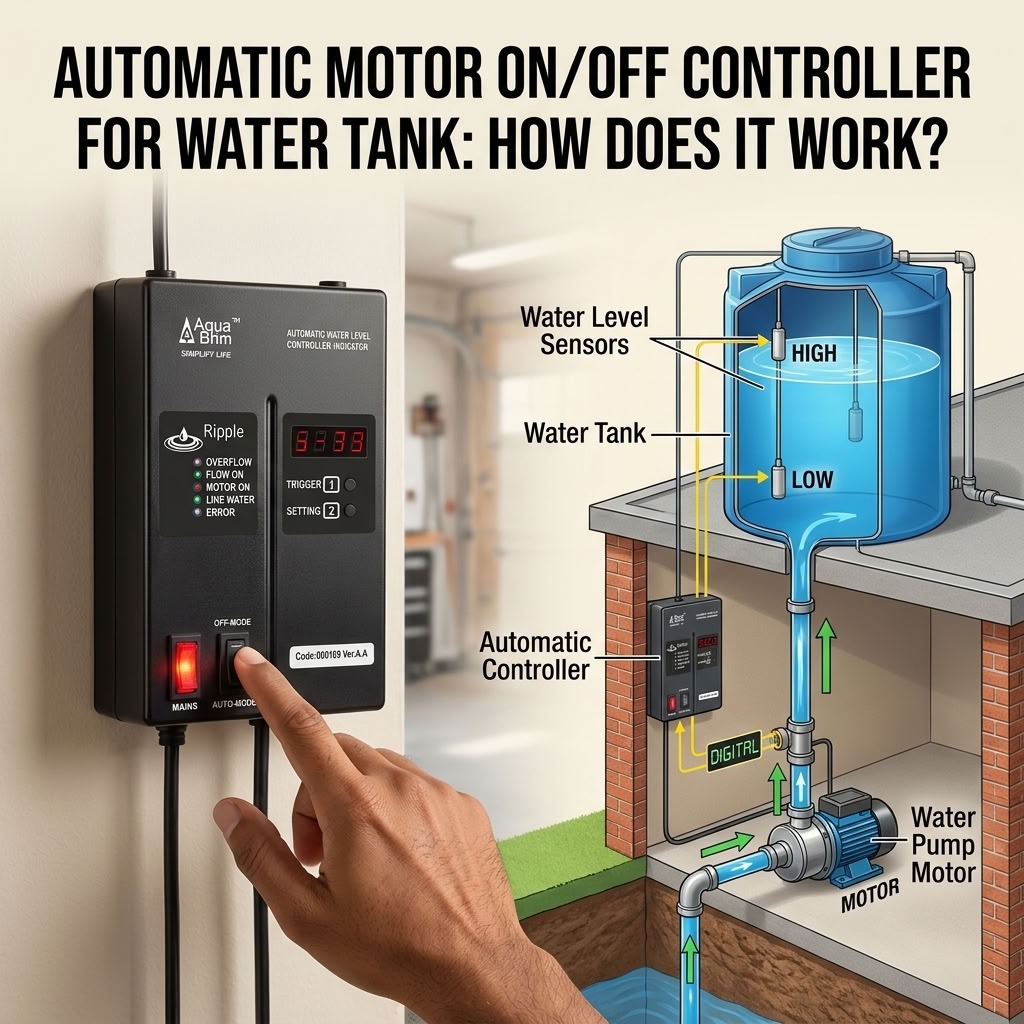
An automatic motor ON/OFF controller for a water tank solves this problem by monitoring water levels and controlling the connected motor automatically. Instead of depending on someone to operate the pump, the system uses sensors and a controller to determine when the motor needs to start and stop.
In this article, we will explain how automatic motor controllers work, what components they use, their benefits and how to choose the right system for your home or building.
What Is an Automatic Motor ON/OFF Controller?
An automatic motor ON/OFF controller is a device that automatically operates a water pump based on the water level in a storage tank and, depending on the system, the availability of water at the source.
The system generally consists of three main components:
- Water-level sensor: Detects the amount of water inside the tank.
- Controller unit: Receives sensor information and decides when the motor should operate.
- Motor connection: Allows the controller to switch the connected water pump ON or OFF.
For example, when the overhead tank reaches a predefined low-water level, the controller can start the motor. As the tank fills, the sensor continuously reports the changing water level. Once the tank reaches its full level, the controller switches the motor OFF.
This process helps reduce manual intervention and the possibility of water overflowing.
How Does an Automatic Motor ON/OFF Controller Work?
The working principle is straightforward:
Water Level Drops → Sensor Detects Low Level → Controller Receives Information → Motor Starts → Tank Fills → Full Level Detected → Motor Stops
Let's understand each step.
1. Water-Level Sensor Monitors the Tank
A sensor is installed inside or near the water tank to monitor its water level.
As the water level changes, the sensor detects the condition and communicates the information to the controller.
In wireless systems, this information is transmitted using radio-frequency communication. This can eliminate the need to run long signal cables between a rooftop tank and the controller.
2. Controller Receives and Processes Information
The controller unit receives information from the water-level sensor.
It evaluates whether the tank needs more water and checks other operating conditions supported by the system, such as water availability in the source tank or supply line.
For example, if the overhead tank is already full, the controller will not start the motor unnecessarily.
3. Motor Starts Automatically
When the water level falls below the configured starting point and the required operating conditions are satisfied, the controller switches ON the connected motor.
The pump begins transferring water from the underground tank, borewell or municipal supply line to the overhead tank.
The exact starting condition depends on the controller model and the type of water source.
4. Water Level Is Monitored During Filling
While the motor is running, the sensor continues monitoring the water level.
The controller receives updated information, allowing it to track the filling process instead of relying only on a fixed running time.
This is particularly useful when water pressure, pump performance or filling time changes.
5. Motor Stops Automatically When the Tank Is Full
When the water reaches the configured full level, the sensor communicates this information to the controller.
The controller then switches OFF the motor.
This helps prevent water from overflowing and avoids unnecessary pump operation.
What Happens If There Is No Water in the Source?
An automatic motor controller can do more than simply detect whether the overhead tank is empty or full.
In suitable systems, it can also monitor the availability of water at the source.
For example, a borewell or underground tank may run low while the motor is pumping water. If the pump continues operating without sufficient water, it can face dry-running problems.
A controller with suitable source-water monitoring and dry-run protection can stop the motor when such a condition is detected.
Aquabrim's Macro controller, for example, monitors both underground and overhead tank levels. According to its published specifications, it starts the motor when the overhead tank falls below 50% and stops it if the underground water level falls below 20% or water flow is interrupted for more than two minutes.
This makes source-water monitoring an important feature to consider when selecting a motor automation system.
Different Types of Automatic Motor ON/OFF Controllers
Not every building has the same water-supply arrangement. A home receiving municipal water has different requirements from a property using a borewell or submersible pump.
Here are some common applications.
1. Controller for Underground-to-Overhead Tank Pumping
This system is suitable for homes and buildings where water is stored in an underground tank and pumped to an overhead tank.
It monitors both tanks and operates the motor according to their water levels.
For example:
- The overhead tank reaches its low-water threshold.
- The controller checks whether sufficient water is available underground.
- The motor starts automatically.
- The overhead tank fills.
- The motor stops when the tank reaches its full level.
Aquabrim's Macro is designed for borewell and submersible-pump applications, including underground-to-overhead tank water transfer.
Explore: Aquabrim Macro – Borewell Water Controller
2. Controller for Municipal Water Supply
Some homes receive municipal water at fixed or irregular times. In such cases, the challenge is not only monitoring the tank but also detecting when water becomes available in the supply line.
A suitable controller can monitor the incoming water supply and start the motor when water is detected, provided the overhead tank requires filling.
Aquabrim's Trigger is designed for municipal and corporation water supply applications. It detects incoming water through a supply-line sensor, starts the connected motor and stops it when the overhead tank reaches the required level.
Explore: Aquabrim Trigger – Municipal Water Controller
3. Controller for Multiple Water Tanks
Large houses, apartments, hotels, schools and commercial buildings may have several overhead tanks.
Manually monitoring every tank can be difficult. A multi-tank automation system can monitor different tanks and help manage the connected pumping arrangement.
For these applications, the controller should be selected according to the number of tanks, motors and the required operating logic.
Explore Aquabrim's product range: Aquabrim Water Automation Products
Benefits of Using an Automatic Motor ON/OFF Controller
Installing an automatic motor controller can make everyday water management easier.
1. Prevents Water Tank Overflow
One of the most important benefits is automatic motor shutdown when the tank reaches its configured full level.
This helps prevent water wastage caused by an unattended running motor.
2. Reduces Manual Work
You no longer need to repeatedly climb to the rooftop or check the tank before operating the motor.
The controller handles the starting and stopping process automatically.
3. Helps Protect the Water Pump
Some automatic controllers include dry-run protection.
These systems can stop the motor when water is unavailable or when specified unsafe operating conditions are detected.
4. Convenient Operation at Any Time
Water may arrive early in the morning, late at night or when nobody is at home.
A suitable automatic controller can respond to water availability and tank conditions without requiring someone to operate the switch manually.
5. Better Water Management
Automatic monitoring helps users understand tank levels and manage available water more effectively.
For buildings with multiple tanks, a suitable multi-tank system can make monitoring considerably easier.
6. Wireless Installation Options
Wireless controllers communicate with tank sensors using radio signals.
This can reduce the need for long sensor cables between the tank and the controller, which is particularly useful in multi-storey buildings.
What Should You Check Before Buying an Automatic Motor Controller?
Before purchasing an automatic motor ON/OFF controller for your water tank, consider the following points.
1. Type of water source: Determine whether your property uses municipal supply, a borewell, a submersible pump or an underground storage tank.
2. Number of tanks: Check whether the system supports your overhead and underground tanks.
3. Motor compatibility: Confirm that the controller is suitable for your motor type and electrical requirements.
4. Dry-run protection: If your water source can become empty or supply can be interrupted, consider a model with suitable dry-run protection.
5. Wireless or wired sensors: Wireless sensors can be useful where running cables between tanks and the controller is inconvenient.
6. Installation and service: Check installation requirements, warranty coverage and after-sales support before making a decision.
7. Monitoring requirements: If you want to check water levels remotely, look for a model that supports app-based or web-based monitoring.
How Aquabrim Makes Water Tank Motor Automation Easier
Aquabrim develops wireless water-level monitoring and automation solutions for residential, commercial and institutional applications.
Its systems are designed to reduce manual motor operation by combining water-level sensors with automatic motor control.
Depending on the application, users can choose solutions for municipal water supply, borewell pumping and multi-tank monitoring.
Some important product options include:
- Macro: Designed for borewell and submersible-pump automation.
- Trigger: Designed for municipal water supply detection and automatic motor control.
- Matrix: Designed for multi-tank water automation applications.
- Flexibell: Designed for wireless water-level indication and alarms; it is a monitoring and alarm product, not an automatic motor ON/OFF controller.
The right product depends on the water source, number of tanks and automation requirements.
Visit the official website: Aquabrim – Wireless Water Level Controllers
Frequently Asked Questions (FAQs)
1. What is an automatic motor ON/OFF controller for a water tank?
It is a device that monitors the water level in a tank and automatically switches the connected water pump ON or OFF according to predefined conditions.
2. How does an automatic water motor controller know when to start?
A sensor monitors the water level. When the level falls below the configured starting point, the controller receives the information and starts the motor if the required operating conditions are satisfied.
3. Does an automatic motor controller stop the motor when the tank is full?
Yes. A suitable automatic controller detects the full-tank condition through its sensor and switches OFF the connected motor.
4. Can an automatic motor controller prevent water tank overflow?
Yes. By monitoring the tank level and stopping the motor when the configured full level is reached, it helps prevent overflow.
5. Does an automatic water motor controller protect against dry running?
Some models include dry-run protection. They can stop the motor when the source tank becomes too low or when water flow is interrupted, depending on the product's features.
6. Can I use an automatic motor controller with a borewell?
Yes. Specific controllers are designed for borewell and submersible-pump applications. Aquabrim Macro is one such option.
7. Does a wireless automatic water level controller require cables between tanks?
Wireless models use radio-frequency communication between the tank sensors and controller. Therefore, they do not require long signal cables between the tanks and controller unit, although electrical connections are still required for the motor and power supply.
8. Can an automatic motor controller work with municipal water supply?
Yes. Certain models are specifically designed to detect municipal water availability and operate the motor accordingly. Aquabrim Trigger is designed for this application.
9. Is an automatic motor controller suitable for apartments?
Yes. Depending on the number of tanks, motors and water sources, suitable systems can be installed in apartments and larger residential buildings.
10. Can I monitor my water tank remotely?
Selected water automation systems support remote monitoring through web or mobile applications. Check the particular model and monitoring configuration before purchasing.
Conclusion
An automatic motor ON/OFF controller makes water tank management easier by monitoring water levels and operating the connected pump automatically.
Instead of manually checking the tank and switching the motor on and off, users can rely on sensors and a controller to manage the filling process. Features such as overflow prevention, source-water monitoring and dry-run protection can make the system even more useful.
Whether you use municipal water, an underground storage tank or a borewell, selecting the right automatic controller can help improve water management and reduce everyday manual work.