
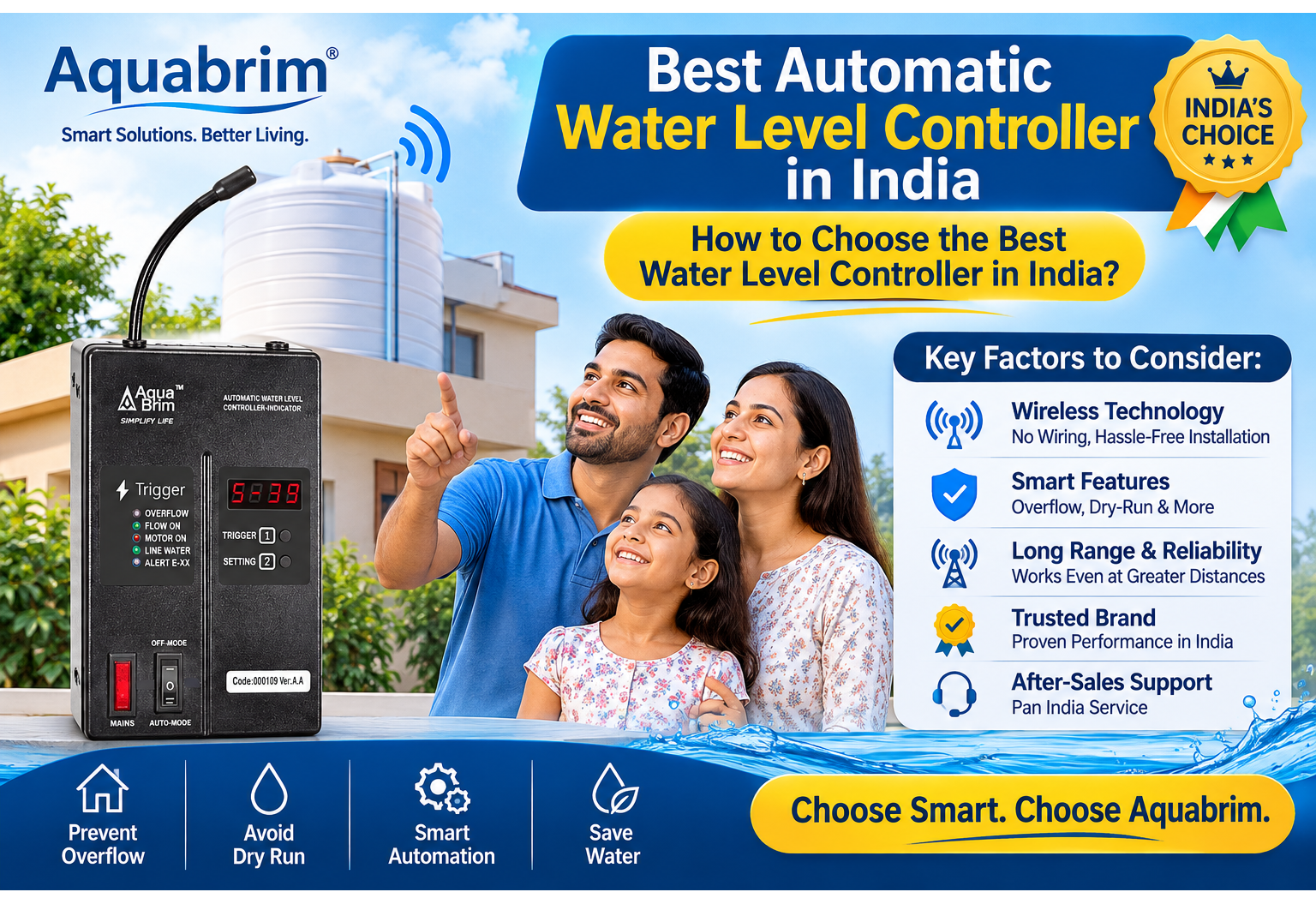
Choosing the best automatic water level controller in India is not simply about finding the cheapest device or the one with the most features. The right controller depends on your water source, tank configuration, motor type, installation requirements, protection features, and whether you need wireless or mobile monitoring.
For a simple home with one overhead tank, a basic automatic controller may be sufficient. A home using a borewell may require dry-run protection. A property with an underground sump and multiple overhead tanks may need a multi-tank controller. And for modern homes or commercial buildings, mobile monitoring can provide additional visibility.
So, before purchasing an automatic water level controller, it is important to understand what your property actually needs.
What Is an Automatic Water Level Controller?
An automatic water level controller is a system that monitors the water level in a tank and automatically controls the connected water pump according to predefined water-level conditions.
Instead of manually switching the pump ON and OFF, the controller can:
- Detect low water levels
- Start the motor when required
- Detect when the tank becomes full
- Stop the motor
- Help prevent tank overflow
- Monitor source-water availability
- Provide dry-run protection on compatible systems
- Provide water-level alerts
- Support wireless monitoring on compatible models
- Provide mobile or web-based monitoring on smart models
The exact functions vary between models, so buyers should always check the specifications of the particular controller rather than assuming every product provides all of these features. Aquabrim
Why Do You Need an Automatic Water Level Controller?
Manual water-pump operation creates several common problems.
Someone has to remember when to switch the motor ON. Then they have to remember to switch it OFF when the tank is full.
If nobody is available, the pump may continue running unnecessarily or the tank may overflow.
In borewell applications, there is another concern: the pump may continue operating when sufficient source water is unavailable.
An automatic controller addresses these situations by allowing the pump to respond to water-level conditions automatically.
The result is a more convenient and systematic water-management process.
10 Factors to Consider When Choosing the Best Automatic Water Level Controller in India
1. Identify Your Water Source
The first question to ask is:
Where does your water come from?
Your property may use:
- Municipal water supply
- Borewell
- Underground sump
- Open well
- Combination of municipal supply and borewell
- Multiple water sources
This is important because different water sources create different automation requirements.
Municipal water supply
If your property depends on municipal water arriving at particular times, the controller may need to detect the availability of water and operate the pump accordingly.
Borewell
A borewell application requires particular attention to source-water availability and dry-run protection.
Underground sump
If water is transferred from an underground sump to an overhead tank, the controller should ideally consider both the source tank and destination tank before operating the pump.
Therefore, do not select a controller before identifying your water source.
2. Check the Number of Tanks
A single-tank installation is very different from a multi-tank property.
For a typical house, you might have:
One underground tank → One overhead tank → One pump
A larger property could have:
Underground sump → Multiple overhead tanks → Multiple pumps
If you have multiple tanks, check the maximum number of tanks the controller can monitor.
You should also check whether the controller can independently manage the required tank levels and motor configuration.
Multi-tank systems may require a dedicated system controller rather than several basic single-tank controllers. Aquabrim
3. Check Your Motor Type and Electrical Rating
This is one of the most important factors.
A water-level controller is connected to a pump or pump-control circuit, so compatibility matters.
Before purchasing, check:
- Motor HP
- Single-phase or three-phase
- Operating voltage
- Current rating
- Pump type
- Starter/panel arrangement
- Whether a contactor is required
- Whether external protection devices are already installed
For larger motors, the controller may operate the pump through an appropriately rated contactor or starter rather than switching the motor directly.
Aquabrim's buying guidance also recommends checking the pump's HP/kW rating, voltage, control method and single-/three-phase compatibility before selecting a controller. Aquabrim
Never select a controller only by looking at its price.
4. Look for Dry-Run Protection
If your pump draws water from a borewell or underground source, dry-run protection becomes particularly important.
A dry-run condition occurs when the pump operates without adequate water available at the source.
A suitable controller/system can detect insufficient source water and stop the pump when the configured protection condition is reached.
When comparing products, don't simply ask:
"Does it have dry-run protection?"
Ask:
"How does the system detect dry running?"
Different systems can use different detection methods, so understanding the actual mechanism is important. GIZMO
For borewell-based homes, this feature can be considerably more important than additional cosmetic features.
5. Check Overflow Protection
One of the primary reasons homeowners install an automatic water level controller is to prevent tank overflow.
A suitable system should detect when the overhead tank reaches its configured full level and stop the pump automatically.
This eliminates the need for someone to stand near the tank waiting for it to fill.
However, make sure you distinguish between:
Water-level indicator
and
Automatic water-level controller
A water-level indicator may only tell you the tank's condition.
An automatic controller should be capable of taking appropriate control action when configured to do so.
6. Decide Between Wired and Wireless
Traditional water-level controllers often require sensor wiring between the tank and the controller.
This can become inconvenient when:
- The tank is on the rooftop
- The motor is on the ground floor
- The building has several floors
- Long cables are difficult to install
- Walls need to be opened
- The distance between the tank and motor is large
Wireless controllers eliminate the physical sensor cable between the tank and controller by using wireless communication.
Aquabrim's buying guide notes that wireless systems can be useful when the overhead tank is far from the motor or when long sensor cables would be inconvenient. Aquabrim
But don't choose wireless based only on the word "wireless."
Check:
- Communication range
- Building structure
- Number of floors
- Walls and concrete
- Possible interference
- Sensor reliability
- Installation environment
The actual installation environment matters when evaluating wireless communication. Aquabrim
7. Consider Mobile Monitoring
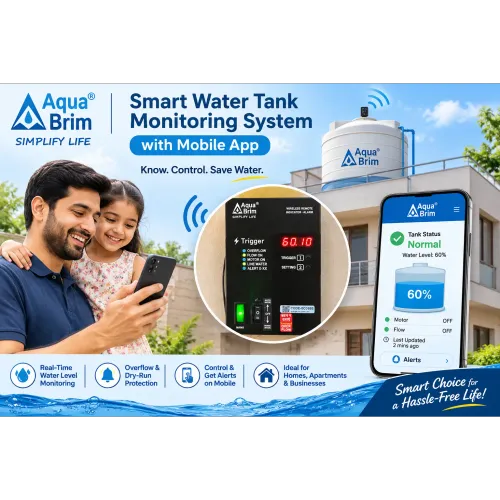
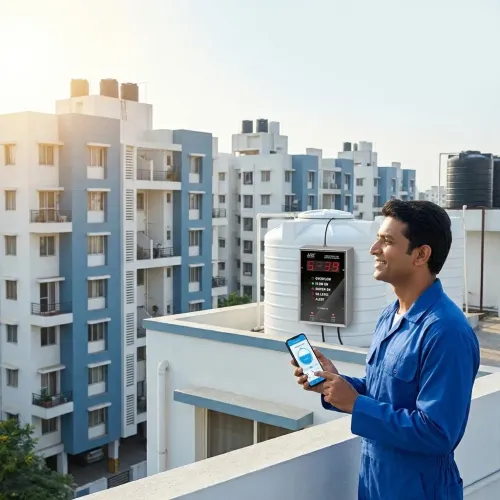
If you want more than automatic pump control, consider a smart water level controller with mobile or web monitoring.
Depending on the product, you may be able to monitor:
- Water level
- Tank status
- Motor status
- Low-water conditions
- Full-tank conditions
- System alerts
- Other connected parameters
This can be particularly useful when you are travelling or when the tank is difficult to access.
However, mobile monitoring should be considered an additional feature—not a replacement for reliable local automation.
The pump should continue to operate according to its local control logic even when internet connectivity is unavailable, where the system is designed for such operation.
8. Check Whether You Need Municipal or Borewell Automation
This distinction is particularly important in India.
For municipal water supply
The controller may need to detect when municipal water becomes available and operate the pump accordingly.
This can be particularly useful where water arrives at irregular or inconvenient times.
For borewell water
The priority may instead be:
- Source-water monitoring
- Dry-run protection
- Overhead tank monitoring
- Automatic motor control
Therefore, the best automatic water level controller for a municipal-supply home may not be the best controller for a borewell home.
The application should determine the product.
9. Consider Multiple Motors and Tanks
If you have a large property, don't purchase a controller designed for a single motor without checking your complete system.
For larger installations, you may need:
- Multiple tank monitoring
- Multiple motor control
- Individual tank-level settings
- Pump sequencing
- Underground tank monitoring
- Overhead tank monitoring
- Valve control
- Remote monitoring
- BMS/MODBUS integration
For example, Aquabrim's Matrix system is designed for multi-tank applications and can support multiple overhead tanks, an underground tank and multiple motors depending on configuration. Aquabrim
For a normal home, however, such a system may be unnecessary.
10. Don't Ignore Installation and After-Sales Support
A water level controller is not simply a device that you plug into a socket.
It interacts with:
- Water-level sensors
- Pumps
- Electrical panels
- Starters
- Contactors
- Tank configurations
- Wireless communication
- Building wiring
Therefore, installation quality matters.
Before buying, ask:
- Who will install the system?
- Is installation included?
- Is site inspection available?
- What is the warranty?
- What happens if the sensor fails?
- Is service available in your city?
- Are replacement parts available?
- Who will troubleshoot the system?
A slightly higher initial price can be worthwhile if the manufacturer provides dependable installation and after-sales support.
Best Automatic Water Level Controller for a Home
For a typical Indian home, start by answering five questions:
Question 1: What is your water source?
Municipal or borewell?
Question 2: How many tanks do you have?
One overhead tank or underground + overhead?
Question 3: What is your pump?
Single-phase, three-phase, submersible, monoblock, etc.
Question 4: Do you need wireless installation?
If running a cable between the tank and pump is difficult, wireless may be more practical.
Question 5: Do you want mobile monitoring?
If you want remote visibility and alerts, consider a connected smart system.
Once these five questions are answered, selecting the appropriate controller becomes much easier.
Aquabrim Automatic Water Level Controller Solutions
Aquabrim offers different water automation solutions for different water-management requirements rather than using one controller for every application.
Trigger – Municipal Water Supply
For homes dependent on municipal water supply, Trigger is designed to detect municipal water availability and automate motor operation according to the system configuration.
This can be useful where water supply arrives at irregular or inconvenient times.
Macro – Borewell and Submersible Pump
For borewell-based homes, Macro is designed to monitor the underground water source and overhead tank while providing automatic motor control and dry-run protection.
This makes it more appropriate for borewell/submersible-pump applications than a basic tank-only controller.
Matrix – Multiple Tanks
For apartments, larger homes, commercial buildings and other multi-tank installations, Matrix provides multi-tank monitoring and automation capabilities.
The system can support multiple overhead tanks, an underground tank and multiple motors depending on the configuration. Aquabrim
Flexibell – Water-Level Monitoring and Alarm
If you primarily need water-level awareness and alerts rather than complete automatic motor control, Flexibell can be considered as a water-level alarm/indicator solution.
The important point is to match the product to the application instead of buying the most feature-rich controller unnecessarily.
Why Aquabrim Can Be Considered When Choosing a Water Level Controller
When comparing automatic water level controllers, consider more than the hardware.
Aquabrim's solutions focus on:
- Wireless water-level sensing
- Automatic motor control
- Tank overflow prevention
- Source-water monitoring
- Dry-run protection on applicable systems
- Multi-tank automation
- Remote monitoring on supported systems
- Application-specific controllers
- Installation and after-sales support
Aquabrim's own buying guide recommends evaluating water source, tank count, wiring feasibility, motor compatibility, dry-run protection, remote monitoring, budget and warranty before selecting a controller. Aquabrim
Common Mistakes When Buying an Automatic Water Level Controller
Choosing Only by Price
The cheapest controller may not provide the protection or compatibility your pump requires.
Buying a Single-Tank Controller for a Multi-Tank System
Multiple tanks and pumps generally require a controller designed for that configuration.
Ignoring the Water Source
A borewell installation has different requirements from a municipal-water installation.
Not Checking Motor Compatibility
Always check the motor's electrical specifications and control arrangement.
Assuming Every Wireless Controller Has the Same Range
Wireless performance depends on the actual building and installation environment.
Confusing Monitoring with Automation
A device that displays the water level is not necessarily capable of automatically controlling the pump.
Ignoring After-Sales Service
A water automation system is useful only when it remains reliable after installation.
Frequently Asked Questions
Which is the best automatic water level controller in India?
There is no single best controller for every application. The right choice depends on your water source, number of tanks, motor type, installation requirements, protection features and monitoring needs.
Which water level controller is best for a borewell?
For a borewell installation, choose a controller that supports the required motor configuration and provides suitable source-water monitoring and dry-run protection.
Which water level controller is best for municipal water?
A controller designed to detect municipal water availability can be useful when the supply arrives at irregular times. Aquabrim Trigger is designed specifically for municipal water supply applications.
Is a wireless water level controller better than a wired controller?
Not necessarily. Wireless is often more convenient where long sensor cables are difficult to install, but the choice should consider communication range, building structure, reliability and installation conditions. Aquabrim
Can an automatic water level controller prevent tank overflow?
Yes, a properly configured automatic controller can stop the pump when the tank reaches the required full level. The exact functionality depends on the controller.
Does an automatic water level controller protect the motor?
Some systems provide dry-run and other motor-related protection, but not every water-level controller does. Check the specific protection features before purchasing.
Can I monitor my water tank from my mobile?
Yes, smart water-level systems can provide mobile or web-based monitoring where the selected model supports connected functionality. Aquabrim
How much does an automatic water level controller cost in India?
The price varies significantly depending on whether you need basic wired control, wireless sensing, dry-run protection, mobile monitoring or multi-tank automation. The complete installed cost can also depend on motor configuration, wiring, sensors and site requirements.
Is a water level controller worth buying?
For homes where pumps are operated manually, an automatic controller can reduce the need for manual switching and help prevent problems such as tank overflow. For borewell systems, suitable source monitoring and dry-run protection can add another important layer of protection.
Conclusion
The best automatic water level controller in India is not necessarily the most expensive or the one with the largest number of features.
The best controller is the one that correctly matches your water source, tank configuration, motor, installation environment and monitoring requirements.
For a simple home, a basic automatic controller may be enough. If wiring is difficult, a wireless controller can be more practical. Borewell users should prioritise source-water monitoring and dry-run protection. Homes wanting remote visibility can consider smart/mobile monitoring. Larger properties may need multi-tank and multi-motor automation.
Before purchasing, therefore, don't ask only:
"Which is the best water level controller?"
Ask:
"Which water level controller is best for my particular water system?"
That question will lead you toward a much better purchase decision.