
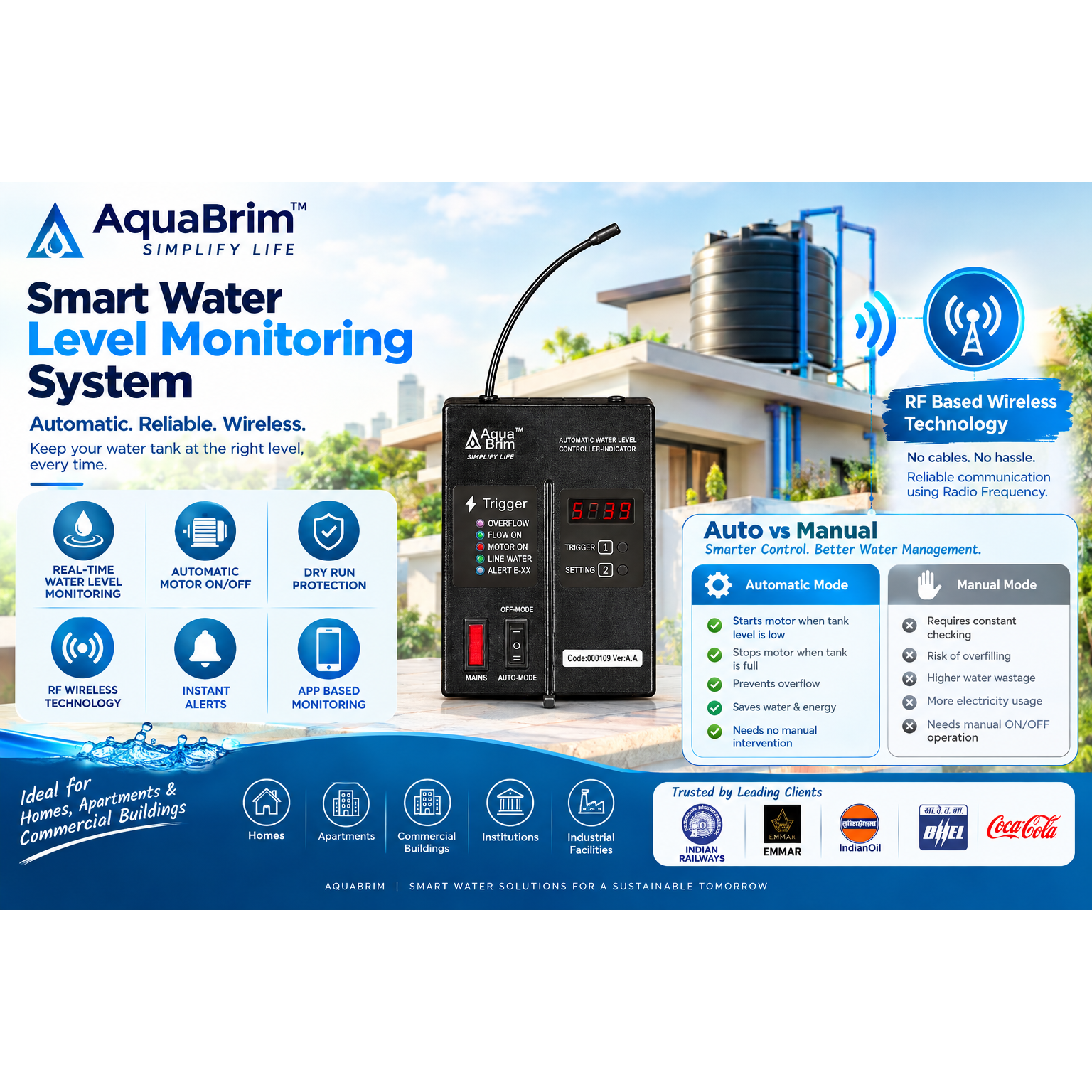
Managing water tanks manually can be inconvenient, especially in homes, apartments, commercial buildings, and institutions with irregular water supply. Someone has to check the tank, start the motor when the water level is low, and remember to switch it off before the tank overflows.
A Smart Water Level Monitoring System automates this process by continuously monitoring water levels and providing real-time information to help manage water efficiently.
AquaBrim's smart water automation solutions combine wireless water-level sensing, automatic motor control, alerts, and remote monitoring to reduce manual intervention and improve water management.
What Is a Smart Water Level Monitoring System?
A Smart Water Level Monitoring System is an automated solution that monitors the amount of water available in one or more tanks and communicates the information to a controller or monitoring platform.
Depending on the configuration, the system can:
- Monitor water levels in real time
- Detect low and full water levels
- Automatically start the water pump
- Automatically stop the motor when the tank is full
- Help prevent tank overflow
- Provide dry-run protection for suitable pump applications
- Send alerts and notifications
- Provide remote monitoring through digital platforms
- Manage multiple tanks
Modern wireless systems can communicate between tank sensors and the controller without requiring cables between the tank and motor panel.
How Does Smart Water Level Monitoring Work?
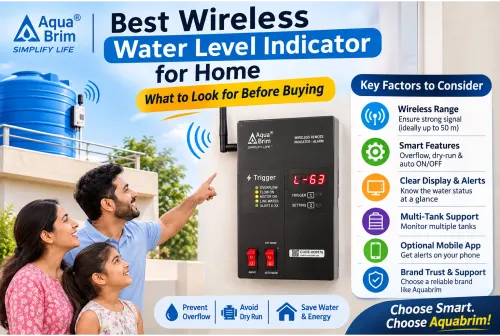
A typical smart water monitoring system consists of a water-level sensor/transmitter, controller, motor connection, and monitoring interface.
1. Water Level Detection
A wireless transmitter installed in the tank measures the water level and sends the information to the controller.
AquaBrim's wireless systems are designed to continuously monitor tank levels and transmit the information using RF technology.
2. Real-Time Monitoring
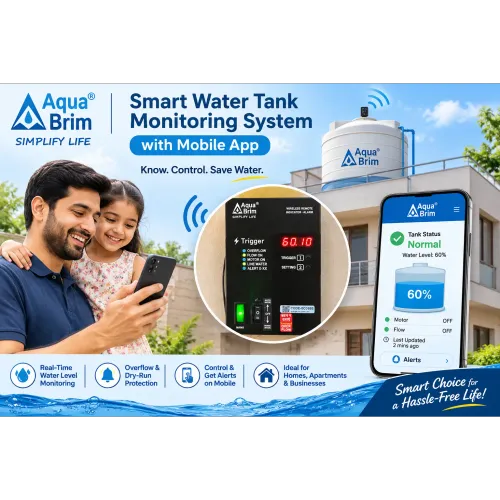
The controller receives the water-level information and displays the current status. Depending on the AquaBrim solution, users can also access monitoring information through digital displays and app/web-based platforms.
3. Automatic Motor Operation
When the water level reaches the configured low-level threshold, the system can automatically start the motor.
When the tank reaches the required level, the system can stop the motor automatically.
4. Alerts and Protection
Smart water automation can identify conditions such as overflow risk, low water availability, or motor-related issues and provide appropriate alerts or protection.
Why Is Smart Water Level Monitoring Important?
Traditional water management depends heavily on people remembering when to check tanks and operate pumps.
This can result in:
- Water tank overflow
- Water wastage
- Unnecessary motor operation
- Motor dry-run risk
- Frequent manual checking
- Difficulty managing multiple tanks
- Lack of visibility when you are away from the property
A smart monitoring system changes this from manual water management to automated water management.
AquaBrim specifically addresses common problems such as overflow, dry-running motors, inconsistent water supply, manual motor switching, and inefficient water monitoring.
Key Benefits of a Smart Water Level Monitoring System
1. Real-Time Water Level Monitoring
Instead of physically visiting the tank, users can monitor the water level through the available display or connected monitoring platform.
This is particularly useful for larger properties and buildings where tanks may be located on rooftops or in underground areas.
2. Automatic Motor ON/OFF
The system can automatically operate the pump according to configured water-level conditions.
This reduces the need for someone to manually switch the motor on and off.
3. Prevents Tank Overflow
When the tank reaches its full-level setting, automatic motor control can stop the pump and help prevent unnecessary water loss.
4. Helps Protect Motors From Dry Run
For borewell and submersible-pump applications, monitoring the source water level can be especially important.
AquaBrim's Macro, for example, monitors underground/borewell conditions and can stop the motor when the source level becomes too low or when flow is interrupted.
5. Wireless Installation
Wireless RF technology eliminates the need for long sensor cables between tanks and the controller in supported AquaBrim systems.
This can make installation cleaner and more practical in existing buildings.
6. Remote Monitoring
Connected AquaBrim solutions provide access to water-level and motor information through digital monitoring platforms, allowing users to stay informed without physically checking the tank.
7. Better Water Management
Continuous monitoring helps users understand water availability and manage pumping more efficiently.
Smart Water Level Monitoring for Different Water Sources
Not every building has the same water supply arrangement. The appropriate automation system depends on the source and number of tanks.
Municipal Water Supply
For municipal water supply applications, AquaBrim Trigger is designed to detect the arrival of municipal water and automatically control the motor for tank filling. It uses wireless communication between the tank sensors and controller.
Borewell and Submersible Pumps
For borewell or submersible-pump applications, AquaBrim Macro monitors the overhead tank as well as the underground/source water conditions and provides automatic motor control and dry-run protection.
Multiple Tanks
For apartments, commercial buildings, and larger installations, AquaBrim Matrix can monitor up to 13 overhead tanks and one underground tank, control up to two motors, and integrate with BMS through MODBUS.
Smart Water Monitoring for Homes and Apartments
A Smart Water Level Monitoring System can be particularly useful in:
- Independent houses
- Villas
- Apartment buildings
- Housing societies
- Commercial buildings
- Hotels
- Hospitals
- Educational institutions
- Industrial facilities
For a single home, the system can automate everyday tank filling. For larger properties, multi-tank solutions can provide centralized monitoring and control.
AquaBrim's product range is designed around different water-management requirements, including municipal supply, borewell systems, and multi-tank installations.
Smart Water Level Monitoring vs Manual Water Management
| Feature | Manual Management | Smart Monitoring System |
|---|---|---|
| Water-level checking | Manual | Automatic |
| Motor starting | Manual | Automatic |
| Motor stopping | Manual | Automatic |
| Overflow prevention | Depends on user | Automated |
| Dry-run protection | Usually limited | Available in suitable systems |
| Remote monitoring | No | Available in connected systems |
| Multiple tank management | Difficult | Supported by suitable systems |
| Daily supervision | High | Much lower |
The major difference is simple: manual systems depend on people, while smart systems use sensors and automation to manage the process.
Why Choose AquaBrim for Smart Water Level Monitoring?
AquaBrim has been developing and installing water automation solutions since 2008. Its current solutions use wireless sensing and automation to address different water-management requirements.
The AquaBrim range includes solutions for:
- Municipal water automation
- Borewell and submersible pump automation
- Multi-tank water management
- Wireless water-level monitoring
- Automatic motor control
- Dry-run protection
- Overflow prevention
- Remote monitoring
- BMS integration
The company's systems are designed to reduce manual water management and provide greater visibility and control over water infrastructure.
Frequently Asked Questions
1. What is a Smart Water Level Monitoring System?
It is an automated system that monitors water levels in tanks using sensors and communicates the information to a controller or monitoring platform. Depending on the system, it can also automatically control the water pump.
2. How does a smart water level monitoring system work?
A sensor measures the water level and sends the information to a controller. Based on configured levels, the controller can start or stop the motor and provide monitoring information.
3. Can a smart water monitoring system prevent tank overflow?
Yes. Systems with automatic motor control can stop the pump when the tank reaches its full-level setting, helping prevent overflow and water wastage.
4. Can it protect a water pump from dry running?
Yes, where the selected system supports dry-run protection. AquaBrim Macro, for example, monitors the source water level and can stop the motor when the underground water level becomes too low.
5. Does AquaBrim use wireless technology?
Yes. AquaBrim's water-level systems use RF wireless technology so tank sensors can communicate with the controller without requiring tank-to-controller wiring.
6. Can I monitor my water tank remotely?
Yes. AquaBrim provides app/web-based monitoring for supported systems, allowing users to view water-related information remotely.
7. Is a Smart Water Level Monitoring System suitable for apartments?
Yes. Smart monitoring can be used in apartments and housing societies. For larger multi-tank installations, AquaBrim Matrix can monitor multiple overhead and underground tanks and control motors according to configured settings.
8. Which AquaBrim controller is suitable for borewell water?
AquaBrim Macro is designed for borewell and submersible-pump applications. It monitors overhead and source/underground water levels and provides automatic motor control and dry-run protection.
9. Which AquaBrim controller is suitable for municipal water supply?
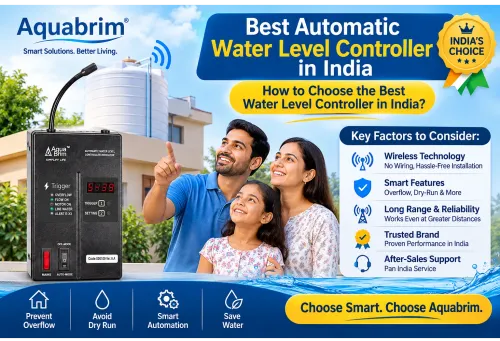
AquaBrim Trigger is designed specifically for municipal/corporation water supply. It detects the arrival of water supply and automatically manages the motor for filling the tank.
10. Can one system monitor multiple water tanks?
Yes. AquaBrim Matrix is designed for multi-tank automation and can monitor up to 13 overhead tanks and 1 underground tank, with control of up to two motors.