
Remote Pump Monitoring System: Monitor Water Pumps and Manage Water Automatically
Managing water pumps manually can become difficult in homes, apartments, commercial buildings, and industrial facilities. Users may need to check tank levels, switch motors on and off, monitor water availability, and ensure that pumps are not running unnecessarily.
These challenges become more complicated when a building has multiple water tanks, underground reservoirs, or an irregular municipal water supply.
A Remote Pump Monitoring System helps users monitor water-system conditions without having to check the pump or tank physically every time. Depending on the system's capabilities, it can provide water-level information, motor status, alerts, and remote access to water automation controls.
AquaBrim offers wireless water-level controllers and water automation solutions designed for residential, commercial, and multi-tank applications. Its website describes web and mobile monitoring capabilities for water levels, motor performance, tank conditions, and system notifications.
What Is a Remote Pump Monitoring System?
A remote pump monitoring system is a technology-based solution that helps users observe the operating status of a water pump and related water infrastructure from a convenient location.
Depending on the equipment installed, the system may monitor:
Water levels in overhead and underground tanks.
Whether the motor is switched on or off.
Water supply availability.
Pump operating conditions and supported safety alerts.
Water-level changes across multiple tanks.
System notifications through a compatible monitoring platform.
Connected equipment through supported building management interfaces.
Some systems provide monitoring only, while others combine monitoring with automatic pump control. It is important to select a system that supports the functions required for your installation.
AquaBrim's water automation solutions combine wireless sensing and automatic motor control in compatible products. The company also provides multi-tank and building management integration options for applications that require more extensive monitoring.
How Does a Remote Pump Monitoring System Work?
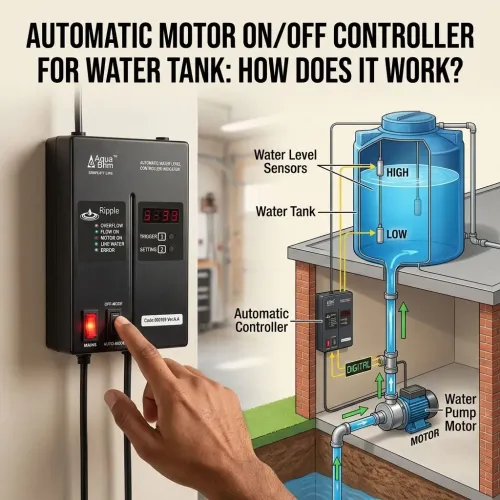
The operating process depends on the controller, sensors, communication method, and monitoring platform. A typical water automation setup works as follows.
1. Sensors Monitor Water Levels
Sensors installed in the relevant tanks detect water levels. Depending on the application, the system may also detect municipal water availability or monitor the underground source.
2. Information Is Sent to the Controller
In a wireless setup, sensors transmit water-level information to a compatible controller using radio frequency (RF) communication.
3. The Controller Processes the Information
The controller evaluates the received readings and applies its configured operating rules. These may include low-level thresholds, full-tank settings, source-water conditions, and motor-control requirements.
4. The Pump Is Monitored or Controlled
A monitoring-focused system displays the supported operating information. An automation-enabled system can also start or stop the motor according to the configured conditions.
5. Users Access Available Information Remotely
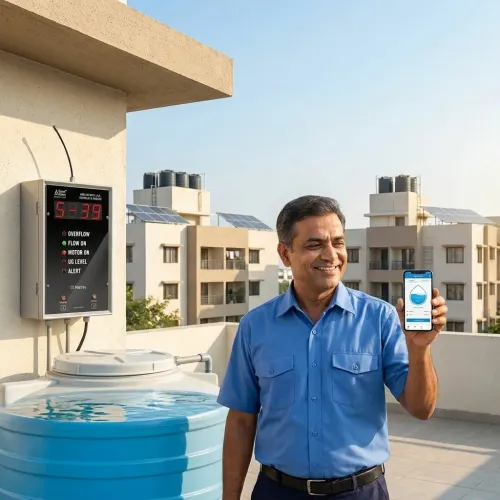
Where compatible web or mobile monitoring is configured, users can check water levels, motor performance, tank conditions, and notifications without visiting each tank or pump location.
6. Alerts Help Users Respond to Problems
Depending on the product and configuration, alerts can help users identify relevant water-level or equipment conditions. The exact alerts available depend on the installed system.
AquaBrim describes its remote monitoring and water automation capabilities. on its official website: https://www.aquabrim.com/
Key Benefits of a Remote Pump Monitoring System
1. Remote Visibility of Water-System Conditions
Users can check available water-level and pump-status information from a compatible monitoring platform. This can be particularly useful when tanks and pumps are located on rooftops, in basements, or in separate utility areas.
2. Automatic Motor Operation
When the selected system supports automatic control, it can start the pump when the water level falls below a configured threshold and stop it when the tank reaches its full setting.
This reduces dependence on manual switching and repeated tank inspections.
3. Reduced Water Overflow
A compatible automatic water-level controller can stop the motor when the tank reaches its configured full level. This helps reduce overflow and unnecessary water wastage.
4. Support for Pump Protection
Pumps can be damaged if they operate without sufficient water. A system with suitable dry-run protection can monitor relevant source-water or operating conditions and stop the motor when its protection rules are triggered.
Users should verify that dry-run protection is included in the selected product and is suitable for their water source.
5. Easier Management of Multiple Tanks
Buildings with several overhead tanks and underground reservoirs may benefit from a centralized monitoring and control system. Instead of checking every tank individually, operators can use a compatible multi-tank controller to coordinate water management.
6. Improved Operational Convenience
Remote visibility can help building managers and homeowners identify water shortages or operating issues sooner, reducing unnecessary visits to pump rooms and rooftops.
7. Building Management System Integration
For larger facilities, monitoring data may need to be available through an existing Building Management System (BMS). A compatible controller with supported communication protocols can help integrate water-system information into broader facility operations.
AquaBrim Matrix supports MODBUS connectivity for BMS integration.
Where Is a Remote Pump Monitoring System Useful?
Residential Homes
Homeowners can monitor available water-level and pump-status information and reduce the need to check rooftop tanks manually. With a compatible automation system, they can also automate routine tank filling.
Apartments and Housing Societies
Apartment buildings often depend on underground reservoirs, overhead tanks, and multiple pumps. Remote monitoring and automatic controls can help staff manage water distribution more efficiently.
Commercial Buildings
Hotels, offices, hospitals, and other commercial properties may need regular water-level checks and dependable pump operation. A suitable monitoring solution can provide greater visibility into the water infrastructure.
Industrial Facilities
Industrial installations may require monitoring of several tanks, configurable operating thresholds, and integration with facility management systems. The selected equipment must match the site's capacity and technical requirements.
Municipal Water Supply Applications
Where water arrives at irregular times, an automation system designed for municipal supply can detect water availability and control tank filling. AquaBrim Trigger is designed for this application.
Borewell and Submersible Pump Installations
Borewell and submersible pump systems need suitable monitoring of both the source water and the receiving tank. AquaBrim Macro is designed for borewell and submersible-pump automation, including source-water monitoring and dry-run protection.
AquaBrimSolutions for Remote Pump Monitoring and Water Automation
AquaBrim offers products designed for different water-management requirements. The appropriate option depends on your water source, number of tanks, motor specifications, and monitoring needs.
1. AquaBrim Trigger — Municipal Water Supply Automation
Trigger is designed for homes and buildings that depend on municipal or corporation water supply. It detects water availability and can automatically operate the motor to fill the overhead tank.
Its listed features include wireless sensing, automatic motor control, and protection features for compatible installations.
2. AquaBrim Macro — Borewell and Submersible Pump Automation
Macro is designed for water pumping from a borewell or underground source to an overhead tank. It monitors relevant tank and source-water levels and supports automatic motor operation.
Its listed features include RF wireless technology, automatic motor control, dry-run protection, and digital level indications.
3. AquaBrim Matrix — Multi-Tank Monitoring and BMS Integration
Matrix is designed for larger installations requiring multi-tank management. AquaBrim lists support for up to 13 overhead tanks and one underground tank, control of up to two motors, programmable timers, and MODBUS connectivity for BMS integration.
4. AquaBrim Wireless Water-Level Monitoring Accessories
AquaBrim's product range also includes wireless water-level transmitters, current and voltage monitoring equipment, flow meters, an IoT gateway, and a wireless signal booster.
These accessories may be relevant to installations that require additional sensing, monitoring, or communication capabilities. Compatibility depends on the selected equipment and system design.
How to Choose the Right Remote Pump Monitoring System
Before selecting a system, consider these factors.
Water Source
Identify whether your installation uses municipal water, a borewell, a submersible pump, or an underground reservoir. Different sources require different monitoring and control arrangements.
Number of Tanks
A single home tank may require a basic controller, while an apartment or commercial building may need multi-tank monitoring and coordinated motor control.
Remote Monitoring Requirements
Decide whether you need local digital indicators, web-based monitoring, mobile access, notifications, or BMS integration. Confirm that the selected product supports the required options.
Motor Compatibility
Check the motor's electrical ratings, phase, and switching requirements. Installation should follow the manufacturer's specifications and applicable electrical safety requirements.
Dry-Run and Overflow Protection
For borewell installations, check the source-water monitoring and dry-run protection features. For all tank-filling applications, verify the automatic stopping behavior and full-level settings.
Wireless Signal Reliability
RF performance depends on distance, walls, floors, metal structures, and the installation environment. Test signal reliability at the actual site and determine whether a compatible signal booster is needed.
Expansion and Maintenance
For larger sites, consider future tank additions, additional sensors, communication requirements, and access to installation and after-sales support.
Installation and Maintenance Best Practices
A remote pump monitoring system needs correct installation and configuration to work reliably.
Install sensors according to the manufacturer's instructions.
Keep the controller in a suitable, protected location.
Verify wireless communication between sensors and the controller.
Confirm that the motor connection matches the controller's specified electrical ratings.
Test automatic start and stop functions, if supported.
Test dry-run protection and other available safety features.
Confirm remote access and notification functions where configured.
Periodically inspect sensors, electrical connections, and communication reliability.
Use a qualified electrician for mains and motor connections.
Remote monitoring can reduce the need for routine physical checks, but it does not eliminate the need for proper maintenance and occasional on-site inspection.
Frequently Asked Questions (FAQs)
1. What is a remote pump monitoring system?
A remote pump monitoring system lets users check supported information about a water pump and its connected water system from a remote location. Depending on the equipment, it may provide water levels, motor status, alerts, and automatic control.
2. How does remote water pump monitoring work?
Sensors collect water-level or operating information and send it to a compatible controller. Where remote monitoring is supported, the information is made available through a web or mobile platform or another supported monitoring interface.
3. Can I monitor my water pump from my mobile phone?
Yes, if the selected system supports mobile or web monitoring and the required connectivity is configured. AquaBrim describes remote access to water levels, motor performance, tank conditions, and system notifications on its official website.
4. Can a remote pump monitoring system switch the motor on and off automatically?
Some systems combine monitoring with automatic motor control. These systems can start the motor when the tank reaches a configured low level and stop it when the tank is full, provided the required conditions are satisfied.
5. Can remote pump monitoring help prevent dry running?
Yes, when the installed controller includes suitable dry-run protection. For example, AquaBrim Macro is designed for borewell and submersible-pump applications and lists dry-run protection among its features.
6. Can a remote pump monitoring system prevent water tank overflow?
A compatible automatic water-level controller can stop the pump when the tank reaches its configured full level. Correct sensor installation and configuration are essential.
7. Is remote pump monitoring suitable for apartment buildings?
Yes. Apartment buildings with multiple tanks and pumps can benefit from centralized monitoring and automation. The system should be selected according to the number of tanks, motors, and required control functions.
8. Can a remote pump monitoring system work with borewell pumps?
Yes, when the controller is designed for borewell or submersible-pump applications. AquaBrim Macro is specifically designed for these applications and supports source-water monitoring and automatic pump control.
9. Can remote pump monitoring be integrated with a Building Management System?
Some controllers support BMS integration through compatible communication protocols. AquaBrim Matrix lists MODBUS connectivity for integrating supported water-management data with a BMS.
10. How do I choose the right remote pump monitoring system?
Consider the water source, number of tanks, motor specifications, remote access requirements, dry-run protection, overflow prevention, wireless range, and BMS requirements. Compare these needs with the manufacturer's official product specifications before selecting a system.