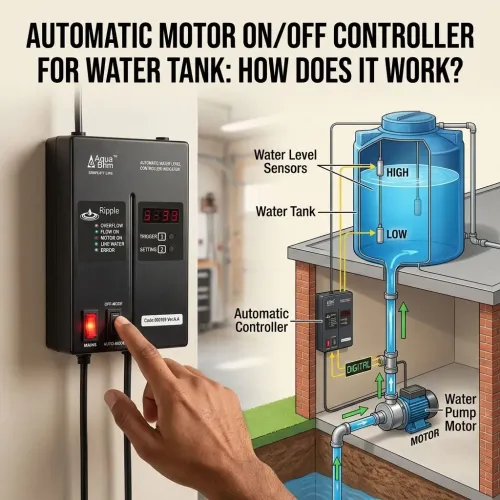

A borewell water level controller is an automated system designed to monitor water availability in a borewell or underground water source and control a connected pump accordingly.
For homes, apartments, commercial buildings and other properties that depend on borewell water, manually switching a submersible pump can be inconvenient—and potentially dangerous for the motor. If the water source becomes too low, the pump may continue running without sufficient water, creating a dry-run condition that can damage the motor.
A smart controller automates this process by monitoring the water source and storage tank, switching the motor ON when water is required and switching it OFF when the desired level is reached.
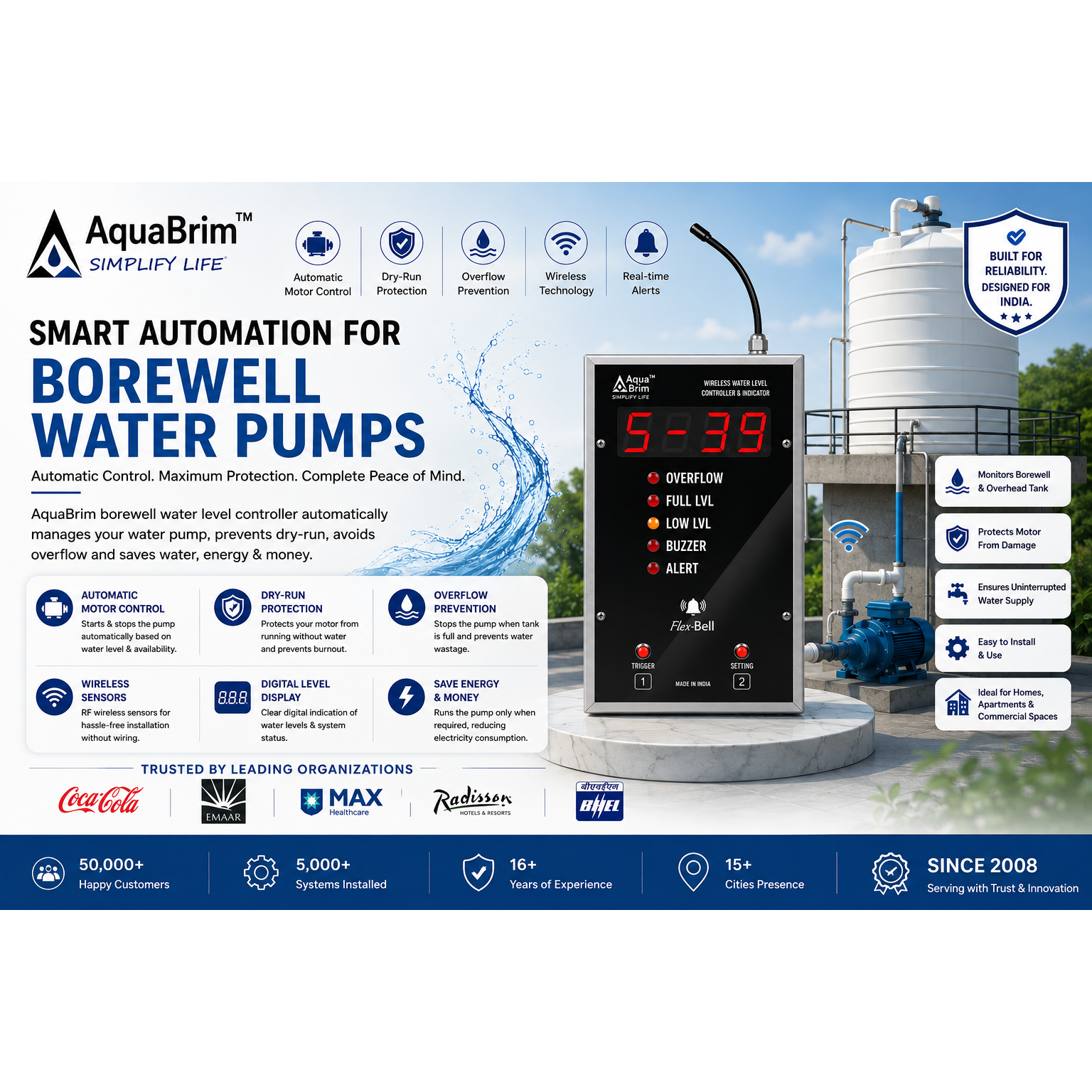
AquaBrim's Macro is specifically designed for borewell and submersible pump automation. It uses RF wireless sensors to monitor the underground source and overhead tank and can automatically control the motor.
Why Do You Need a Borewell Water Level Controller?
Borewell water systems typically involve several things that need to work together:
Borewell → Submersible Pump → Underground/Sump Storage → Overhead Tank → Building
Without automation, someone generally needs to:
- Check whether water is available.
- Switch the pump ON.
- Monitor the overhead tank.
- Remember to switch the pump OFF.
- Check whether the underground source has sufficient water.
- Restart the pump after the source recovers.
This becomes especially difficult in apartments, large homes and commercial properties.
A borewell water level controller can automate these operations while providing additional protection for the pumping system.
How Does a Borewell Water Level Controller Work?
A smart borewell controller generally uses water-level sensors and a controller connected to the pump.
1. Water level is monitored
Sensors monitor the water level in the borewell, underground tank or other source, depending on the installation.
2. Overhead tank level is monitored
The controller also monitors the overhead tank to determine when additional water is required.
3. Pump starts automatically
When the overhead tank reaches its configured low-level threshold and water is available at the source, the controller starts the pump.
With AquaBrim Macro, the overhead tank's automatic start level is specified as below 50%.
4. Pump continues filling the tank
The controller monitors the system while the pump is operating.
5. Pump stops automatically
When the tank reaches the required level, the motor is switched OFF, helping prevent unnecessary pumping and overflow.
6. Dry-run protection operates when necessary
If the underground water source becomes too low or water flow is interrupted, the controller can stop the motor to protect it.
For Macro, the specified dry-run cutoff occurs when the underground level falls below 20%, or when flow is interrupted for more than 2 minutes. The system is specified to restart when the underground level reaches 30%.
Key Benefits of a Borewell Water Level Controller
1. Automatic Pump Operation
One of the biggest advantages is that you don't have to manually operate the pump every time the tank needs water.
The controller can automatically start and stop the motor based on configured water levels.
2. Dry-Run Protection
Dry running is a major concern with borewell and submersible pumps.
If the pump operates when sufficient water isn't available, it can lead to overheating and potential motor damage.
A suitable controller monitors source conditions and can stop the pump when a dry-run condition is detected.
AquaBrim Macro specifically includes underground tank protection and dry-run protection as key features.
3. Prevents Overhead Tank Overflow
Overflow can waste large quantities of water and can also create problems around rooftops and water-storage areas.
By monitoring the overhead tank level and stopping the pump when the required level is reached, automated control reduces the possibility of unattended overflow.
4. Wireless Water Level Monitoring
Traditional systems may require cables between sensors and control equipment.
AquaBrim Macro uses RF wireless technology, allowing tank-level information to be communicated to the controller without tank-to-controller wiring.
This can be particularly useful where installing long sensor cables would be inconvenient.
5. Reduced Manual Intervention
Instead of repeatedly checking the overhead tank and operating a motor switch, the automation system handles routine pump operation automatically.
This is useful for:
- Independent houses
- Apartments
- Housing societies
- Commercial buildings
- Offices
- Institutions
- Properties using borewell water
6. Multiple Tank Support
Some properties have more than one overhead tank or storage tank.
Aquabrim Macro supports additional wireless sensors for multi-tank applications, allowing connected tanks to be monitored by the system.
For larger installations, Aquabrim also offers MATRIX, which is designed for multi-tank automation and can monitor up to 13 overhead tanks and 1 underground tank, with control for up to two motors.
Who Should Install a Borewell Water Level Controller?
A borewell water level controller can be particularly useful if your property has:
Independent Homes
If you use a borewell and regularly need to switch a submersible pump manually, automation can make daily water management easier.
Apartments & Housing Societies
Multiple tanks and higher water consumption make manual monitoring increasingly difficult.
Commercial Buildings
Offices, shops, hotels and other commercial properties can benefit from automatic water management.
Institutional Buildings
Schools, hospitals and other facilities often require reliable water availability and controlled pumping.
Properties With Frequent Dry-Run Problems
If the borewell water level changes significantly, source-level monitoring and dry-run protection become especially important.
How to Choose the Right Borewell Water Level Controller
Before purchasing a controller, consider the following:
1. Type of Water Source
Confirm that the controller supports your setup:
- Borewell
- Submersible pump
- Underground sump
- Overhead tank
2. Dry-Run Protection
This is one of the most important features for borewell installations.
Ask how the system detects insufficient water and what happens when the source level becomes too low.
3. Tank Capacity and Number of Tanks
If you have multiple overhead tanks, select a controller that supports your required number of sensors.
4. Wireless Range
Wireless technology can simplify installation, but the controller should be appropriate for the physical distance and building structure.
5. Motor Compatibility
Check the pump type, electrical configuration and controller specifications before installation.
6. Additional Monitoring
Depending on your requirements, features such as flow monitoring, alerts, digital displays and remote monitoring can provide additional visibility.
Aquabrim's broader water automation range includes wireless sensors, flow meters, current/voltage monitoring, IoT gateways and other automation accessories.
Why Choose Aquabrim for Borewell Pump Automation?
Aquabrim focuses on water automation systems designed for different water-supply situations.
Its product range includes:
- Trigger – designed for municipal water supply automation.
- Macro – designed for borewell and submersible pump automation.
- MATRIX – designed for multi-tank and larger building applications.
- FLEXIBELL – a wireless water-level alarm/indicator.
Aquabrim states that its systems have served 50,000+ customers, with 5,000+ systems installed, across 15+ cities and with 16+ years of experience.
Frequently Asked Questions About Borewell Water Level Controllers
1. What is a borewell water level controller?
A borewell water level controller is an automated system that monitors water availability and tank levels and controls a borewell or submersible pump accordingly. It can help automate pumping, prevent tank overflow and provide dry-run protection.
2. Can a borewell water level controller control a submersible pump?
Yes. Controllers designed for borewell applications can be compatible with submersible pumps. AquaBrim Macro is specifically designed for borewell and submersible pump automation.
3. Does a borewell controller prevent dry running?
A suitable controller can provide dry-run protection by monitoring water availability and stopping the motor when insufficient water is detected. Aquabrim Macro specifies dry-run cutoff when the underground level falls below 20% or when flow is interrupted for more than two minutes.
4. Can it automatically start the borewell pump?
Yes. When the overhead tank reaches its configured low level and the source has sufficient water, an automatic controller can start the pump. Macro's specified overhead-tank auto-start point is below 50%.
5. Can it stop the pump when the overhead tank is full?
Yes. Automatic water-level controllers monitor the tank and can switch the motor OFF when the configured full level is reached, helping prevent overflow.
6. Does Aquabrim Macro require wiring between the tank and controller?
No. Macro uses RF wireless technology, so tank sensors communicate wirelessly with the controller rather than requiring tank-to-controller wiring.
7. Can a borewell water level controller work with an underground tank?
Yes. Macro is designed to monitor an underground source/tank together with the overhead tank and automate pumping between them.
8. What happens if the borewell water level becomes too low?
A suitable controller detects the low source condition and stops the motor to prevent dry running. With Macro, the specified underground cutoff is below 20%, with restart at 30% or above.
9. Can one controller manage multiple tanks?
Yes, depending on the controller model. Macro supports additional wireless sensors for multi-tank applications. For larger systems, AquaBrim MATRIX is designed to monitor up to 13 overhead tanks and one underground tank.
10. Is a borewell water level controller better than manually operating the pump?
For many borewell installations, automation can provide greater convenience and protection because the system can monitor water levels and operate the pump automatically instead of relying on someone to check the tank and switch the motor.
11. Does a borewell controller help prevent water wastage?
Yes. By automatically stopping the pump when the overhead tank reaches the required level, an automated system can help reduce unnecessary pumping and tank overflow.
12. Can I manually operate the pump if required?
Some controllers provide a manual control function. Aquabrim Macro includes a manual trigger button; its product documentation specifies pressing and holding the trigger for five seconds to manually start the motor.
13. What is the difference between a borewell water level controller and a regular water-level indicator?
A water-level indicator primarily tells you the water level. A water-level controller can go further by using that information to automatically operate the pump. The exact capabilities depend on the product.
14. Is wireless technology useful for borewell pump automation?
Yes. Wireless sensors can reduce the need for long cables between tanks and the controller, making installation cleaner and potentially easier in existing buildings. Aquabrim Macro uses RF wireless communication.