
What Is an Automatic Water Pump Controller?
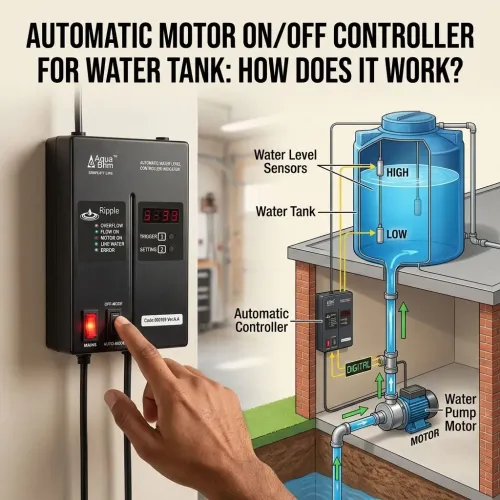
An automatic water pump controller is a device that automatically controls a water pump based on water-level and/or water-supply conditions.
Instead of manually operating a pump, the controller receives information from sensors and decides when the motor should start or stop.
A typical automated system works like this:
Water Source → Pump/Motor → Overhead Tank → Water Supply
When the tank level becomes low and water is available, the system can start the pump. As the tank fills, the controller continues monitoring the level and stops the motor when the desired level is reached.
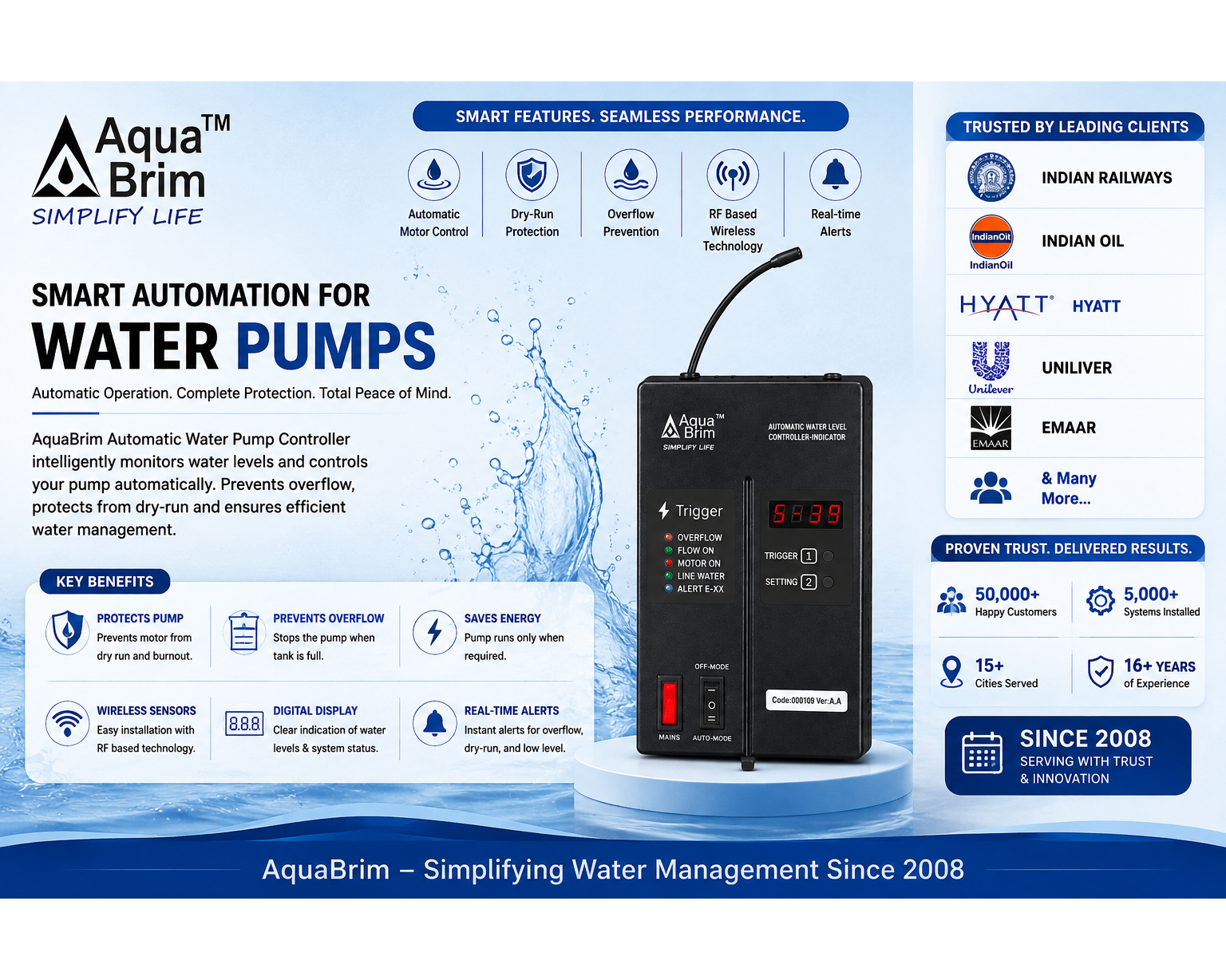
AquaBrim describes its systems as continuously monitoring water availability and tank levels and automatically managing motor activity.
Why Do You Need an Automatic Water Pump Controller?
Manual pump operation may appear simple, but it can create several problems.
1. Tank Overflow
If the motor is left running after the tank becomes full, water can overflow onto the terrace or surrounding area.
2. Motor Dry Running
A pump operating without adequate water can experience dry-run conditions. For borewell and submersible applications, source-level monitoring and dry-run protection are particularly important.
3. Water Wastage
Overflowing tanks waste water that could otherwise be conserved.
4. Electricity Wastage
A motor that runs longer than necessary consumes electricity unnecessarily.
5. Manual Intervention
Someone has to remember to check the tank and operate the pump.
An automatic controller addresses these issues by making water pumping more intelligent and less dependent on manual operation.
How Does an Automatic Water Pump Controller Work?
The exact operation depends on the controller and water-source configuration, but the basic process is straightforward.
Step 1: The Sensor Monitors Water
Sensors monitor the water level in the relevant tank or detect water availability in the supply line.
Step 2: Information Is Sent to the Controller
The sensor communicates the water-level information to the control unit.
Modern systems can use wireless communication. AquaBrim's Trigger and Macro systems use RF-based wireless sensor technology.
Step 3: The Controller Determines Whether Pumping Is Required
When the tank reaches the configured low-level threshold and water is available, the controller can activate the pump.
Step 4: The Pump Fills the Tank
The motor runs while the controller continues monitoring the tank.
Step 5: The Pump Stops Automatically
When the tank reaches the configured full level, the controller switches the motor OFF.
This automatic process helps reduce the need for someone to constantly monitor the tank.
Key Benefits of an Automatic Water Pump Controller
1. Automatic Motor ON/OFF
The most important advantage is automatic motor operation.
Instead of manually switching the pump on and off, the controller can manage the motor according to water-level conditions.
AquaBrim's systems are designed to automatically start the motor when water is required and stop it when the tank reaches the required level.
2. Prevents Water Tank Overflow
Overflow is one of the most common consequences of forgetting to switch off a water pump.
An automatic water pump controller monitors the tank and stops the motor when the configured level is reached.
This can help:
- Reduce water wastage
- Prevent unnecessary pumping
- Reduce manual monitoring
- Maintain a controlled water level
Overflow prevention is one of the core features highlighted by AquaBrim.
3. Dry-Run Protection
For borewell and submersible pumps, dry-run protection can be particularly important.
AquaBrim Macro is designed for borewell and submersible pump applications and monitors the underground source along with the overhead tank. Its dry-run protection can stop the motor when the source level becomes too low or when flow is interrupted.
This can help protect the pump from damage caused by operating without adequate water.
4. Wireless Water-Level Monitoring
Installing cables between a rooftop tank and a motor room can be inconvenient, particularly in existing buildings.
Wireless systems can reduce the need for long sensor cables.
AquaBrim uses RF wireless technology in its Trigger and Macro systems, allowing sensor information to be communicated wirelessly to the controller.
5. Saves Time and Reduces Manual Work
With an automatic water pump controller, you don't need to repeatedly:
- Climb to the terrace
- Check the tank
- Switch the motor ON
- Wait for the tank to fill
- Return to switch the motor OFF
Automation handles routine pump operation for you.
6. Helps Reduce Water and Energy Waste
An automated system can stop the pump once the required water level is reached.
This can reduce unnecessary pumping and prevent water from continuously overflowing from the tank.
AquaBrim's systems are designed around water conservation, motor protection and efficient water management.
Automatic Water Pump Controllers for Different Water Sources
Not every property has the same water-supply arrangement.
The right controller should be selected according to the source of water and pumping system.
Municipal Water Supply
Properties dependent on municipal or corporation water supply have a unique challenge: the water may arrive at specific or unpredictable times.
AquaBrim Trigger
AquaBrim Trigger is designed specifically for municipal water supply applications.
It detects water availability in the supply line and can automatically start the motor when water arrives. It then fills the overhead tank and stops the motor according to the configured conditions.
The system uses RF wireless technology and includes features such as automatic motor control, dry-run protection, overflow prevention, voltage protection, timer mode and digital/LED indication.
This can be particularly useful in areas where residents need to monitor municipal water availability manually.
Automatic Water Pump Controller for Borewell Pumps
Borewell installations require a different approach.
A pump may have sufficient water one day and insufficient water another day. Simply monitoring the overhead tank isn't always enough.
AquaBrim Macro
AquaBrim Macro is designed for borewell and submersible pump automation.
It monitors the underground source and overhead tank using wireless sensors. According to AquaBrim, Macro automatically starts the pump when the overhead tank falls below its configured threshold and includes underground tank protection and dry-run protection.
This makes source monitoring an important consideration when selecting an automatic pump controller for borewell applications.
Automatic Water Pump Controllers for Multiple Tanks
Large buildings can have multiple overhead tanks, underground tanks and pumps.
Managing them individually can require considerable manual effort.
For such applications, a multi-tank automation system can provide centralized control.
AquaBrim Matrix
AquaBrim Matrix is designed for large residential complexes, commercial buildings and institutional sites.
According to AquaBrim, Matrix can control up to 13 overhead tanks and one underground tank, with up to two motors. It uses wireless sensors and also supports MODBUS connectivity for Building Management Systems.
This makes it suitable for more complex water-management requirements.
Important Features to Look For
Before buying an automatic water pump controller, consider these features.
Automatic Motor Control
The system should be able to start and stop the pump according to configured conditions.
Water-Level Monitoring
Accurate monitoring is essential for reliable automation.
Overflow Protection
The controller should stop pumping when the tank reaches its configured full level.
Dry-Run Protection
This is especially important for borewell and submersible pumps.
Wireless Sensors
Wireless communication can make installation easier by reducing the requirement for long sensor cables.
Digital Display
A digital display can provide quick information about the water level and system status.
Alerts
Alerts can notify users about important events such as low water, overflow or system conditions.
Remote Monitoring
For advanced installations, web/mobile monitoring can provide visibility into water levels, motor performance and notifications. AquaBrim provides web and mobile monitoring capabilities for its smart water automation systems.
Where Can an Automatic Water Pump Controller Be Used?
Automatic pump controllers can be useful in a wide range of applications.
Homes
Automate overhead tank filling and reduce daily motor monitoring.
Apartments
Manage water pumping more efficiently in residential buildings.
Commercial Buildings
Reduce manual involvement in routine water management.
Hotels
Maintain reliable water availability while controlling pumping operations.
Hospitals
Support organized water management across multiple tanks and pumping systems.
Industrial Facilities
Multi-tank controllers can help manage more complex water-storage arrangements.
Institutional Buildings
Schools, offices and other institutions can benefit from automated water-level management.
AquaBrim: Smart Water Automation Since 2008
AquaBrim has been developing water automation solutions since 2008, with products designed for different water-supply requirements in Indian conditions.
According to AquaBrim, its systems have served 50,000+ customers, with 5,000+ systems installed, across 15+ cities, supported by 16+ years of experience.
Its water automation portfolio includes:
- Trigger — municipal water supply automation
- Macro — borewell and submersible pump automation
- MATRIX — multi-tank water automation
- FLEXIBELL — wireless water-level alarm/indicator
AquaBrim's approach is to match the controller with the actual water-source and tank configuration rather than treating every installation as the same.
Frequently Asked Questions About Automatic Water Pump Controllers
1. What is an automatic water pump controller?
An automatic water pump controller is a system that monitors water-level or water-supply conditions and automatically switches a connected pump ON or OFF according to configured requirements.
2. How does an automatic water pump controller work?
Sensors monitor the water level or water availability and send information to the controller. When water is required and the appropriate conditions are met, the controller starts the pump. When the tank reaches the required level, it stops the pump.
3. Can an automatic pump controller prevent tank overflow?
Yes. A suitable controller can stop the pump when the overhead tank reaches its configured full level, helping prevent overflow and water wastage.
4. Can an automatic pump controller protect a motor from dry running?
Yes, if the controller includes dry-run protection. AquaBrim's Macro is designed for borewell/submersible applications and includes dry-run protection based on underground water availability and flow conditions.
5. Can an automatic pump controller work with a borewell?
Yes. The controller should be specifically compatible with borewell and submersible pump applications. AquaBrim Macro is designed for this purpose.
6. Can it work with municipal water supply?
Yes. AquaBrim Trigger is designed for municipal/corporation water supply and can detect water availability in the supply line and automatically control the motor.
7. Does an automatic water pump controller require wiring?
It depends on the system. Wireless controllers can communicate between the sensors and controller using RF technology. AquaBrim Trigger and Macro use wireless RF communication.
8. Can one controller manage multiple tanks?
Yes, depending on the controller model. AquaBrim Matrix is designed to manage up to 13 overhead tanks and one underground tank and can control up to two motors.
9. Can I monitor my water tank remotely?
Advanced systems can provide remote monitoring. AquaBrim's smart platform provides access to water levels, motor performance, tank conditions and system notifications through web and mobile interfaces.
10. Does an automatic pump controller save water?
It can help reduce water wastage by automatically stopping the pump when the required tank level is reached, reducing the possibility of unattended overflow.
11. Does an automatic pump controller save electricity?
By stopping the pump when pumping is no longer required, an automatic controller can reduce unnecessary motor running time and therefore help avoid avoidable electricity consumption.
12. Is an automatic controller better than manually switching a water pump?
For many installations, automation provides greater convenience because the system can monitor conditions and operate the pump without requiring someone to manually check the tank throughout the day.
13. Which AquaBrim product is suitable for borewell pumps?
AquaBrim Macro is designed for borewell and submersible pump automation and includes underground-source monitoring and dry-run protection.
14. Which AquaBrim product is suitable for municipal water supply?
AquaBrim Trigger is designed specifically for municipal/corporation water supply applications and automatically detects water availability in the supply line.
15. Which controller is suitable for multiple overhead tanks?
For larger installations with multiple tanks, AquaBrim Matrix is designed for centralized multi-tank water-level monitoring and motor control.