
What Is a Wireless Water Level Monitoring System?
A Wireless Water Level Monitoring System is a smart solution that uses wireless sensors to monitor the amount of water in one or more tanks and communicate the information to a controller or monitoring platform.
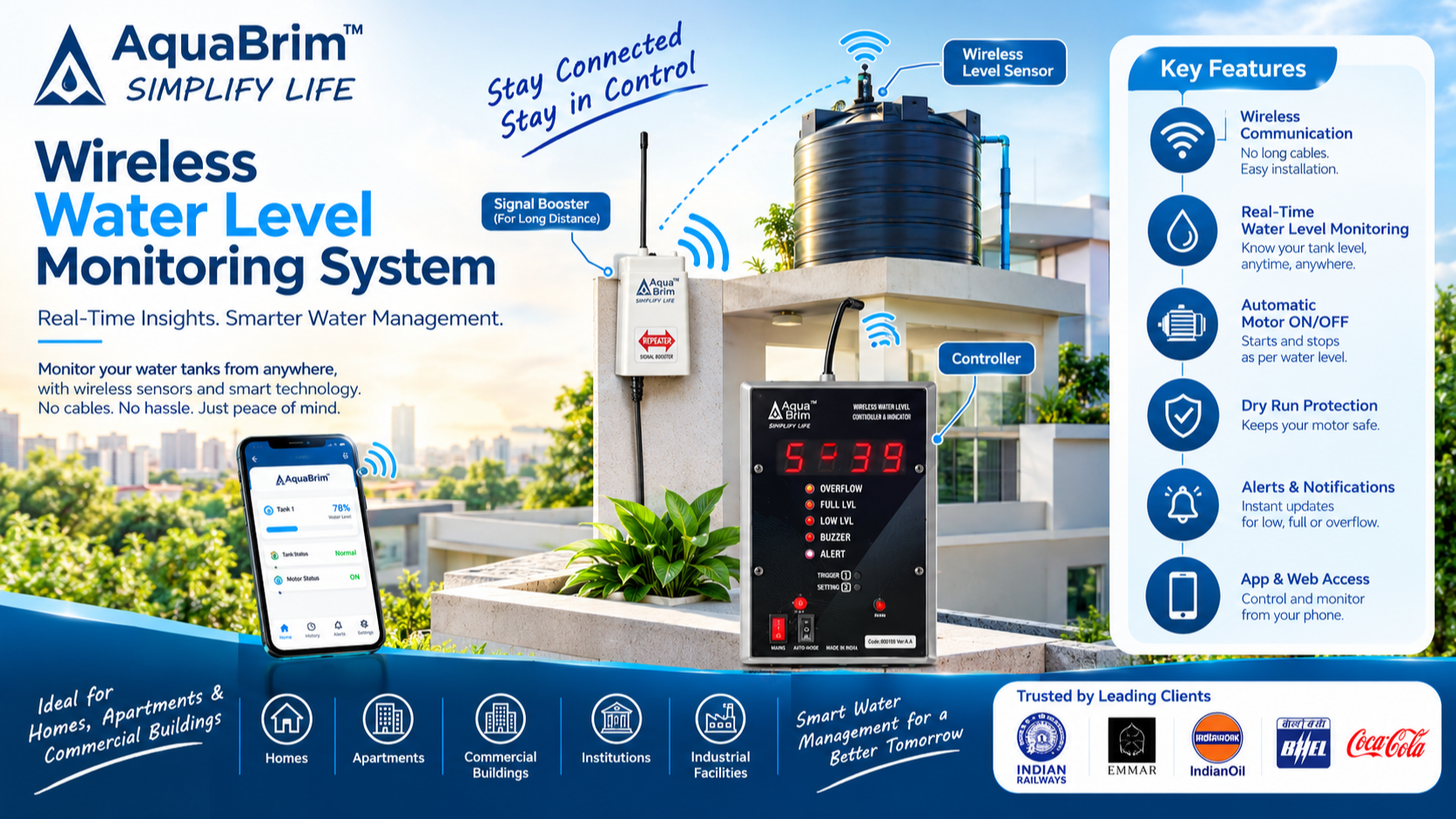
Unlike traditional wired systems, wireless technology reduces the need to run long cables between rooftop tanks, underground tanks and the control unit. Sensors installed in the tanks transmit water-level information wirelessly using RF technology.
AquaBrim uses wireless sensor technology across its water automation solutions to monitor tank levels and support automated water management.
Why Is Wireless Water Level Monitoring Important?
Manually checking water tanks can be inconvenient, particularly when tanks are located on rooftops or when a property has several tanks.
Without proper monitoring:
- Water tanks can overflow.
- Low water levels may go unnoticed.
- Pumps may run unnecessarily.
- Manual tank inspections become necessary.
- Multi-tank water management can become complicated.
- Building operators may not have real-time information about tank conditions.
A wireless monitoring system provides a way to receive water-level information without physically checking every tank.
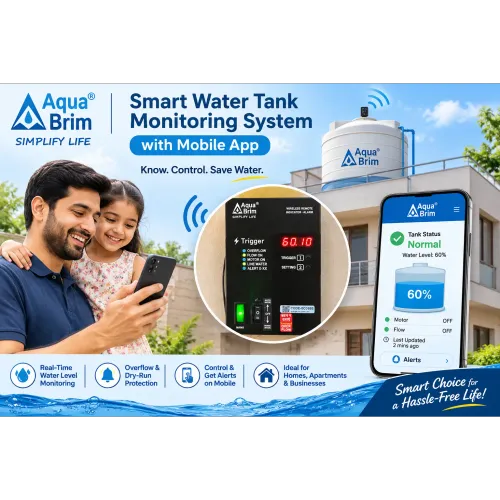
AquaBrim's platform can provide real-time visibility into water levels, motor performance, tank conditions and system notifications, with web and mobile access available within its smart water-management ecosystem.
How Does a Wireless Water Level Monitoring System Work?
A typical system consists of wireless level sensors, a controller and, where applicable, a web or mobile monitoring platform.
1. Sensor Measures the Water Level
A wireless transmitter is installed inside the water tank to detect its level.
2. Sensor Sends Information Wirelessly
The transmitter communicates the level information to the controller using RF wireless technology.
3. Controller Processes the Information
The controller receives and displays the water-level data.
4. Users Can Monitor the Tank
Depending on the system, water levels can be viewed through a digital display or connected monitoring platform.
5. Automation Can Be Added
When the monitoring system is part of an automatic water controller, the information can also be used to operate the motor.
For example, AquaBrim Macro continuously monitors underground and overhead tank levels and can automatically operate the motor according to configured conditions.
Key Features of a Wireless Water Level Monitoring System
1. Wireless Sensor Technology
Wireless sensors communicate tank-level information to the controller without requiring long signal cables.
2. Real-Time Water-Level Monitoring
Users can monitor current tank conditions through compatible digital displays or connected monitoring platforms.
3. Multiple Tank Monitoring
Some systems can monitor several tanks from a single controller.
AquaBrim Matrix, for example, is designed to monitor up to 13 overhead tanks and 1 underground tank.
4. Automatic Pump Control
When monitoring is integrated with a compatible automatic controller, water-level information can trigger motor ON/OFF operation.
5. Overflow Monitoring
The system can identify configured full or overflow conditions and provide alerts or, in compatible controllers, stop the motor.
6. Dry-Run Protection
For suitable borewell and underground-water applications, monitoring the source-water level can help prevent the pump from operating without adequate water.
AquaBrim Macro includes dry-run protection based on underground water level and flow conditions.
7. Remote Monitoring
AquaBrim's smart platform provides web and mobile access for monitoring water levels, motor performance, tank conditions and notifications.
8. BMS Integration
For larger commercial and institutional installations, Matrix supports MODBUS connectivity for integration with a Building Management System.
Wireless Water Level Monitoring for Homes
For residential applications, wireless monitoring can make it easier to know when the overhead tank needs attention.
Instead of repeatedly climbing to the rooftop to inspect the tank, a suitable system can provide level information through the controller or connected monitoring platform.
When combined with automatic pump control, the system can also help automate tank filling.
AquaBrim's residential product range includes Trigger for municipal water supply and Macro for borewell/submersible applications.
Wireless Water Level Monitoring for Apartments
Apartments often have more complicated water systems involving underground storage tanks, overhead tanks and multiple pumps.
A wireless monitoring system can help building operators keep track of water levels without installing extensive sensor wiring.
For larger multi-tank installations, AquaBrim Matrix can monitor up to 13 overhead tanks and one underground tank, while also supporting up to two motors and MODBUS/BMS connectivity.
Wireless Water Level Monitoring for Commercial Buildings
Commercial buildings may have several water storage points and require continuous visibility of their water infrastructure.
Wireless monitoring can help facility teams:
- Monitor multiple tanks
- Identify low water levels
- Detect full or overflow conditions
- Monitor motor status
- Reduce manual inspections
- Integrate water information with building-management systems
The appropriate configuration depends on the number of tanks, motors, water sources and monitoring requirements.
Wireless Monitoring for Borewell Water Systems
Borewell systems require monitoring not only of the overhead tank but also of the available water source.
AquaBrim Macro is designed for borewell and submersible pump applications. Its wireless sensors monitor the underground source and overhead tank, while the controller can automatically operate the motor based on configured levels.
According to AquaBrim's current Macro specifications, the motor can stop if the underground level falls below 20% or if water flow is interrupted for more than two minutes.
Wireless Monitoring for Municipal Water Supply
Municipal water supply can arrive at different times, making manual monitoring inconvenient.
AquaBrim Trigger is designed for municipal/corporation water supply applications. Its wireless system detects water availability in the supply line and can automatically start the connected motor when supply is detected, while also monitoring the tank level.
The current Trigger specifications state a detection range of up to 50 metres from the motor in suitable installations.
Wireless Water Level Monitoring for Multiple Tanks
Monitoring multiple tanks manually becomes increasingly difficult as the size of a property grows.
A centralized wireless system can provide a consolidated view of tank levels.
For example, AquaBrim Matrix uses RF communication in the 433–434 MHz band and is designed to monitor up to 13 overhead tanks and one underground tank. It can also control up to two motors and send data to a BMS through MODBUS.
Wireless Water Level Monitoring and IoT
Wireless monitoring can also be combined with IoT connectivity.
An IoT-enabled water management system can connect sensors and controllers to a digital platform, allowing users to view water levels, motor conditions and alerts remotely.
AquaBrim's ecosystem includes wireless sensing, automatic motor control, app-based access, real-time alerts, IoT Gateway connectivity and BMS integration for applicable installations.
This can be particularly useful for facility managers responsible for multiple buildings or water systems.
Benefits of a Wireless Water Level Monitoring System
Reduces Manual Tank Checking
Users can monitor tank conditions without repeatedly visiting the tank.
Reduces Cable Requirements
Wireless RF communication eliminates the need for tank-to-controller signal wiring in compatible systems.
Helps Prevent Overflow
Monitoring full and overflow conditions can help users respond before water is unnecessarily wasted.
Supports Pump Protection
When integrated with appropriate automation, source-level monitoring can support dry-run protection.
Supports Multi-Tank Management
Larger wireless systems can monitor multiple tanks from a centralized controller.
Enables Remote Visibility
Connected systems can provide access to water-level and system information through web or mobile platforms.
Simplifies Water Management
Combining monitoring with automation can reduce the need for repetitive manual motor operation.
How to Choose a Wireless Water Level Monitoring System
Before selecting a system, consider the following:
1. Number of Tanks
Determine whether you need to monitor one tank or multiple overhead and underground tanks.
2. Water Source
Identify whether your property uses:
- Municipal water
- Underground storage
- Borewell
- Submersible pump
- Multiple water sources
3. Monitoring Requirements
Decide whether you need only level indication or also:
- Automatic motor control
- Dry-run protection
- Overflow prevention
- Remote monitoring
- Alerts
- BMS integration
4. Wireless Range
Check the required distance between the tank sensors and controller.
5. Future Expansion
For larger buildings, select a system capable of supporting additional tanks or sensors if required.
6. Automation Requirements
A monitoring-only system and an automatic motor controller serve different purposes.
For example, AquaBrim Flexibell is specifically a wireless water-level indicator and alarm system and does not automatically operate pumps.
For automatic motor control, AquaBrim offers systems such as Trigger, Macro and Matrix according to the application.
AquaBrim Wireless Water Level Monitoring Solutions
AquaBrimprovides different products for different water-management requirements:
Trigger
Designed for municipal/corporation water supply, with wireless water detection and automatic motor control.
Macro
Designed for borewell and submersible pump applications, monitoring underground and overhead water levels with automatic motor control and dry-run protection.
Matrix
Designed for large multi-tank installations, with centralized wireless monitoring, motor control and BMS integration.
Flexibell
Designed for wireless water-level indication and alarms for up to six tanks; it monitors and alerts but does not control the motor.
Frequently Asked Questions — Wireless Water Level Monitoring System
1. What is a Wireless Water Level Monitoring System?
It is a system that uses wireless sensors to measure water levels in tanks and transmit the information to a controller or monitoring platform without requiring long signal cables.
2. How does wireless water level monitoring work?
A sensor installed in the tank measures the water level and communicates the information wirelessly to a controller. The controller can display, process or transmit the information depending on the system configuration.
3. Does a wireless water level monitoring system require cables?
Wireless systems such as AquaBrim's Macro use RF communication, so no signal wiring is required between the tank and controller. The controller still requires its appropriate electrical connection and installation.
4. Can a wireless monitoring system monitor multiple tanks?
Yes. The number of tanks depends on the particular system. AquaBrim Matrix can monitor up to 13 overhead tanks and one underground tank, while Flexibell can monitor up to six tanks.
5. Can wireless water level monitoring control a water pump?
Monitoring by itself does not necessarily control a pump. A compatible automatic controller is required for motor ON/OFF operation. AquaBrim Trigger, Macro and Matrix combine water-level monitoring with motor automation, while Flexibell is designed for monitoring and alarms only.
6. Can I monitor my water tank remotely?
Yes, where the installation includes compatible connected monitoring capabilities. AquaBrim's smart platform provides web and mobile access to water levels, motor performance, tank conditions and system notifications.
7. Can a wireless monitoring system help prevent tank overflow?
Yes. Monitoring can identify full or overflow conditions, and compatible automatic controllers can stop the motor when the configured tank level is reached. AquaBrim lists overflow prevention among the features of its water automation systems.
8. Does wireless water level monitoring support borewell applications?
Yes. AquaBrim Macro is designed for borewell and submersible pump applications and monitors the underground source and overhead tank using wireless sensors.
9. Can wireless water level monitoring be integrated with a BMS?
Yes, with a compatible system. AquaBrim Matrix supports MODBUS connectivity, allowing water-level and system data to be integrated with a Building Management System.
10. How do I choose the right wireless water level monitoring system?
Start by identifying your water source, number of tanks, number of motors and monitoring requirements. For municipal supply, Trigger is designed for water-supply detection and automatic motor control; for borewell or submersible pumping, Macro is designed for underground-to-overhead automation; and for larger multi-tank installations, Matrix provides centralized wireless management.