
An overhead water tank is an essential part of water management in many Indian homes, apartments, offices, hotels, hospitals and commercial buildings. But keeping track of the tank level and manually switching the water pump ON and OFF can become a daily hassle.
You may switch the motor ON and forget to turn it OFF. The tank then overflows, wasting water. In a borewell system, the opposite problem can occur—the pump may run when the source has insufficient water, creating a dry-run condition.
An overhead tank water level controller automates this process. It monitors the water level and, depending on the system, water availability at the source, and automatically controls the motor.
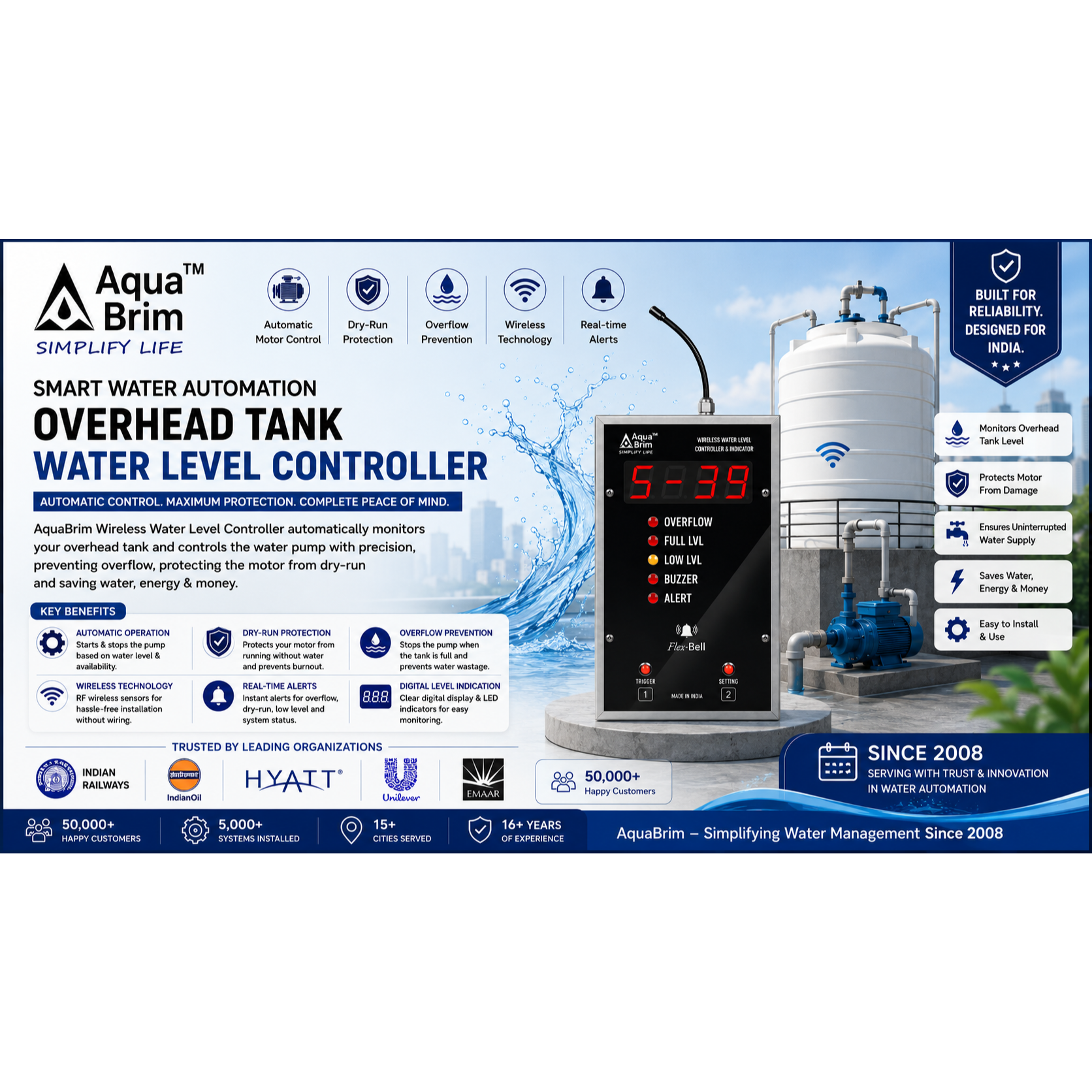
Aquabrim's water automation systems are designed to monitor water levels, automate motor operation, prevent overflow and help protect motors from dry running.
What Is an Overhead Tank Water Level Controller?
An overhead tank water level controller is a device or automated system that monitors the water level in an overhead tank and controls a connected water pump according to predefined levels.
In a typical setup:
Water Source → Pump/Motor → Overhead Tank → Building Water Supply
The controller monitors the tank and can:
- Detect when the tank water level becomes low
- Start the motor automatically
- Monitor the filling process
- Stop the motor when the desired level is reached
- Help prevent tank overflow
- Monitor source-water availability in suitable systems
- Provide dry-run protection where supported
- Provide wireless level monitoring in compatible systems
Aquabrim describes its controllers as systems that continuously monitor water availability and tank levels and automatically manage motor operation.
Why Is an Overhead Tank Water Level Controller Important?
Manual water-pump operation creates several common problems.
Tank Overflow
You may forget that the motor is running, causing water to overflow from the overhead tank.
Motor Dry Running
If the water source becomes unavailable, a pump can continue operating without adequate water unless appropriate protection is installed.
Unnecessary Water Wastage
Overflowing tanks can waste a significant amount of water.
Electricity Wastage
Running a motor longer than necessary can consume unnecessary electricity.
Manual Monitoring
Someone has to repeatedly check the tank and operate the motor.
An automated controller is designed to reduce these problems by making the pumping process automatic.
How Does an Overhead Tank Water Level Controller Work?
The exact operation depends on the type of controller and water source, but the basic process is simple.
Step 1: The Sensor Monitors the Tank
A water-level sensor continuously monitors the amount of water in the overhead tank.
Step 2: The Controller Receives the Level Information
The sensor sends the tank-level information to the controller.
With Aquabrim's wireless systems, RF sensors communicate with the controller without requiring tank-to-controller wiring.
Step 3: The Water Level Falls
When the tank reaches the configured low level, the controller determines that additional water is required.
Step 4: The Motor Starts
If the required water source is available, the controller automatically starts the motor.
Aquabrim's Macro, for example, monitors the underground source and overhead tank and automatically starts the motor when the overhead tank falls below its configured threshold.
Step 5: The Tank Fills
The controller continues monitoring the water level while the motor operates.
Step 6: The Motor Stops
When the desired tank level is reached, the controller stops the motor, helping prevent overflow.
This means you don't have to repeatedly climb to the terrace or remember to switch the motor off.
Benefits of an Overhead Tank Water Level Controller
1. Automatic Motor ON/OFF
The biggest advantage is automation.
Instead of manually switching the pump on and off, the controller can operate it according to the tank's water level.
This is particularly useful for homes where the water tank is located on the roof or another difficult-to-access location.
2. Prevents Overhead Tank Overflow
Overflow is one of the most common problems with manual pump operation.
An automated controller monitors the water level and stops the motor when the tank reaches the configured level.
This helps reduce:
- Water wastage
- Unnecessary pumping
- Wet terraces
- Repeated manual checking
Aquabrim specifically lists tank overflow prevention among its water automation features.
3. Reduces Manual Work
You don't need to keep checking the tank throughout the day.
Once the system is properly configured, the controller can manage routine filling automatically.
This can be particularly helpful for:
- Elderly people
- Working professionals
- Large families
- Apartment residents
- Facility managers
- Commercial properties
4. Helps Protect the Motor
For borewell and submersible pump applications, monitoring the water source is particularly important.
Aquabrim Macro is designed to monitor the underground source as well as the overhead tank and includes dry-run protection.
If insufficient water is detected, the controller can stop the pump according to its configured protection logic.
5. Wireless Water-Level Monitoring
Installing cables between a rooftop tank and a motor room can be inconvenient.
Wireless water-level controllers use radio-frequency communication between sensors and the controller.
Aquabrim Macro uses RF wireless technology and is designed to provide tank-level monitoring without wiring between the tanks and controller.
6. Better Water Management
A smart controller doesn't simply tell you whether the tank is full or empty.
Depending on the system, it can provide:
- Digital water-level information
- Motor status
- Overflow indication
- Low-level indication
- Alerts
- Wireless monitoring
- Remote monitoring
- Scheduling
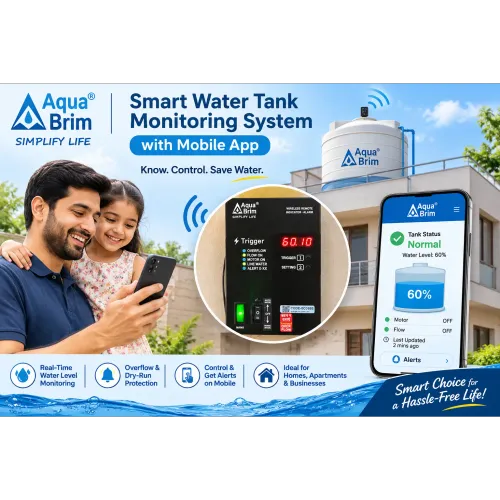
Aquabrim's platform also provides web and mobile access for monitoring water levels, motor performance, tank conditions and system notifications.
Overhead Tank Controller for Different Water Sources
The right controller depends heavily on where your water comes from.
Municipal Water Supply
If your overhead tank is filled from a municipal or corporation water line, the controller needs to account for water availability in the supply line.
Aquabrim Trigger
Aquabrim Trigger is designed for municipal/corporation water supply applications.
It detects water availability, automatically starts the motor when supply is confirmed and stops the motor when the tank is full or when certain protection conditions occur. It uses RF wireless technology and supports overhead and underground tanks.
This makes it suitable for homes and buildings where municipal water supply may arrive at specific or irregular times.
Overhead Tank Controller for Borewell Water
For properties using a borewell or submersible pump, simply monitoring the overhead tank may not be enough.
The system should also consider the water available at the source.
Aquabrim Macro
Aquabrim Macro is designed specifically for borewell and submersible pump automation.
It monitors both the underground source and overhead tank and can automatically control the pump. It also includes dry-run protection, RF wireless technology, multi-tank support and digital level indication.
This makes source monitoring an important consideration when selecting an overhead tank controller for a borewell installation.
Overhead Tank Controllers for Apartments and Large Buildings
Large buildings can have several overhead tanks instead of one.
Managing them manually can become difficult because facility staff may need to monitor multiple water levels and pumps.
For these applications, a multi-tank water automation system can be more appropriate.
Aquabrim Matrix
Aquabrim Matrix is designed for large residential complexes, commercial buildings and institutional installations.
According to Aquabrim, Matrix can manage up to 13 overhead tanks and 1 underground tank, control up to two motors and provide wireless communication between the sensors and central controller. It also supports MODBUS connectivity for Building Management Systems.
This type of centralized automation can provide facility teams with better visibility of the entire water system.
Features to Look for in an Overhead Tank Water Level Controller
Before purchasing an overhead tank controller, consider these features.
Automatic Motor Control
The controller should automatically start and stop the motor according to the configured tank levels.
Overflow Protection
The system should stop pumping when the tank reaches its desired level.
Dry-Run Protection
If your water source is a borewell or underground tank, dry-run protection can be particularly important.
Wireless Sensors
Wireless technology can eliminate the need for long sensor cables between the tank and controller.
Digital Level Display
A digital display makes it easier to see the current water-level information.
Alerts
Alerts can notify users when important conditions occur.
Remote Monitoring
For advanced installations, web or mobile monitoring can provide access to water-system information from a distance.
Multi-Tank Support
If you have multiple overhead tanks, select a system designed to support your required number of tanks.
Aquabrim provides these capabilities across different products, with functionality depending on the specific system.
How to Choose the Right Overhead Tank Water Level Controller
Before choosing a controller, answer these questions:
1. Where does your water come from?
Is it:
- Municipal supply?
- Borewell?
- Underground tank?
- Multiple sources?
2. How many tanks do you have?
A single house may only need one overhead tank controller, while an apartment or commercial building may need multi-tank automation.
3. What type of pump do you use?
Check whether your pump is a submersible, borewell or another type and verify controller compatibility.
4. Do you need dry-run protection?
For borewell and submersible pumps, this can be an important requirement.
5. Is wireless installation preferable?
If the tank is far from the motor/controller, wireless sensors may make installation more convenient.
6. Do you require remote monitoring?
For commercial and institutional properties, remote monitoring and alerts can make water-system management easier.
Why Choose Aquabrim?
Aquabrim has been developing water automation solutions for Indian conditions since 2008. Its current product range is designed around different water-management requirements, including municipal water supply, borewell/submersible pumps and multi-tank installations.
Aquabrim states that its systems have served 50,000+ customers, with 5,000+ systems installed, across 15+ cities, with 16+ years of experience.
Its product range includes:
- Trigger — municipal water supply automation
- Macro — borewell and submersible pump automation
- Matrix — multi-tank water automation
- Flexibell — wireless water-level alarm/indicator
This product-specific approach allows customers to choose a controller according to their actual water-supply setup rather than using the same system for every application.
Frequently Asked Questions About Overhead Tank Water Level Controllers
1. What is an overhead tank water level controller?
An overhead tank water level controller is an automated system that monitors the water level in an overhead tank and controls the connected pump or motor according to configured water levels.
2. How does an overhead tank water level controller work?
A sensor monitors the tank's water level and communicates the information to the controller. When the water level falls to the configured low point, the controller can start the motor, and when the required level is reached, it can stop the motor.
3. Can an overhead tank controller prevent overflow?
Yes. Automatic controllers can stop the motor when the tank reaches its configured full level, helping prevent water overflow and wastage. Aquabrim lists overflow prevention as one of its key water-automation features.
4. Can I use an overhead tank controller with a borewell pump?
Yes, but the controller should be designed for borewell/submersible applications and ideally include source-level monitoring and dry-run protection. Aquabrim Macro is designed for borewell and submersible pump automation.
5. Does an overhead tank controller protect the motor from dry running?
Suitable systems can provide dry-run protection by monitoring water availability at the source. Aquabrim Macro includes underground-source monitoring and dry-run protection.
6. Can an overhead tank controller work wirelessly?
Yes. Wireless water-level controllers use RF communication between the tank sensor and controller. Aquabrim's Macro and Trigger systems use RF wireless technology.
7. Can one controller manage multiple overhead tanks?
Yes, depending on the model. Aquabrim Matrix is designed to manage up to 13 overhead tanks and one underground tank.
8. Can I use an overhead tank controller for municipal water supply?
Yes. A controller designed for municipal supply can detect incoming water and automate the motor accordingly. Aquabrim Trigger is designed for municipal/corporation water supply applications.
9. Does an overhead tank controller save water?
It can help reduce water wastage by automatically stopping the motor when the tank reaches the required level, reducing the chance of unattended overflow.
10. Can I monitor my overhead tank remotely?
Advanced water automation systems can provide remote monitoring. Aquabrim's web and mobile platform provides monitoring of water levels, motor performance, tank conditions and system notifications.
11. Is a wireless water level controller better than a traditional float switch?
The right choice depends on the installation. A wireless electronic controller can offer additional capabilities such as wireless sensing, automatic motor control, dry-run protection, alerts and remote monitoring that may not be available with a basic mechanical float switch.
12. What should I check before buying an overhead tank water level controller?
Check your water source, pump type, number of tanks, required tank levels, wireless requirements, dry-run protection, motor compatibility and whether you need features such as alerts or remote monitoring.