
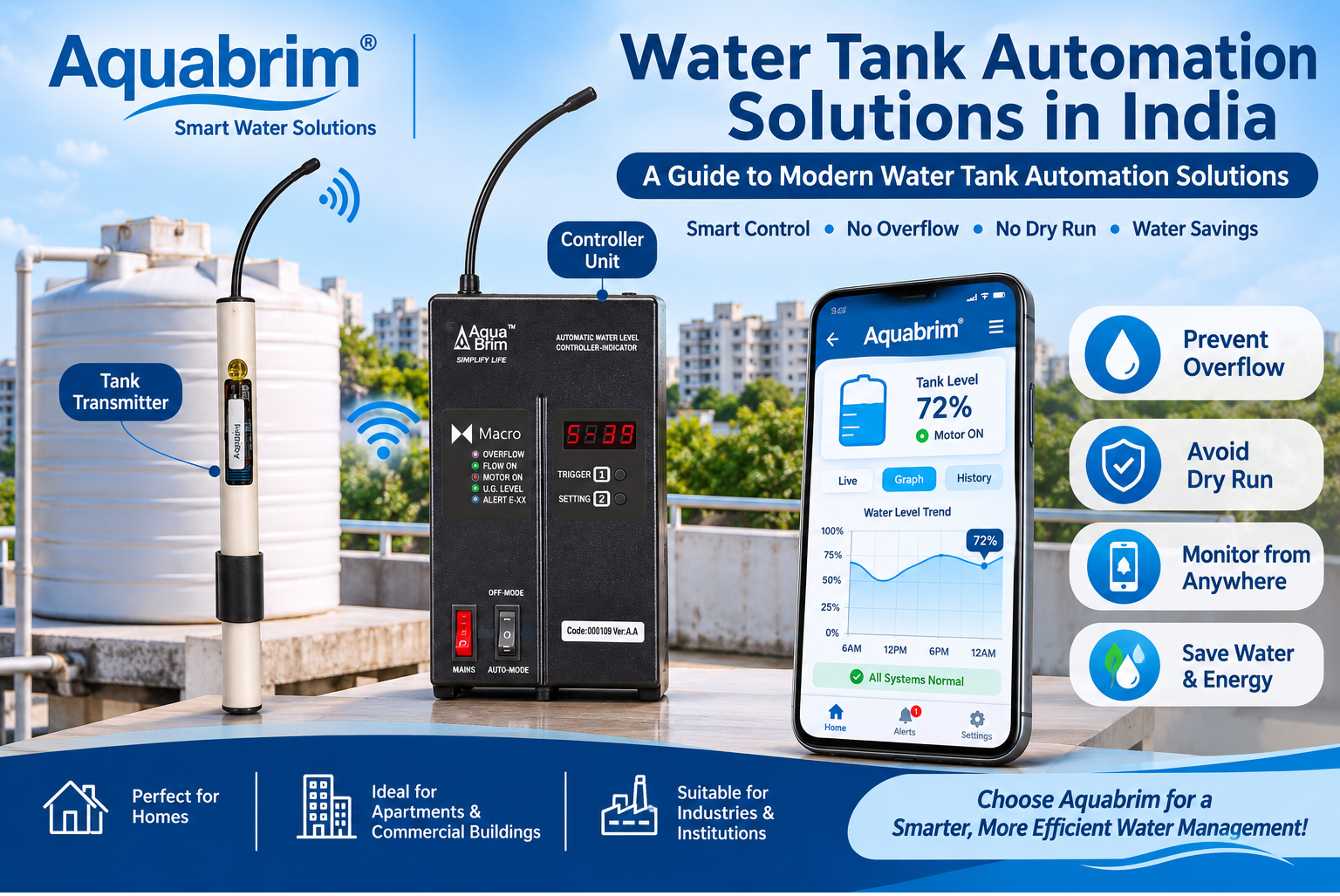
Water is one of those things we tend to notice only when there is a problem.
The overhead tank is empty when you need water. The motor is still running when the tank is already full. Someone has to climb to the terrace to check the level. A borewell pump runs when the underground water is low. Or a caretaker has to keep checking several tanks across a building.
These are everyday water-management problems in India, and most of them have one thing in common: too much dependence on manual operation.
Modern water tank automation solutions in India are designed to make this process more reliable. Depending on the property and its water source, automation can include automatic pump control, wireless water-level sensing, dry-run protection, overflow prevention, multi-tank monitoring and even mobile or web-based monitoring.
But water tank automation is not a single product.
The right solution for a small home with one overhead tank can be very different from what is required for an apartment complex, hotel, factory or commercial building.
This guide explains how modern water tank automation works and what to consider before choosing a system.
What Is Water Tank Automation?
Water tank automation means using sensors, controllers and related equipment to monitor water levels and automatically manage the movement of water between storage tanks.
A basic arrangement might look like this:
Water Source → Pump → Overhead Tank → Water Usage
In a manual system, someone has to decide when to start and stop the pump.
In an automated system, sensors monitor the water conditions and the controller makes decisions based on configured levels.
For example:
Tank level low → Controller starts pump → Tank fills → Full level detected → Controller stops pump
A more advanced system may also monitor the source tank:
Source tank low → Pump prevented from running
This is particularly useful for borewell and underground-sump applications.
Modern systems can go further by adding wireless communication, alerts, remote monitoring and multi-tank control.
Why Is Water Tank Automation Becoming Important in India?
Indian homes and buildings often have a fairly complicated water-storage arrangement.
A typical property may have:
- Municipal water supply
- Underground storage tank
- Borewell
- Overhead tank
- Booster or transfer pump
- Multiple overhead tanks
- Separate pumps for different areas
Managing all of this manually becomes increasingly difficult as the property gets larger.
There is also a practical problem with manual operation: people are not always available when the water system needs attention.
Someone may forget to switch off the pump. A caretaker may not notice that a tank is empty. Water may arrive from the municipal line at an inconvenient hour.
Automation helps shift some of these responsibilities from people to the system.
How Does a Water Tank Automation System Work?
Although different systems use different technologies, the basic concept is straightforward.
1. Water-Level Sensor
A sensor detects the water level in the tank.
Depending on the system, the sensor may detect:
- Low level
- Intermediate level
- Full level
- Overflow level
2. Controller
The controller receives the sensor information and compares it with the configured operating conditions.
It then determines whether the pump should run, stop or remain off.
3. Motor or Pump Control
The controller operates the pump directly where electrically appropriate, or through a suitable starter/contactor arrangement.
4. Protection
More advanced systems can monitor source-water availability and provide features such as dry-run protection.
5. Wireless or Connected Monitoring
Modern systems can transmit information wirelessly or to a web/mobile platform.
This allows users to see what's happening without physically visiting the tank.
The result is a system that moves from:
Manual checking → Automatic decision-making
7 Major Water Tank Automation Solutions Available in India
Different homes and buildings need different levels of automation.
1. Automatic Water Level Controller
This is the most common form of water tank automation for homes.
The controller monitors the tank and automatically operates the pump.
For example:
Water level falls → Pump starts
Water level reaches full → Pump stops
This can significantly reduce the need to manually switch the motor.
It can also help prevent water wastage caused by an unattended pump.
2. Wireless Water Level Automation
Wireless automation is particularly useful when the water tank and motor are far apart.
Imagine an overhead tank on the roof and a pump several floors below.
Installing a long sensor cable may be inconvenient, particularly in an already finished building.
A wireless sensor can send tank-level information to a compatible controller using radio communication.
This can make installation cleaner and more flexible.
However, wireless range should always be considered in relation to the actual building. Concrete walls, floors and other obstructions can affect communication.
3. Borewell and Dry-Run Protection
Borewell applications need additional consideration.
A pump may be required to fill the overhead tank, but the water source itself may not always have sufficient water.
If the pump continues running without adequate source water, it can create a dry-run condition.
A suitable automation system can monitor the source condition and prevent or stop pump operation when the required protection condition is detected.
For borewell homes, source-water monitoring can be just as important as overhead tank monitoring.
4. Municipal Water Supply Automation
Municipal water supply creates a different automation challenge.
Water may arrive only at certain times, and the timing may not always be convenient.
A municipal water automation system can detect the availability of incoming water and coordinate pump operation with the storage tank level.
For example:
Municipal supply available → System detects supply → Pump operates → Overhead tank fills → Pump stops
Aquabrim Trigger is designed around this type of municipal-water application, combining supply detection, wireless tank-level sensing and automatic motor control.
5. Multi-Tank Water Automation
Large homes, apartments, institutions and commercial properties may have several tanks.
For example:
- One underground sump
- Six overhead tanks
- Two transfer pumps
- Multiple water-use zones
Managing these individually can become complicated.
A multi-tank automation system can bring the information and control functions into a centralised system.
Aquabrim Matrix is designed for larger multi-tank applications and can support multiple overhead tanks, an underground tank and multiple motors depending on configuration.
This type of system can also be useful where integration with building-management systems is required.
6. Water-Level Monitoring and Alarm Systems
Not every property needs automatic pump control.
Sometimes the requirement is simply:
"Tell me when the tank is low or full."
A wireless water-level indicator or alarm can be suitable for this purpose.
For example, Aquabrim Flexibell is designed for wireless water-level indication and alarms and can monitor multiple tanks depending on configuration.
This is an important distinction:
Water-level indicator = tells you what is happening.
Automatic controller = can take action on the pump.
Choosing between the two depends on the actual requirement.
7. Smart and Mobile Water Monitoring
The next level of water automation is connected monitoring.
Instead of checking a display inside the building, users can access supported information through a web or mobile platform.
Depending on the system, this may include:
- Tank levels
- Motor status
- Low-water alerts
- Full-tank alerts
- System notifications
- Multiple-tank information
- Historical information
This can be particularly useful for property owners, facility managers and people who travel frequently.
Water Tank Automation for Different Types of Properties
The right automation strategy depends heavily on the property.
Independent House
A typical home may need:
Underground tank → Pump → Overhead tank
A basic automatic controller may be sufficient.
If wiring is difficult, a wireless system can make installation easier.
If the home uses a borewell, dry-run protection becomes more important.
Villa or Large Home
A larger home may have:
- Multiple overhead tanks
- Underground sump
- Borewell
- Multiple pumps
Here, a multi-tank or more advanced automation system may make more sense than several independent controllers.
Apartment Society
Apartment buildings can have several tanks and pumps operating simultaneously.
A suitable automation system can provide:
- Centralised monitoring
- Multiple tank-level sensing
- Multiple motor control
- Pump protection
- Alerts
- Operational visibility
This can reduce the amount of manual checking required from maintenance staff.
Commercial Building
Hotels, offices, hospitals and commercial properties often cannot afford prolonged water-system downtime.
Automation can help facility teams monitor the system more systematically.
Depending on the installation, integration with a BMS can also be useful.
Industrial Facility
Industrial applications may require more than basic tank automation.
The system may need:
- Multiple tanks
- Multiple pumps
- Industrial electrical control
- Level thresholds
- Timers
- Valve monitoring
- Communication protocols
- BMS/SCADA integration
The automation architecture should therefore be designed around the complete water system rather than selecting a residential controller and attempting to expand it beyond its intended use.
How to Choose the Right Water Tank Automation Solution in India
Before purchasing a system, start with the water system you already have.
Step 1: Identify the Water Source
Is it:
- Municipal supply?
- Borewell?
- Underground sump?
- Multiple sources?
Step 2: Count the Tanks
Make a simple list:
Underground tanks: ___
Overhead tanks: ___
Step 3: Count the Pumps
Identify:
- Number of pumps
- Pump HP
- Single-phase/three-phase
- Pump type
Step 4: Determine the Required Automation
Do you want:
- Automatic ON/OFF?
- Overflow prevention?
- Dry-run protection?
- Water-level indication?
- Alarm?
- Mobile monitoring?
- Multi-tank monitoring?
Step 5: Check Installation Requirements
Determine the distance between:
- Tank and controller
- Tank and pump
- Multiple tanks
Then decide whether wired or wireless communication makes more sense.
Step 6: Consider Future Expansion
If you are planning to add another tank or pump later, choose a system that can accommodate the expected expansion.
Step 7: Consider Service Support
Ask about:
- Installation
- Warranty
- Service availability
- Replacement sensors
- Spare parts
- AMC
- Technical support
A water automation system should be evaluated as a complete solution, not simply as a box of electronics.
What Features Should a Modern Water Tank Automation System Have?
A good system doesn't necessarily need every possible feature.
Instead, look for features relevant to your application.
Essential for many homes
- Reliable water-level sensing
- Automatic pump control
- Full-level detection
- Overflow prevention
- Suitable electrical compatibility
Important for borewell systems
- Source-water monitoring
- Dry-run protection
- Underground tank monitoring
Useful for larger buildings
- Multi-tank monitoring
- Multiple motor control
- Centralised display
- Timers
- Valve monitoring
- BMS integration
Useful for modern connected homes
- Mobile/web monitoring
- Alerts
- Remote visibility
- Historical information
The goal should be useful automation, not simply maximum features.
Water Tank Automation vs Manual Pump Operation
The difference is easy to understand.
Manual system
Person checks tank → Switches motor ON → Waits → Checks tank → Switches motor OFF
The system depends on human attention.
Automated system
Sensor detects level → Controller decides → Motor operates → Full level detected → Motor stops
The system handles routine decisions automatically.
This doesn't mean automation eliminates the need for maintenance.
Sensors, pumps, electrical connections and plumbing still need periodic inspection.
But it can remove a repetitive daily task from the homeowner or maintenance team.
Can Water Tank Automation Save Water?
Yes, when correctly designed and installed.
Consider a simple situation.
The tank becomes full at 7:00 AM.
The pump is forgotten and continues running until 7:20 AM.
The water discharged during those 20 minutes is essentially wasted.
An automatic controller can stop the pump when the full-level condition is detected.
The actual water savings depend on the previous operating pattern, pump flow rate and household usage, but preventing repeated overflow can make a meaningful difference over time.
There is also an indirect benefit: people don't need to keep guessing how long the motor should run.
Can Water Tank Automation Save Electricity?
It can help reduce unnecessary pump operation.
If a pump runs after the tank is already full, electricity is being consumed without providing useful additional water storage.
Automatic pump control can stop the motor once the required water level is reached.
However, the amount of electricity saved depends on the pump, operating schedule, water demand and how much unnecessary running occurred previously.
Automation should therefore be viewed primarily as a control and efficiency solution, not as a guaranteed electricity-saving device.