
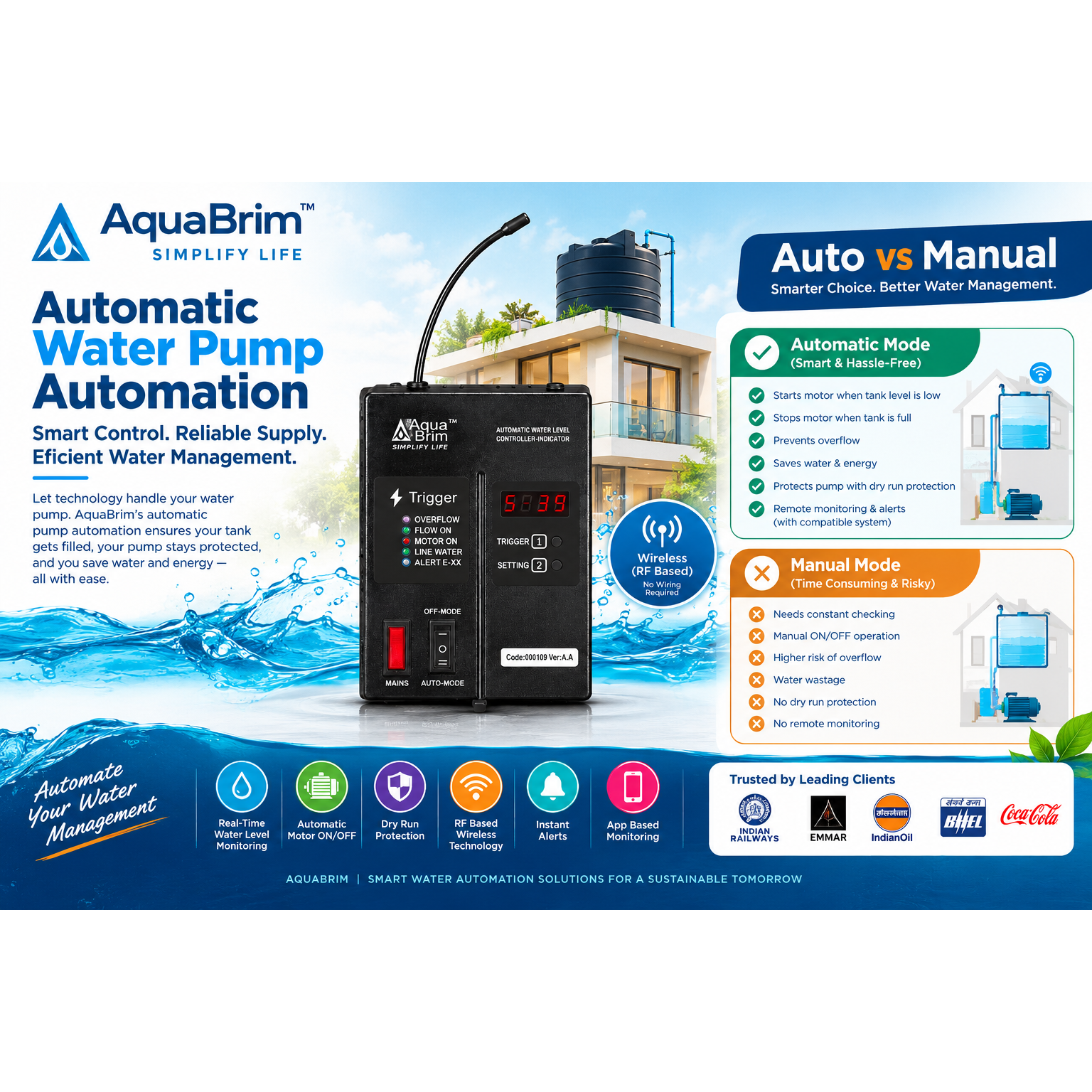
Managing a water pump manually can be inconvenient. Someone has to check the tank level, start the motor when water is low, monitor the filling process, and switch the motor off before the tank overflows.
An Automatic Water Pump Automation system removes much of this manual work by connecting water-level monitoring with automatic pump control. The system can determine when water is required, start the motor, continuously monitor the tank, and stop the motor when the required water level is reached.
AquaBrim's smart water automation solutions are designed around these requirements, with wireless sensing, automatic motor control, overflow prevention, dry-run protection, and remote monitoring depending on the product and application.
What Is Automatic Water Pump Automation?
Automatic Water Pump Automation is a system that automatically controls a water pump according to water level, water availability, or other configured conditions.
Instead of manually operating the pump, the automation system receives information from water-level or water-supply sensors and decides when the motor should operate.
A typical automated process works like this:
Water Level Drops → Sensor Detects Low Level → Controller Checks Conditions → Motor Starts → Tank Fills → Full Level Detected → Motor Stops
This can help reduce manual intervention, prevent unnecessary pump operation, and improve water management.
AquaBrim's automatic controllers are designed to monitor water levels and automatically switch connected motors ON or OFF according to the application.
How Does Automatic Water Pump Automation Work?
An automated water pump system generally consists of a water-level sensor/transmitter, controller, pump connection, and monitoring system.
1. Water Level Is Monitored
A sensor continuously monitors the water level in the overhead tank or other water-storage source.
With AquaBrim's wireless systems, the level information is transmitted to the controller using wireless RF communication.
2. Controller Receives the Information
The controller evaluates the water-level information and other conditions required for safe pump operation.
For example, when the overhead tank reaches a configured low level, the system can determine that additional water is required.
3. Motor Starts Automatically
When the required conditions are satisfied, the controller switches the water pump ON.
For borewell applications, AquaBrim Macro can automatically start the motor when the overhead tank level falls below its configured threshold.
4. Tank Filling Is Monitored
While the pump is operating, the system continues monitoring the water level.
This means the pump does not have to be left running based on an estimated filling time.
5. Motor Stops Automatically
Once the tank reaches the required level, the controller switches the motor OFF.
This automatic stopping function helps prevent unnecessary pumping and reduces the possibility of tank overflow.
Why Is Automatic Water Pump Automation Important?
Manual pump operation creates several common problems:
- Forgetting to switch the motor OFF
- Tank overflow
- Water wastage
- Unnecessary electricity consumption
- Repeatedly checking the water tank
- Motor dry-running
- Difficulty monitoring rooftop tanks
- Inconvenience when nobody is at home
AquaBrim's water automation solutions are designed specifically to address these types of problems through automatic monitoring and pump control.
Key Benefits of Automatic Water Pump Automation
1. Automatic Motor ON/OFF
The biggest advantage is that the pump does not need to be manually operated every time the tank needs water.
The controller can start the pump when water is required and stop it once the desired level is reached.
2. Prevents Water Tank Overflow
One of the most common causes of water wastage is leaving a pump running after the tank has become full.
Automatic water-level monitoring allows the controller to stop the motor when the tank reaches its configured full level.
3. Helps Protect the Pump From Dry Run
A pump can be damaged when it operates without sufficient water at its source.
For borewell and underground-water applications, dry-run protection is particularly important.
AquaBrim Macro monitors source/underground water conditions and can stop the motor when a configured dry-run condition is detected. Its current specifications include cutoff when the underground level drops below 20% or when water flow is interrupted for more than two minutes.
4. Reduces Manual Monitoring
Instead of repeatedly checking the tank, users can allow the automated system to monitor the water level.
This is particularly useful when the tank is on a rooftop or in another difficult-to-access location.
5. Wireless Communication
AquaBrim uses wireless sensor technology in its water automation solutions.
The tank sensor communicates with the controller using radio-frequency communication, reducing the need for cables between the tank and motor controller.
This can be particularly useful in existing buildings where installing long sensor cables would require additional wiring or wall work.
6. Remote Monitoring
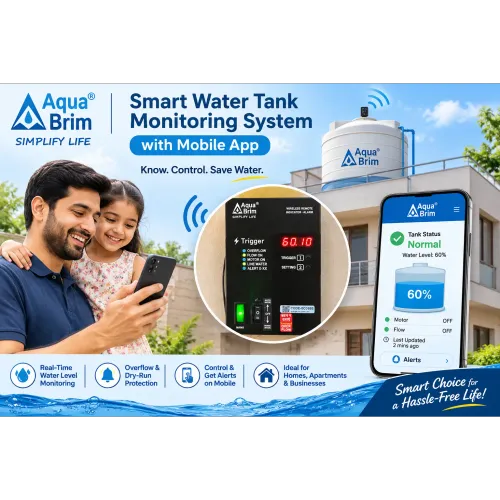
Supported AquaBrim systems can provide app/web-based monitoring, allowing users to view water levels, motor status, and alerts remotely.
This adds another layer of convenience because users don't always need to physically visit the motor or tank.
Automatic Water Pump Automation vs Manual Pump Operation
| Feature | Manual Pump Operation | Automatic Pump Automation |
|---|---|---|
| Checking water level | Manual | Automatic |
| Starting motor | Manual | Automatic |
| Stopping motor | Manual | Automatic |
| Overflow prevention | Depends on user | Automated |
| Dry-run protection | Usually limited | Available in suitable systems |
| Wireless monitoring | No | Available |
| Remote monitoring | No | Available with supported systems |
| Daily supervision | High | Low |
| Multiple tank management | Difficult | Available with suitable systems |
The main difference is that manual pumping depends on human attention, while automatic pump automation responds to actual water conditions.
Automatic Water Pump Automation for Different Water Sources
The correct automation system depends on where the water comes from and how the building's water system is configured.
Municipal Water Supply
For homes that receive water from a municipal or corporation supply, the controller needs to detect when water becomes available.
AquaBrim Trigger is designed for municipal water supply automation. It detects water availability, controls the motor automatically, and monitors the overhead tank.
This can be particularly useful when municipal water arrives at unpredictable times.
Borewell and Submersible Pumps
Borewell systems have a different challenge: the water source itself can become insufficient.
AquaBrim Macro is designed for borewell and submersible pump automation. It monitors the overhead tank and source/underground conditions and automatically controls the pump.
Multiple Water Tanks
Large buildings may have several overhead tanks and underground tanks.
In such situations, managing every pump and tank manually can become complicated.
AquaBrim Matrix is designed for multi-tank water management and can coordinate multiple tanks and motors. AquaBrim's multi-tank automation approach is intended to eliminate repeated manual switching and improve water distribution.
Important Features to Look for in an Automatic Water Pump Automation System
Before selecting an automatic pump automation solution, consider the following features.
Automatic Motor ON/OFF
The controller should be capable of starting and stopping the motor according to configured water conditions.
Water-Level Monitoring
Real-time tank-level information allows the system to make decisions based on actual water availability rather than estimated filling time.
Overflow Protection
The system should stop the pump when the tank reaches its required full level.
Dry-Run Protection
For borewell and underground-water applications, dry-run protection is an important safety feature.
Wireless RF Communication
Wireless communication can eliminate the need for long cables between the water tank and controller.
Remote Monitoring
App/web monitoring can provide convenient access to tank and motor information.
Alerts
Notifications can help users identify important water or motor conditions.
Multi-Tank Support
For apartments, commercial buildings, and institutions, the ability to manage multiple tanks can be essential.
AquaBrim Automatic Water Pump Automation Solutions
AquaBrim provides different automation solutions depending on the water source and application.
AquaBrim Trigger
Designed for municipal/corporation water supply automation, Trigger combines water-supply detection, wireless water-level monitoring, automatic motor ON/OFF, overflow prevention, and dry-run protection.
AquaBrim Macro
Designed for borewell and submersible pump automation, Macro automatically manages water movement from the source to the overhead tank while providing source-water monitoring and dry-run protection.
AquaBrim Matrix
Designed for multi-tank automation, Matrix is suitable for larger buildings where several overhead and underground tanks need centralized monitoring and pump control.
Choosing the correct system according to the water source is important because municipal supply, borewell systems, and multi-tank installations have different automation requirements.
Who Can Benefit From Automatic Water Pump Automation?
Automatic pump automation can be useful for:
- Independent homes
- Villas
- Apartments
- Housing societies
- Commercial buildings
- Hotels
- Hospitals
- Schools and colleges
- Industrial facilities
- Institutional buildings
It is especially useful when water tanks are difficult to access, water supply is irregular, or several tanks need to be managed.