
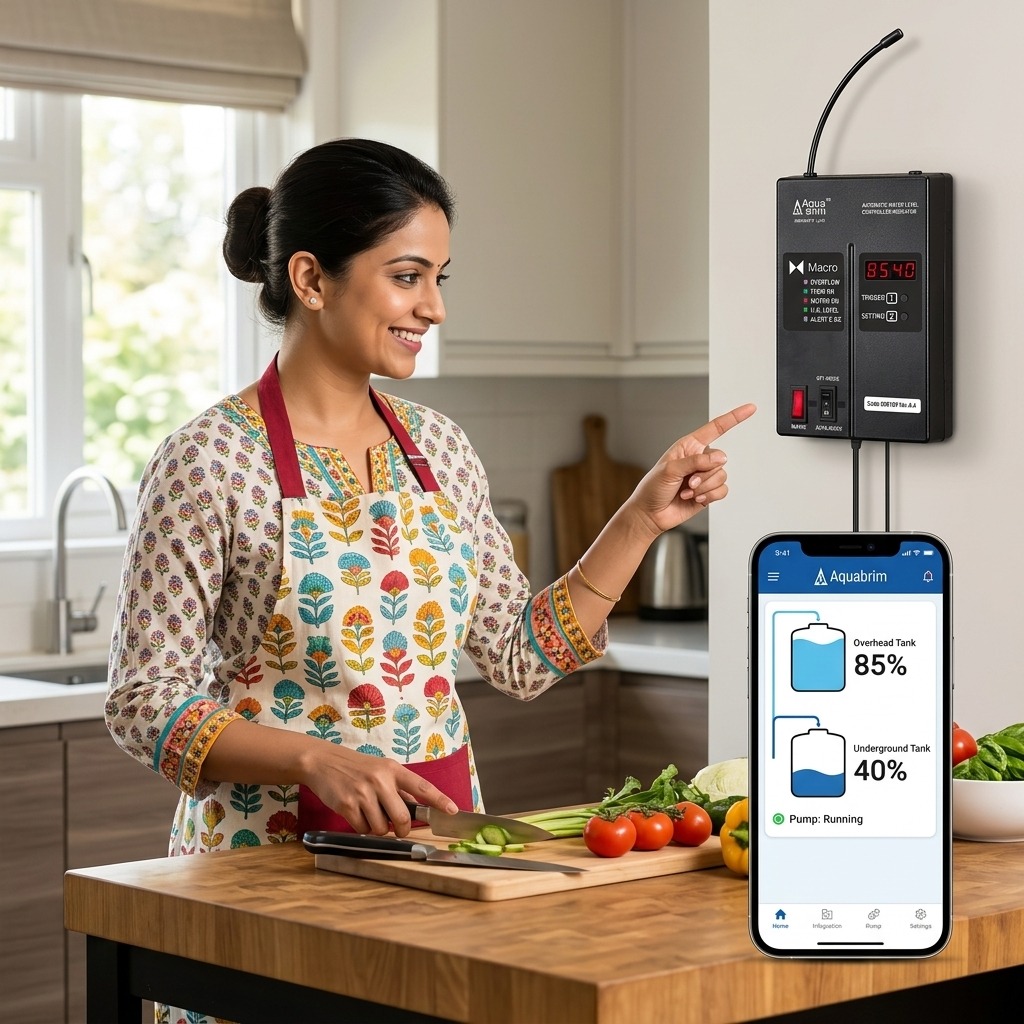
How an Automatic Water Tank Controller Works
Managing your home's water supply can become a daily responsibility. You need to check whether water is available, switch on the pump, monitor the overhead tank, and remember to switch off the motor before the tank overflows.
An automatic water pump controller simplifies this process by monitoring water levels and controlling pump operation automatically.
Instead of relying on manual switching, the system uses sensors and a control unit to determine when the pump should start and stop. Depending on the model, it can also monitor water availability and help protect the pump from dry running.
Whether you live in an independent house, apartment, or multi-storey building, an automatic water tank controller can make water management more convenient.
In this guide, we explain how an automatic water tank controller works, its essential components, its benefits, and how to choose the right solution for your property.
What Is an Automatic Water Pump Controller?
An automatic water pump controller is an electronic device that manages the operation of a water pump according to predefined conditions.
These conditions may include the water level inside a tank, the availability of water from the source, and the operating status of the system.
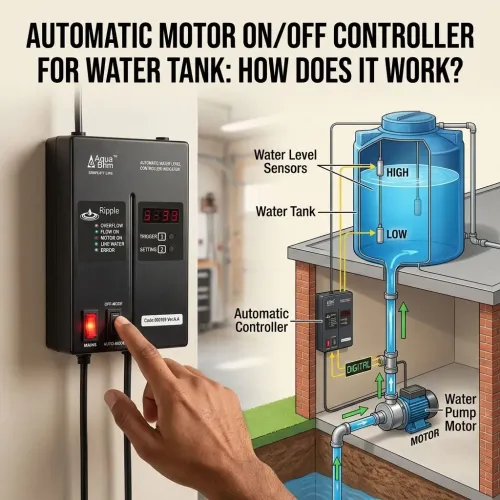
A typical automatic water tank controller consists of three essential components:
- Water-level sensors: Detect the water level in the tank or storage source.
- Control unit: Processes sensor information and determines when the pump should operate.
- Pump-control connection: Switches the connected pump on or off according to the controller's logic.
Advanced systems may also include wireless transmitters, digital displays, dry-run protection, and remote monitoring features.
Aquabrim offers water automation solutions designed for different requirements, including municipal water supply, borewell pumping, underground sumps, and overhead tanks.
How Does an Automatic Water Tank Controller Work?
The working principle is straightforward: the controller monitors the water conditions and operates the pump when the required conditions are met.
Here is the typical process.
Step 1: The System Monitors the Water Level
A sensor monitors the water level inside the overhead tank.
Depending on the system, another sensor may monitor the underground sump, borewell, or incoming water supply.
The sensor communicates the relevant information to the controller. In a wireless system, this communication takes place through a wireless signal rather than a long sensor cable.
Step 2: The Controller Detects When Water Is Required
As water is consumed, the level inside the overhead tank gradually decreases.
When the level reaches the configured starting threshold, the controller determines that the tank needs to be refilled.
For example, a compatible system may be configured to start filling when the overhead tank level falls below 50%.
The actual starting level depends on the controller's configuration and operating logic.
Step 3: The Controller Checks Water Availability
Before starting the pump, some automatic water tank controllers also check whether water is available at the source.
This is particularly useful when the property depends on an underground sump, borewell, or municipal water supply.
If the required water is unavailable, a suitable controller can prevent the pump from starting or stop it when a dry-run condition is detected.
The exact protection method depends on the controller model and its supported sensors.
Step 4: The Water Pump Starts Automatically
When the tank needs water and the necessary operating conditions are satisfied, the controller switches on the connected pump.
The pump transfers water from the source into the overhead tank.
This eliminates the need to switch on the motor manually every time the tank needs refilling.
Step 5: The Tank Fills While the System Monitors Its Level
As water enters the tank, the sensor continues monitoring the changing water level.
The controller receives updated information and tracks the tank's progress toward its configured full level.
This allows the system to control pump operation according to actual water-level conditions rather than relying solely on an estimated filling time.
Step 6: The Pump Switches Off Automatically
When the tank reaches the configured upper level, the controller switches off the pump.
This helps prevent water from overflowing and reduces unnecessary pump operation.
The system can then continue monitoring the tank and repeat the process when water is needed again.
In simple terms:
Water level decreases → Controller detects the need for water → Pump starts when operating conditions are satisfied → Tank fills → Full level is detected → Pump stops automatically.
How Does a Wireless Automatic Water Pump Controller Work?
A wireless automatic water pump controller performs the same basic automation using wireless communication between compatible sensors and the controller.
Instead of running long signal cables between the rooftop tank and the pump-control unit, the sensors transmit water-level information wirelessly.
This can simplify installations where the overhead tank and pump are located on different floors or in separate areas of a property.
For example, Aquabrim Macro uses RF-based wireless sensors to monitor the underground water source and overhead tank.
According to its product specifications, Macro automatically starts filling when the overhead tank level falls below its configured 50% threshold. It stops the motor when the tank reaches the full level or when specified dry-run protection conditions are triggered.
A wireless system can therefore reduce the need for extensive sensor wiring while providing automatic water-level monitoring.
What Happens When Water Is Not Available?
One important consideration in pump automation is the availability of water at the source.
Imagine that your overhead tank needs filling, but your underground sump is nearly empty.
If the pump continues operating without sufficient water, it may experience dry running, potentially causing damage depending on the pump and operating conditions.
A controller equipped with suitable dry-run protection can monitor the source or other relevant operating conditions and stop the pump when the configured protection criteria are met.
For example, Aquabrim Macro monitors the underground water source and includes protection logic for low source-water levels and interrupted water flow.
This feature is particularly useful for properties that rely on underground sumps or borewell and submersible pumps.
How Does an Automatic Water Pump Controller Prevent Tank Overflow?
Tank overflow often happens when someone forgets to switch off the motor after the tank becomes full.
An automatic water pump controller reduces this risk by monitoring the tank's water level continuously.
When the sensor detects that the tank has reached the configured upper level, the controller switches off the pump.
This helps:
- Reduce water wastage.
- Prevent unnecessary pump operation.
- Reduce the need for manual tank monitoring.
- Make everyday water management more convenient.
Correct sensor installation and appropriate controller configuration are essential for reliable operation.
Automatic Water Pump Controllers for Different Water Sources
Not every property receives water in the same way. The right controller depends on where your water comes from and how it is stored.
1. Municipal Water Supply
Homes that depend on municipal water may receive water at specific times of the day.
If the supply arrives early in the morning or at irregular hours, manually checking for water can be inconvenient.
Aquabrim Trigger is designed for homes and buildings that depend on municipal water supply.
Its wireless sensor technology detects water availability in the supply line and allows the system to automate the connected motor according to water availability and tank-level conditions.
2. Underground Sump to Overhead Tank
Many homes store water in an underground sump and use a pump to transfer it to an overhead tank.
In this arrangement, the controller needs to consider both the overhead tank's water level and the availability of water in the underground source.
Aquabrim Macro is designed for this type of application and supports automatic pump control with source-water protection features.
3. Multiple Water Tanks
Apartments, hotels, commercial buildings, and institutional facilities may have several overhead tanks and underground storage tanks.
These installations may require a controller that can monitor multiple tanks and coordinate pump operation.
Aquabrim Matrix is designed for multi-tank water management, supporting up to 13 overhead tanks and one underground tank according to its published product specifications.
The appropriate solution depends on the number of tanks, pump arrangement, and required automation logic.
Key Benefits of an Automatic Water Tank Controller
An automatic water tank controller offers several practical benefits.
1. Automatic Pump ON/OFF Operation
The controller switches the pump on when water is required and off when the tank reaches its configured level.
2. Reduced Water Overflow
Automatic shut-off helps prevent water from overflowing after the tank becomes full.
3. Pump Protection
Models with suitable dry-run protection can help prevent the pump from operating when the required water supply is unavailable.
4. Less Manual Monitoring
You do not need to repeatedly check the tank or remember to switch the motor off manually.
5. Convenient Wireless Installation
Wireless models can reduce the need for long sensor cables between the tank and controller.
6. Support for Different Water Storage Arrangements
Depending on the model, a controller may support overhead tanks, underground sumps, borewells, or multiple-tank installations.
7. Smarter Water Management
Compatible models may offer additional indicators, monitoring, scheduling, or connectivity features.
Actual features vary by model, so always check the specifications before purchasing.
Why Choose Aquabrim for Water Pump Automation?
Aquabrim provides water-level automation solutions for residential, commercial, and institutional applications.
Its products address different water management requirements:
- Trigger: Designed for municipal water supply applications.
- Macro: Designed for borewell, submersible pump, and underground-to-overhead tank automation.
- Matrix: Designed for multi-tank water management in larger buildings and facilities.
Depending on the model and configuration, features include wireless water-level sensing, automatic pump control, overflow prevention, and dry-run protection.
Frequently Asked Questions
1. What is an automatic water pump controller?
An automatic water pump controller is a device that monitors water-level conditions and automatically operates a connected pump according to predefined settings.
2. How does an automatic water tank controller work?
It uses sensors to monitor water levels and, where supported, water availability. When the tank requires water and the necessary conditions are satisfied, the controller starts the pump and stops it when the required level is reached.
3. Can an automatic water pump controller prevent tank overflow?
Yes. A properly installed and configured controller with suitable water-level sensing can switch off the pump when the tank reaches its configured full level.
4. Does an automatic water pump controller protect against dry running?
Some models include dry-run protection. They may monitor the source-water level or other operating conditions and stop the pump when the configured protection criteria are met.
5. Can I install an automatic water pump controller in my home?
Yes. Residential controllers are available for different arrangements, including overhead tanks, underground sumps, municipal water supply, and borewell pumping. Select a compatible model and have the electrical installation carried out appropriately.
6. Is a wireless automatic water pump controller better than a wired one?
Wireless controllers can simplify sensor communication where long cables are inconvenient. Wired controllers may be suitable when cable routing is straightforward. The right choice depends on the building layout, product design, and installation requirements.
7. Which Aquabrim controller is suitable for my home?
Trigger is designed for municipal water supply applications, while Macro is designed for borewell and submersible pump applications. For larger installations involving multiple tanks, Matrix may be suitable. Review the product specifications to determine the right option.
Conclusion
An automatic water pump controller simplifies water management by monitoring tank levels and operating the pump according to predefined conditions.
From detecting low water levels to starting the motor and switching it off when the tank is full, the system reduces manual intervention and helps prevent overflow. Models with suitable dry-run protection can also help protect the pump when water is unavailable.
The key to choosing the right solution is understanding your water source, tank arrangement, pump specifications, and required protection features.
Explore Aquabrim's water automation solutions to find an automatic water pump controller suited to your home or building.